
Ptilothrix bombiformis
(Cresson, 1878)
Hibiscus bee, Eastern digger bee, Hibiscus turret bee
Ptilothrix bombiformis is a solitary ground-nesting in the Apidae, commonly known as the hibiscus bee or eastern digger bee. It is one of only two of the Ptilothrix found in the United States, with a distribution centered in the eastern half of North America. The species is notable for its specialized association with mallow family plants (Malvaceae), particularly Hibiscus species, and for its distinctive nesting involving water transport to excavate hard soil. Females construct turreted nest entrances and are active primarily during summer months when plants are in bloom.
Pronunciation
How to pronounce Ptilothrix bombiformis: /ˌtaɪloʊˈθrɪks ˌbɒmbɪˈfɔːrmɪs/
These audio files are automatically generated. While they are not always 100% accurate, they are a good starting point.
Identification
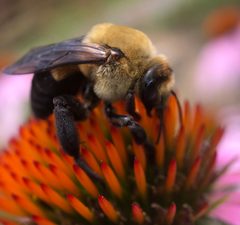
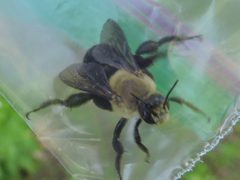
Most reliably identified by the combination of: (1) bumblebee-like appearance with yellow hairs on , mesosoma, and T1 only; (2) association with Hibiscus/mallow flowers; (3) presence of distinctive turreted mud nest entrances in hard-packed soil near water sources; and (4) long, densely hairy legs with females showing hind leg hairs. Distinguished from true bumblebees (Bombus) by solitary nesting , lack of corbiculae (), and more restricted yellow color pattern. Distinguished from other ground-nesting bees by the unique water-carrying behavior and turreted nest construction. The only eastern US of its ; sister species Ptilothrix sumichrasti occurs in Arizona and New Mexico.
Images
Habitat
Requires three specific components: (1) presence of Hibiscus or other Malvaceae flowers for pollen and nectar; (2) accessible water source (ponds, lakes, puddles) for nest construction; and (3) hard-packed, dried mud or clay soil for nest excavation. Naturally occurs in marshy areas supporting native Hibiscus such as Hibiscus moscheutos and Hibiscus laevis. Highly adaptable to human-altered landscapes, utilizing ornamental Hibiscus syriacus (rose-of-Sharon) in residential plantings, dirt roads and levees for nesting substrate, and irrigation puddles for water. Nest often form where suitable soil conditions persist across .
Distribution
Eastern United States, ranging from the Atlantic coast westward through the Mississippi Valley; rarely recorded in southern Ontario, Canada. One of two Ptilothrix in the US, with the other (P. sumichrasti) restricted to Arizona and New Mexico. Within its range, distribution is patchy and localized by availability of suitable components.
Seasonality
active from June through early autumn, with timed to coincide with Hibiscus bloom period. : one per year with no adult overlap across seasons. Adults do not survive winter; persists as larvae in cocoons underground.
Diet
Oligolectic on pollen of Malvaceae, primarily Hibiscus . Documented native include Hibiscus moscheutos, Hibiscus laevis, and Hibiscus dasycalyx. Readily utilizes introduced Hibiscus syriacus (rose-of-Sharon). Nectar feeding also restricted to Malvaceae flowers. This narrow dietary specialization is characteristic of the tribe Emphorini.
Host Associations
- Hibiscus moscheutos - pollen and nectar sourceNative , swamp rose-mallow
- Hibiscus laevis - pollen and nectar sourceNative , halberd-leaf rose-mallow
- Hibiscus dasycalyx - pollen and nectar sourceNative , eastern Texas; for which P. bombiformis is a key
- Hibiscus syriacus - pollen and nectar sourceIntroduced ornamental, rose-of-Sharon
- Althaea officinalis - pollen and nectar sourceMarshmallow, documented at Lake Kittamaqundi, Maryland
Life Cycle
Complete with solitary ground-nesting . Female excavates vertical nest shaft in hard soil, using water carried from surface sources to soften substrate. Constructs mud turret around entrance. Nest interior waterproofed with wax-soil mixture. provisioned with pollen ball and single , then sealed with spiral wax-soil plug. Typically 1-2 cells per nest. Larva feeds on pollen provision, excretes of pollen exines (outer walls) onto cell interior. After feeding, larva spins cocoon and overwinters. following summer. : no adult stage overlap between years.
Behavior
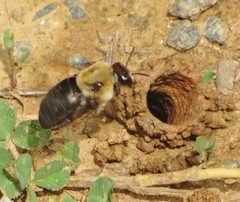
Females exhibit remarkable water-carrying : land on water surface, imbibe water, transport in crop to nest site, and regurgitate to moisten soil for excavation. Excavation involves removal of mud pellets with hind legs, creating characteristic pellet-strewn ground around nest. Nest construction includes building turret of dried mud at entrance and final mud cap upon completion. Males exhibit territorial behavior at flowers, perching on Hibiscus blossoms and defending them from other visitors by attacking and chasing; unsuccessful defenders may be displaced by rival males. Territorial fights incidentally increase pollination by dislodging pollen. Mating occurs when female visits flower. Females tolerate nests in close proximity, creating used across .
Ecological Role
of Malvaceae, with documented importance for of native and endangered Hibiscus . In eastern Texas, identified as the only effective pollinator of endangered Hibiscus dasycalyx, with pollinators (beetles, skippers) failing to achieve pollination. Male territorial at flowers enhances pollen transfer through physical disturbance. As ground-nesting , contributes to soil bioturbation through nest excavation. Provides prey base for nest and , though specific natural enemies not documented in available sources.
Human Relevance
Positive: important of native and ornamental Hibiscus , including rose-of-Sharon in residential landscapes. Adaptable to anthropogenic , facilitating observation and appreciation of native . Negative: minimal; nest excavation in bare soil could theoretically create minor surface disturbance in high-traffic areas, but not documented as problematic. No sting documented, though females possess stinger typical of Apidae.
Similar Taxa
- Bombus spp.Similar bumblebee-like appearance in size, shape, and coloration. Distinguished by social colony formation, presence of corbiculae () rather than scopal hairs, and lack of turreted ground nests.
- Xylocopa virginicaLarge, robust with some color pattern overlap. Distinguished by wood-nesting (excavating tunnels in structural timber), different color pattern with less sharply defined yellow/black boundaries, and lack of water-carrying nest construction.
- Anthophora abruptaAnother large, hairy, ground-nesting apid . Distinguished by use of existing soil cavities rather than excavated turreted nests, different color pattern (often more uniformly brown or with different yellow distribution), and lack of specialized water transport .
- Ptilothrix sumichrastiSister in same , in Arizona and New Mexico. Would require examination of subtle morphological differences; separated by geography.
More Details
Conservation significance
Documented as the key for the endangered Hibiscus dasycalyx in eastern Texas, with a 2025 study demonstrating that while pollinators visited the flowers, only Ptilothrix bombiformis visits resulted in successful pollination.
Taxonomic history
Originally described by Cresson in 1878. One of four currently recognized North American in Ptilothrix, with two additional species (P. chiricahua, P. zacateca) described in 2023.
Nest architecture
The mud turret at the nest entrance, constructed from dried mud pellets, gives rise to the 'turret ' and the 'chimney bee' designation for related . The spiral wax-soil plug sealing is distinctive.
Sources and further reading
- BugGuide
- Wikipedia
- GBIF taxonomy match
- iNaturalist taxon
- NCBI Taxonomy
- Catalogue of Life
- Mellow mallow bees, Ptilothrix bombiformis — Bug of the Week
- Archive — Bug of the Week
- The North American bees of the genus Ptilothrix Cresson, 1878 (Hymenoptera, Apidae, Emphorini), with the description of two new species