
Diadasia bituberculata
(Cresson, 1879)
Bindweed Turret Bee, Bindweed Bee, Digger Bee, Chimney Bee
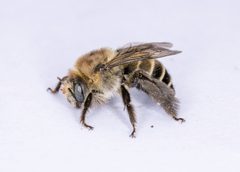
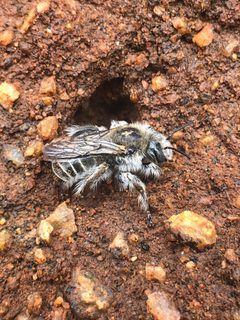
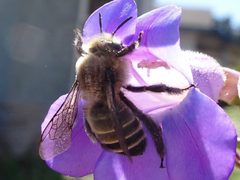
Diadasia bituberculata is a solitary ground-nesting in the Apidae, commonly known as the bindweed turret bee. It is native to the western coast of North America, with its range extending from Oregon through California to Baja California, Mexico. The is an obligate of bindweed (morning glory), foraging almost exclusively on plants in the Convolvulus. Females construct distinctive soil turrets at nest entrances in flat, bare ground, provisioning underground with pollen for their offspring.
Pronunciation
How to pronounce Diadasia bituberculata: //ˌdaɪəˈdeɪziə ˌbaɪˌtjuːbɚˈkjuːlətə//
These audio files are automatically generated. While they are not always 100% accurate, they are a good starting point.
Identification
The can be distinguished from other Diadasia by its association with bindweed flowers and the presence of soil turrets at nest entrances. The turrets are tube-like structures protruding above ground that serve as nest entrance markers. Males have been observed forming mating near nesting areas. The 's fast, erratic pattern and small size make it challenging to photograph or observe closely in the field.
Images
Habitat
Nests are constructed in dry, flat, bare ground such as parking lots, trails, and open areas with sparse vegetation. The shows a preference for tilled and irrigated soils in agricultural landscapes, though such areas may present ecological traps due to exposure. Nesting occurs in where multiple females construct individual nests in close proximity.
Distribution
The range extends along the western coast of North America from Oregon south through California to Baja California, Mexico. The is most abundant in California, with concentrated in coastal and inland valley regions.
Seasonality
are active from April through July. Nesting activity peaks in late spring and early summer, with nests sealed by early summer. hatch and larvae develop through the remainder of the year, with new adults emerging the following spring to restart the cycle.
Diet
feed on nectar and collect pollen from bindweed (Convolvulus, morning glory). Documented floral include island false bindweed (Calystegia macrostegia), showy penstemon (Penstemon spectabilis), cobwebby thistle (Cirsium occidentale), and mariposa lily (Calochortus venustus), though bindweed remains the primary pollen source. Nectar is also used to moisten soil during turret construction.
Host Associations
- Convolvulus - pollen sourcePrimary pollen ; obligate
- Calystegia macrostegia - pollen and nectar sourceIsland false bindweed
- Penstemon spectabilis - pollen and nectar sourceShowy penstemon
- Cirsium occidentale - pollen and nectar sourceCobwebby thistle
- Calochortus venustus - pollen and nectar source mariposa lily
- Bombyliidae - Bee fly larvae are of larvae; turrets may provide protection
Life Cycle
Females lay 1-2 per nest. Larvae feed on provisioned pollen until reaching adulthood. Development occurs underground through the remainder of the year after nests are sealed. New emerge in early spring to mate and initiate nesting. The complete cycle spans approximately one year.
Behavior
Solitary but gregarious: females nest individually but in large . Males patrol nesting areas and form mating balls around emerging females. Females construct soil turrets at nest entrances using moistened earth; the function of turrets is hypothesized to include deterrence, though this remains unconfirmed. Nests are excavated in flat ground with turrets protruding above the surface.
Ecological Role
of bindweed and associated plant . As a ground-nesting , it contributes to soil aeration and nutrient cycling through nest excavation. The species serves as prey for bee flies (Bombyliidae).
Human Relevance
Research subject for studies on native nesting , agricultural impacts on , and microbial ecology of pollen provisions. The has been featured in science communication media including KQED's Deep Look documentary. Potential for use in understanding how farming practices affect ground-nesting bee .
Similar Taxa
- Diadasia rinconisCongeneric solitary with similar mating , but occurs in Sonoran Desert rather than coastal California; different floral specialization
- Anthophora bomboidesAlso a turret-building digger bee, but constructs nests in sand dunes rather than flat bare ground and is a mimic
More Details
Research significance
This is the focus of ongoing research at UC Davis on microbial of pollen provisions, nest site selection under agricultural land use, and interactions between farming practices and native reproductive success. Doctoral candidate Shawn Christensen has studied the species extensively since 2016.
Nesting ecology
Tillage and irrigation positively influence nest initiation, but residues may create ecological traps. Providing strips of bare, tilled, irrigated soil free of late-season in field margins could support nesting .
Sources and further reading
- BugGuide
- Wikipedia
- GBIF taxonomy match
- iNaturalist taxon
- NCBI Taxonomy
- Catalogue of Life
- The Glory of the Bindweed Turret Bees | Bug Squad
- Bembicid Holdings | Entomology Research Museum
- Congratulations, Rei! | Bug Squad
- UC Davis: All A'Buzz With Bee Nests and Art | Bug Squad
- Busy Bees: An Up-Close Look at One Bee Species' Scramble to Mate
- insect species | Blog