
Ptilothrix
Smith, 1853
chimney bees, mallow bees
Species Guides
2- Ptilothrix bombiformis(Hibiscus bee)
- Ptilothrix chiricahua
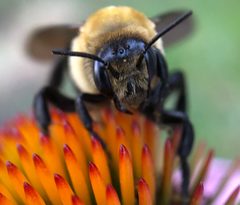
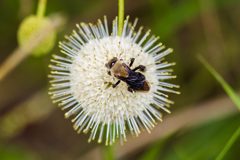
Ptilothrix is a of solitary, ground-nesting bees in the Apidae, tribe Emphorini, with an amphitropical distribution in the New World. These bees range from 7 to 15 mm in body length and are distinguished by prominent, coarse scopae on their hind legs adapted for collecting large-grained pollen. Females excavate nests in hard-packed soil using water carried from ponds to moisten the substrate, constructing distinctive turreted or chimney-like nest entrances. The genus exhibits narrow pollen specialization (oligolecty), with specializing on particular plant families including Malvaceae, Convolvulaceae, Onagraceae, Cactaceae, Pontederiaceae, and Asteraceae.
Pronunciation
How to pronounce Ptilothrix: //ˈtaɪ.loʊ.θrɪks//
These audio files are automatically generated. While they are not always 100% accurate, they are a good starting point.
Identification
Distinguished from other ground-nesting bees by the combination of: (1) exceptionally prominent, coarse scopae on hind legs with long hairs adapted for large-grained pollen collection; (2) turreted or chimney-like nest entrances constructed in hard-packed soil; (3) water-carrying for nest excavation; and (4) large body size relative to many other solitary bees. Differs from honey bees and bumble bees, which possess corbiculae (smooth ) rather than scopae. Separable from other Emphorini by the degree of scopal development and nesting behavior. -level identification requires examination of morphological details including male genitalia and female scopal characteristics.
Images
Habitat
Ground-nesting in hard-packed or clay soils, often in areas with access to standing water for nest construction. Nests are frequently constructed in open, bare ground including: lake and pond banks, road margins through marshlands, shores, and other human-modified with compacted soils. Some nest in dense . Habitat selection is constrained by the need for both suitable soil texture for excavation and proximity to water sources for soil softening.
Distribution
Amphitropical distribution in the New World, occurring in both North and South America with ranging across the Americas. Four species recognized in North America: Ptilothrix bombiformis (eastern United States, primarily east of the Mississippi River), Ptilothrix sumichrasti (Arizona and New Mexico region), Ptilothrix chiricahua (Chiricahua region, described 2023), and Ptilothrix zacateca (Zacatecas region, described 2023). Most abundant at latitudes outside of the tropics. The is absent from the Old World.
Seasonality
activity period varies by and region. Ptilothrix bombiformis is active from June into early autumn in temperate eastern North America. Some species exhibit bimodal patterns with adults appearing in dry reproductive seasons. Pupal allows delayed emergence until favorable environmental conditions occur, enabling to avoid unfavorable seasons such as rainy periods.
Diet
Oligolectic pollen specialization on specific plant . Documented plant families include: Malvaceae (mallows, hibiscus, rose-of-sharon), Convolvulaceae (morning glories), Onagraceae (evening primroses), Cactaceae (cacti), Pontederiaceae (water hyacinth relatives), and Asteraceae (sunflower family). also consume nectar from host plants and possibly other floral sources.
Host Associations
- Malvaceae - pollen sourcePrimary for Ptilothrix bombiformis and P. plumata; includes Althaea officinalis (marshmallow), Hibiscus spp., and ornamental rose-of-sharon
- Convolvulaceae - pollen sourceDocumented pollen
- Onagraceae - pollen sourceDocumented pollen
- Cactaceae - pollen sourceDocumented pollen
- Pontederiaceae - pollen sourceDocumented pollen
- Asteraceae - pollen sourceDocumented pollen
Life Cycle
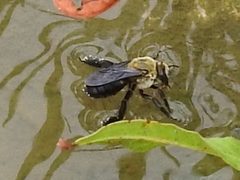
Solitary ground-nesting with no social organization. Females construct individual nests consisting of one to multiple excavated in hard soil. Nest construction involves: landing on water surface to imbibe water, returning to nest site, regurgitating water to moisten and soften soil, excavating galleries using and legs, and removing soil pellets to form a turret at the surface. Each brood cell is provisioned with a pollen cake and nectar, then sealed with a mud plug after oviposition. Development includes , larval, prepupal, and pupal stages. Egg-to- development time is highly variable: some eggs produce adults in the same reproductive season, while others enter prepupal and emerge in the following dry season. This developmental plasticity facilitates mate finding through synchronized and allows avoidance of unfavorable conditions.
Behavior
Females exhibit distinctive water-carrying : they walk on water surfaces to drink, transport water internally to nest sites, and regurgitate it to soften hard soil for excavation. During construction, females roll excavated mud pellets with their hind legs, leaving characteristic debris piles around nest entrances. Nest defense behaviors include covering nest entrances with soil and shaking the body at the entrance when are detected. Females may abandon incomplete nests if risk is high. Males patrol flowers and exhibit aggressive mating behavior, including physical displacement of other males. This male aggression at flowers contributes substantially to pollination—studies on Hibiscus indicate males deposit over 20% of pollen grains on anthers despite comprising only 5% of floral visits.
Ecological Role
Important of specialized plants, particularly Malvaceae. Male territorial at flowers enhances pollen transfer . The coarse scopal allows exploitation of large-grained pollen resources that may be underutilized by other bees, potentially reducing . Nesting activities contribute to soil aeration and turnover in compacted substrates. Serve as hosts for (Leucospis spp.) and parasitic flies (Anthrax spp.), supporting higher .
Human Relevance
Ptilothrix bombiformis and related provide pollination services for ornamental mallows including hibiscus and rose-of-sharon in residential landscapes. Their ground-nesting habits and distinctive chimney-like turrets make them observable and accessible for natural history study. The species Ptilothrix bombiformis has been documented utilizing human-created such as banks and roadside margins, suggesting some adaptability to anthropogenic environments. No documented negative impacts; non-aggressive and do not defend nests.
Similar Taxa
- Bombus (bumble bees)Similar size and coloration in some , but distinguished by social colony organization, corbiculae () rather than scopae, and above-ground nesting
- Xylocopa (carpenter bees)Similar robust build and size, but distinguished by wood-nesting , different leg pollen-carrying structures, and lack of water-carrying nest excavation behavior
- Anthophora (digger bees)Similar ground-nesting habit, but distinguished by less prominent scopae, different nesting substrate preferences, and lack of turreted chimney nests
- Other Emphorini genera (e.g., Emphorini)Similar tribe membership and pollen specialization, but distinguished by degree of scopal development, specific nesting , and plant associations
More Details
Nesting mortality
Nest averages approximately 57% in P. bombiformis , with primary causes including fungal and failure to hatch. In P. plumata in Brazil, nest mortality reaches approximately 88% among completed nests, attributed primarily to fire and other .
Water-walking ability
Ptilothrix can walk on water surfaces supported by their legs, an used during water collection for nest construction.
New species descriptions
Two North American were described in 2023: Ptilothrix chiricahua from the Chiricahua region and Ptilothrix zacateca from the Zacatecas region, bringing the total described species in the to 16.
Sources and further reading
- BugGuide
- Wikipedia
- iNaturalist taxon
- NCBI Taxonomy
- Catalogue of Life
- Mellow mallow bees, Ptilothrix bombiformis — Bug of the Week
- Archive — Bug of the Week
- Variability in egg‐to‐adult development time in the bee Ptilothrix plumata and its parasitoids
- The North American bees of the genus Ptilothrix Cresson, 1878 (Hymenoptera, Apidae, Emphorini), with the description of two new species