
Diadasia enavata
(Cresson, 1872)
Sunflower Chimney Bee
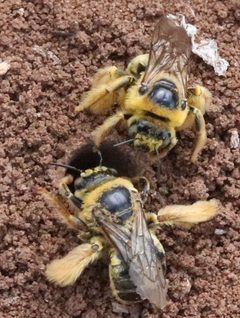
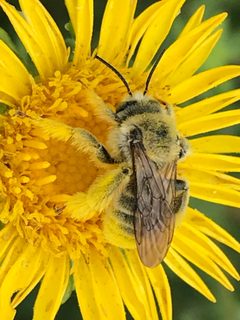
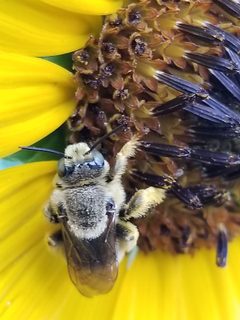
Diadasia enavata, commonly known as the sunflower chimney bee, is a solitary ground-nesting in the Apidae. It is a restricted to plants in the Asteraceae family, and has been documented pollinating Coreopsis tinctoria. The occurs across Central America and North America. Like other Diadasia species, it constructs burrows in soil, often with distinctive turret-like structures at the entrance.
Pronunciation
How to pronounce Diadasia enavata: /daɪəˈdeɪziə ɛnəˈvɑːtə/
These audio files are automatically generated. While they are not always 100% accurate, they are a good starting point.
Images
Habitat
Ground-nesting that excavates burrows in soil. Observations in Colorado indicate use of bare earth on trails and open ground for nesting. The species requires access to Asteraceae plants for foraging.
Distribution
Central America and North America. Documented in the southwestern United States including Colorado, with observations at elevations including plains and higher-elevation sites.
Diet
restricted to Asteraceae plants. Documented visiting Coreopsis tinctoria for pollen and nectar collection.
Host Associations
- Coreopsis tinctoria - Observed pollinating this
- Asteraceae - Restricted to this plant for foraging
Life Cycle
Solitary with ground-nesting . Females construct individual burrows in soil, provision with pollen from Asteraceae , and lay . Development includes egg, larval, and pupal stages within the nest before .
Behavior
Males have been observed approaching flowers, including milkweed. As a solitary , females work independently to construct and provision nests. Male may occur near nesting areas, a trait observed in though not explicitly documented for this species.
Ecological Role
of Asteraceae plants. Contributes to of native and agricultural plants in this through pollen transfer.
Human Relevance
Contributes to pollination of native wildflowers and potentially agricultural sunflowers and related crops. Of interest to native conservation efforts.
Similar Taxa
- Diadasia rinconisCongeneric cactus chimney bee with similar ground-nesting and male , but differs in geographic range (Sonoran Desert) and plant specialization
- Diadasia bituberculataBindweed turret bee with similar turret-building nest architecture, but specializes on Convolvulaceae (morning glories) rather than Asteraceae
More Details
Nesting Biology
The 'chimney bee' refers to the turret-like structures that Diadasia often construct at their nest entrances. These structures are built from soil and wax secretions and may function in nest recognition, water drainage, or deterrence.
Sources and further reading
- BugGuide
- Wikipedia
- GBIF taxonomy match
- iNaturalist taxon
- NCBI Taxonomy
- Catalogue of Life
- The Glory of the Bindweed Turret Bees | Bug Squad
- Congratulations, Rei! | Bug Squad
- UC Davis: All A'Buzz With Bee Nests and Art | Bug Squad
- Bug Eric: A Beautiful Place to "Bee"
- Busy Bees: An Up-Close Look at One Bee Species' Scramble to Mate
- Bug Eric: World Bee Day....A Little "Bee"hind