
Perdita heliotropii
Cockerell, 1900
Heliotrope Fairy Bee
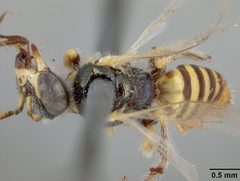
Perdita heliotropii is a of mining bee in the Andrenidae, described by Cockerell in 1900. The "Heliotrope Fairy " reflects its association with heliotrope plants. As a member of the Perdita, it belongs to a diverse group of small, solitary bees native to North America. The species epithet "heliotropii" indicates a likely -plant specialization on Heliotropium species.
Pronunciation
How to pronounce Perdita heliotropii: /pɛrˈdiːta hiːliˈoʊtroʊpiːaɪ/
These audio files are automatically generated. While they are not always 100% accurate, they are a good starting point.
Identification
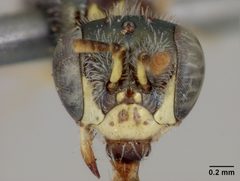
Members of the Perdita are among the smallest North American bees, typically measuring 2–10 mm. P. heliotropii can be distinguished from by its association with Heliotropium plants and subtle morphological characters including specific facial markings and wing venation patterns. Exact identification requires examination of microscopic features such as male genitalia and female scopal hairs.
Images
Distribution
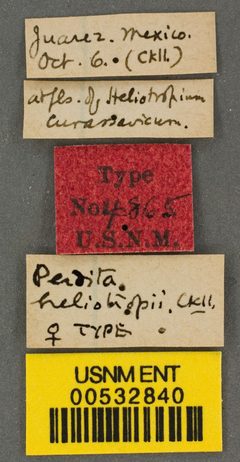
Recorded from North America and Middle America. Specific collection localities are documented in the UCR Entomology Research Museum primary type collection, indicating presence in the southwestern United States and adjacent regions of Mexico.
Diet
Likely oligolectic on Heliotropium (heliotropes), based on the species epithet and known specialization patterns in the Perdita. However, specific pollen collection records for this species have not been documented.
Host Associations
- Heliotropium - likely oligolectic pollen inferred from epithet
Behavior
As a solitary mining bee, females excavate individual nest burrows in soil. Nesting may occur where soil conditions and floral resources are favorable. Males patrol plant patches seeking mates.
Ecological Role
, likely specializing on Heliotropium . Contributes to native plant and serves as prey for parasitic bees and .
Similar Taxa
- Other Perdita speciesMany Perdita are morphologically similar and require microscopic examination for identification. plant association with Heliotropium is a key distinguishing feature for P. heliotropii.
More Details
Type specimen
Primary catalogued in UCR Entomology Research Museum (compiled 2010, updated 2016)
Conservation status
Not formally assessed; trends unknown
Sources and further reading
- BugGuide
- GBIF taxonomy match
- iNaturalist taxon
- Catalogue of Life
- Primary Type List | Entomology Research Museum
- You, Too, Can Plant a Pollinator Garden | Bug Squad
- 'Am I Even a Bee?' Identity Crisis Unfolds in This Charming Book | Bug Squad
- Researchers Develop Genome Map for Mojave Poppy Bee
- Bug Eric: World Bee Day....A Little "Bee"hind
- The best species name ever! | Beetles In The Bush