
Perdita
Smith, 1853
Fairy Bees
Species Guides
41- Perdita albipennis(white-winged fairy bee)
- Perdita beata
- Perdita bequaerti(Bequaert's miner bee)
- Perdita bequaertiana
- Perdita bicuspidariae
- Perdita californica(California Fairy Bee)
- Perdita calochorti
- Perdita chamaesarachae(Five-Eyes Fairy Bee)
- Perdita cladothricis
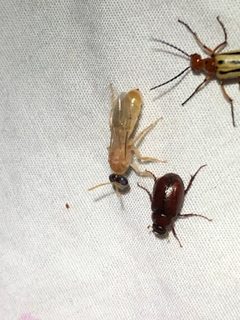
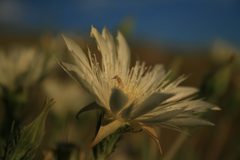
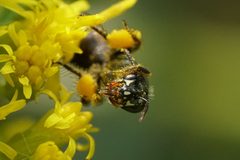
Perdita is a large of native North American bees in the Andrenidae, with over 600 recognized and . These bees are among the smallest in North America, ranging from 2.0 to 10.0 mm in length. The genus shows exceptional diversity in desert regions of the southwestern United States and Mexico. Many species exhibit bright metallic coloration with yellow or white markings. The genus was extensively revised by P.H. Timberlake, who described most species.
Pronunciation
How to pronounce Perdita: /pɛrˈdiːtə/
These audio files are automatically generated. While they are not always 100% accurate, they are a good starting point.
Identification
Distinguished from other Andrenidae by small size combined with often bright metallic coloration and facial markings. Separated from similarly small Halictidae (sweat bees) by andrenid wing venation and scopal structure. Within Andrenidae, distinguished from Andrena by generally smaller size, more frequent metallic coloration, and often more specialized associations. Subgenus Xerophasma identifiable by enlarged ocelli and pale coloration associated with activity.
Images
Appearance
Small bees, typically 2.0–10.0 mm in length. Body often brightly colored with metallic reflections (green, blue, or bronze) and/or distinct yellow or white markings. Some exhibit pale or white . Members of the subgenus Xerophasma show increasing ocellar size associated with foraging .
Habitat
Diverse across North America, with highest diversity in desert regions. occupy arid and semi-arid environments including Mojave Desert, Sonoran Desert, and Chihuahuan Desert. Some species restricted to specific soil types such as gypsum deposits. Ground-nesting in burrows excavated in soil of varying textures from sandy to clayey.
Distribution
Native to North America. Center of diversity in southwestern United States and northern Mexico. Documented from California, Nevada, Arizona, New Mexico, Utah, and Texas. Range extends from western Canada through the United States to Mexico. Some have extremely restricted distributions (e.g., Perdita meconis limited to eastern Mojave Desert).
Seasonality
Activity patterns vary by and region. Spring and summer activity common in temperate areas. Some species adapted to desert conditions with activity timed to ephemeral bloom periods. Subgenus Xerophasma includes foragers.
Life Cycle
Solitary bees with ground-nesting . Females excavate burrows in soil. Some show prolonged , remaining in stasis underground during unfavorable conditions such as drought years.
Behavior
Solitary nesting . Females excavate individual burrows in soil; multiple females may nest in close proximity, creating that resemble social colonies. Some in subgenus Xerophasma exhibit foraging, an unusual behavior among bees. Many species show high fidelity to particular plant groups.
Ecological Role
Important native , particularly in arid . Many are floral (oligolectic), contributing to pollination of specific plant groups including Onagraceae (evening primroses and related plants). Specialist pollination relationships documented for species such as Perdita meconis with Arctomecon poppies.
Human Relevance
Contributions to native conservation awareness; Perdita minima cited as smallest known bee in North American educational contexts. Perdita meconis subject of conservation concern and genetic research through the Beenome100 project. Some considered for Act listing due to restricted ranges and threats from urban development and mining.
Similar Taxa
- AndrenaSimilar (Andrenidae) and ground-nesting habit; distinguished by generally larger size, less frequent metallic coloration, and broader plant associations
- HalictidaeSimilar small size and metallic coloration; distinguished by different wing venation, scopal structure, and -level characters
- PanurginusSame tribe (Panurgini); distinguished by morphological characters and associations
More Details
Taxonomic History
The was extensively treated by P.H. Timberlake, who in addition to T.D.A. Cockerell described most of the recognized . The subgenus Xerophasma has been revised to include three newly described species to the Mojave Desert.
Conservation Genetics
Perdita meconis (Mojave poppy ) was selected for sequencing as part of the Beenome100 project, representing one of the first high-quality genomes for a bee of conservation concern. The genome provides insights into drought through and -plant specialization.
Nocturnal Adaptation
The subgenus Xerophasma shows evolutionary trends toward foraging, expressed through increasing ocellar size and pale —unusual adaptations among bees that forage in low-light conditions.
Sources and further reading
- BugGuide
- Wikipedia
- GBIF taxonomy match
- iNaturalist taxon
- NCBI Taxonomy
- Catalogue of Life
- Primary Type List | Entomology Research Museum
- You, Too, Can Plant a Pollinator Garden | Bug Squad
- 'Am I Even a Bee?' Identity Crisis Unfolds in This Charming Book | Bug Squad
- Researchers Develop Genome Map for Mojave Poppy Bee
- Bug Eric: World Bee Day....A Little "Bee"hind
- The best species name ever! | Beetles In The Bush
- A Revision of Perdita (Xerophasma) Timberlake (Hymenoptera: Andrenidae)