
Spanioneura fonscolombii
Foerster, 1848
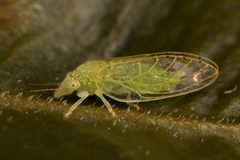
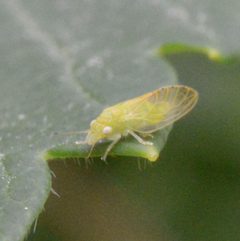
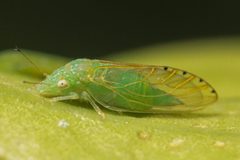
Spanioneura fonscolombii is a plant-parasitic specialized on box (Buxus) . First described from Europe in 1848, it has been accidentally introduced to the United States and represents a pest of ornamental and native boxwoods. The species shows distinctive green coloration with patterned wings and has been documented causing damage to plants, with some dispute regarding gall formation.
Pronunciation
How to pronounce Spanioneura fonscolombii: //ˌspæn.i.oʊˈnʊə.rə ˌfɒn.skoʊˈlɒm.bi.aɪ//
These audio files are automatically generated. While they are not always 100% accurate, they are a good starting point.
Identification
Distinguished from the related Boxwood psyllid (Psylla buxi) by abdominal tip coloration: Spanioneura fonscolombii has an orange abdominal tip lacking dark spots, and lacks the yellowing on wing seen in P. buxi. The combination of green body, yellowish wing cells with four dark spots, and orange-tipped is diagnostic.
Images
Habitat
Associated with boxwood plants (Buxus ) in forested, ornamental, and horticultural settings. In Turkey, found in forestry areas with Buxus balearica.
Distribution
Native to Europe: Belgium, France, Great Britain, Italy, Luxembourg, Romania, Spain, Switzerland, and Turkey (first recorded 2017 in Kahramanmaraş region, representing the southernmost and easternmost global distribution). Accidentally introduced to the United States of America.
Seasonality
Nymphs mature and leave plants in late summer. may overwinter on host plants. overwinter on shoots and leaves.
Diet
Phloem-feeding on Buxus . Documented include Buxus sempervirens and Buxus balearica.
Host Associations
- Buxus sempervirens - primary European box, primary documented
- Buxus balearica - Identified as new record in Turkey; damage observed
Life Cycle
are laid on shoots and leaves and overwinter. Nymphs develop on leaves, sometimes within clustered, thickened, concave leaf structures. Nymphs mature and depart in late summer. may overwinter on host plants. Alternative as eggs also occurs.
Behavior
Nymphs are coated in white wax. High densities have been observed in some areas. and nymphs live on leaves; dispute exists regarding whether true gall induction occurs or whether nymphs simply inhabit modified leaf clusters.
Ecological Role
Plant-parasitic pest of boxwood . Potential economic importance in ornamental horticulture and forestry contexts.
Human Relevance
Pest of ornamental boxwood (Buxus sempervirens) in gardens and landscapes. Accidentally introduced to North America where it may impact cultivated and potentially native boxwood .
Similar Taxa
- Psylla buxiAlso associated with box; distinguished by orange abdominal tip without dark spots and lack of yellowing on wing
Misconceptions
There is dispute regarding gall formation: Plant of Europe states and larvae live freely without causing galls, while British Plant Gall Society literature describes clustered, thickened, concave leaves sheltering nymphs. The nature of this plant-insect interaction remains unresolved.
More Details
Taxonomic history
First described by Arnold Förster in 1848. The name is sometimes spelled 'fonscolombei' in older literature.
Global spread
Represents a case of accidental introduction to North America, with established in the United States. The Turkish record (2017) represents the most southern and eastern known distribution globally.