
Boreioglycaspis melaleucae
Moore, 1964
melaleuca psyllid
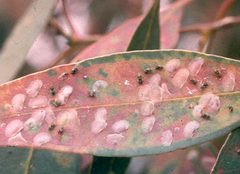
Boreioglycaspis melaleucae is a native to Australia, introduced to Florida in 2002 as a agent against the tree Melaleuca quinquenervia. It is a phloem-feeding on Melaleuca quinquenervia and has established self-sustaining in South Florida. The produces waxy secretions from specialized integumentary structures and excretes honeydew. Its in Florida are influenced by temperature extremes, with development ceasing below 10°C and above 30°C, and it by the encyrtid Psyllaephagus migrator.
Pronunciation
How to pronounce Boreioglycaspis melaleucae: /bɔˈraɪ.oʊˌɡlaɪˈkæspɪs mɛləˈluːkaɪ/
These audio files are automatically generated. While they are not always 100% accurate, they are a good starting point.
Images
Habitat
Strictly associated with Melaleuca quinquenervia trees; occurs on foliage and young stems where phloem feeding takes place. In its introduced Florida range, inhabits wetland including the Everglades, as well as upland sites where the tree has invaded.
Distribution
Native to Australia (New South Wales, Northern Territory); introduced and established in Florida, USA (first released in Broward County in February 2002, with subsequent spread throughout South Florida). GBIF records also indicate presence in Puerto Rico (PUEOO) and Caloosahatchee region (CALOO).
Seasonality
Activity limited by temperature thresholds; development occurs between 10°C and 30°C with optimal development at 25°C. Summer temperatures in southern Florida frequently exceed 30°C, causing growth reduction during this period. No individuals complete development below 10°C or above 30°C.
Diet
Phloem feeder; specialized on Melaleuca quinquenervia (Myrtaceae). Feeds on vascular tissues of leaves and young stems.
Host Associations
- Melaleuca quinquenervia (Cav.) S.T. Blake - obligate Only known ; complete development and restricted to this
Life Cycle
Developmental stages include , nymph (with multiple instars), and . Total development rate increases linearly with temperature up to 25°C, then decreases at higher temperatures. Nymphal is temperature-dependent with no development below 10°C or above 30°C.
Behavior
Produces waxy secretions from specialized structures on the ; both males and females excrete honeydew. are capable of to locate plants.
Ecological Role
agent for Melaleuca quinquenervia in Florida; reduces tree through phloem feeding. Serves as host for the Psyllaephagus migrator, which has reduced in Florida.
Human Relevance
Intentionally introduced for of melaleuca, an tree that displaces native vegetation, degrades wildlife , creates fire hazards, and causes human health problems in South Florida. effectiveness is limited by high summer temperatures and .
More Details
Temperature Limitations
Mean maximum daily temperatures in southern Florida commonly exceed 30°C, with maximum temperatures ranging from 30–35°C during 138 days in 2006. These lethal upper temperature thresholds limit growth rates during summer months.
Parasitoid Impact
The encyrtid Psyllaephagus migrator, native to Australia and in Florida, parasitizes B. melaleucae. Trapping data indicate this has reduced of the biocontrol agent in Florida.
Terpenoid Profile
longevity is greater on Melaleuca quinquenervia plants containing E-nerolidol versus viridiflorol foliar terpenoid profiles, though this does not translate to longer ovipositional periods or increased .
Sources and further reading
- BugGuide
- GBIF taxonomy match
- iNaturalist taxon
- NCBI Taxonomy
- Catalogue of Life
- A Psyllid, Boreioglycaspis melaleucae Moore (Insecta: Hemiptera: Psyllidae)
- Biology and Host-Range of Boreioglycaspis melaleucae (Hemiptera: Psyllidae), Potential Biological Control Agent for Melaleuca quinquenervia (Myrtaceae)
- Host range of Boreioglycaspis melaleucae Moore (Hemiptera: Psyllidae), a potential biocontrol agent of Melaleuca quinquenervia (Cav.) S.T. Blake (Myrtaceae), under quarantine
- Ultrastructure of Wax-Producing Structures on the Integument of the Melaleuca Psyllid Boreioglycaspis melaleucae (Hemiptera: Psyllidae), with Honeydew Excretion Behavior in Males and Females
- Geographic Distribution and Regional Impacts ofOxyops vitiosa(Coleoptera: Curculionidae) andBoreioglycaspis melaleucae(Hemiptera: Psyllidae), Biological Control Agents of the Invasive TreeMelaleuca quinquenervia
- Influence of Temperature, Humidity, and Plant Terpenoid Profile on Life History Characteristics of Boreioglycaspis melaleucae (Hemiptera: Psyllidae), a Biological Control Agent of the Invasive Tree Melaleuca quinquenervia
- Figure 2 from: McClelland AR, Moore MR, Bremer JS, Talamas EJ, Halbert SE, Singarayan VT, Brown BT, Purcell MF, Brookes DR, Hentz MG (2025) You can run, but you will never escape: A new species of Psyllaephagus Ashmead (Hymenoptera, Encyrtidae), parasitoid of the classical biological control agent Boreioglycaspis melaleucae (Moore) (Hemiptera, Aphalaridae) in Florida, USA. Journal of Hymenoptera Research 98: 95-116. https://doi.org/10.3897/jhr.98.133593
- Figure 1 from: McClelland AR, Moore MR, Bremer JS, Talamas EJ, Halbert SE, Singarayan VT, Brown BT, Purcell MF, Brookes DR, Hentz MG (2025) You can run, but you will never escape: A new species of Psyllaephagus Ashmead (Hymenoptera, Encyrtidae), parasitoid of the classical biological control agent Boreioglycaspis melaleucae (Moore) (Hemiptera, Aphalaridae) in Florida, USA. Journal of Hymenoptera Research 98: 95-116. https://doi.org/10.3897/jhr.98.133593
- Figure 4 from: McClelland AR, Moore MR, Bremer JS, Talamas EJ, Halbert SE, Singarayan VT, Brown BT, Purcell MF, Brookes DR, Hentz MG (2025) You can run, but you will never escape: A new species of Psyllaephagus Ashmead (Hymenoptera, Encyrtidae), parasitoid of the classical biological control agent Boreioglycaspis melaleucae (Moore) (Hemiptera, Aphalaridae) in Florida, USA. Journal of Hymenoptera Research 98: 95-116. https://doi.org/10.3897/jhr.98.133593
- You can run, but you will never escape: A new species of Psyllaephagus Ashmead (Hymenoptera, Encyrtidae), parasitoid of the classical biological control agent Boreioglycaspis melaleucae (Moore) (Hemiptera, Aphalaridae) in Florida, USA
- Figure 3 from: McClelland AR, Moore MR, Bremer JS, Talamas EJ, Halbert SE, Singarayan VT, Brown BT, Purcell MF, Brookes DR, Hentz MG (2025) You can run, but you will never escape: A new species of Psyllaephagus Ashmead (Hymenoptera, Encyrtidae), parasitoid of the classical biological control agent Boreioglycaspis melaleucae (Moore) (Hemiptera, Aphalaridae) in Florida, USA. Journal of Hymenoptera Research 98: 95-116. https://doi.org/10.3897/jhr.98.133593
- Initial Impacts and Field Validation of Host Range for <I>Boreioglycaspis melaleucae</I> Moore (Hemiptera: Psyllidae), a Biological Control Agent of the Invasive Tree <I>Melaleuca quinquenervia</I> (Cav.) Blake (Myrtales: Myrtaceae: Leptospermoideae)
- Supplementary material 3 from: McClelland AR, Moore MR, Bremer JS, Talamas EJ, Halbert SE, Singarayan VT, Brown BT, Purcell MF, Brookes DR, Hentz MG (2025) You can run, but you will never escape: A new species of Psyllaephagus Ashmead (Hymenoptera, Encyrtidae), parasitoid of the classical biological control agent Boreioglycaspis melaleucae (Moore) (Hemiptera, Aphalaridae) in Florida, USA. Journal of Hymenoptera Research 98: 95-116. https://doi.org/10.3897/jhr.98.133593
- Supplementary material 1 from: McClelland AR, Moore MR, Bremer JS, Talamas EJ, Halbert SE, Singarayan VT, Brown BT, Purcell MF, Brookes DR, Hentz MG (2025) You can run, but you will never escape: A new species of Psyllaephagus Ashmead (Hymenoptera, Encyrtidae), parasitoid of the classical biological control agent Boreioglycaspis melaleucae (Moore) (Hemiptera, Aphalaridae) in Florida, USA. Journal of Hymenoptera Research 98: 95-116. https://doi.org/10.3897/jhr.98.133593
- Supplementary material 2 from: McClelland AR, Moore MR, Bremer JS, Talamas EJ, Halbert SE, Singarayan VT, Brown BT, Purcell MF, Brookes DR, Hentz MG (2025) You can run, but you will never escape: A new species of Psyllaephagus Ashmead (Hymenoptera, Encyrtidae), parasitoid of the classical biological control agent Boreioglycaspis melaleucae (Moore) (Hemiptera, Aphalaridae) in Florida, USA. Journal of Hymenoptera Research 98: 95-116. https://doi.org/10.3897/jhr.98.133593