
Phyllaphis fagi
(Linnaeus, 1761)
Woolly Beech Aphid
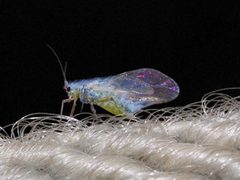
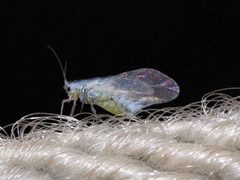
Phyllaphis fagi, the woolly beech aphid, is a small sap-sucking insect that lives exclusively on beech trees (Fagus ). It produces dense white to bluish-white wax threads that give colonies a distinctive woolly appearance. The species has a complex involving both winged and wingless forms, with up to ten per year in favorable conditions. Native to Europe, it has been introduced to several other regions including North America, Australia, and New Zealand, where it can become a significant pest in beech forests and nurseries.

Pronunciation
How to pronounce Phyllaphis fagi: //ˈfɪl.lə.fɪs ˈfeɪ.dʒaɪ//
These audio files are automatically generated. While they are not always 100% accurate, they are a good starting point.
Identification
The combination of small size (1–3 mm), bluish-green body color, and especially the dense white woolly wax coating distinguishes this from other beech-associated insects. The wax production is more profuse than in most other species. Colonies on the undersides of leaves appear as white woolly patches. Similar woolly aphids on beech bark rather than leaves may be confused with beech bark (Cryptococcus fagisuga), which is in a different (Eriococcidae) and produces fluffy white wax on bark rather than foliage; bark scales are sedentary and lack the mobile colony of Phyllaphis fagi.
Images
Habitat
Exclusively associated with beech trees (Fagus ), occurring primarily on the undersides of leaves and sometimes on young shoots. Found in forest nurseries, mature beech forests, and urban plantings of beech. Requires temperate climates with seasonal temperature variation to complete its .
Distribution
Native to Central and Southern Europe. Introduced to the Middle East, Australia, New Zealand, and North America. Present in Belgium with records from multiple regions. GBIF distribution records include São Miguel (Azores).
Seasonality
hatch in spring before budburst. Fundatrix develops over 2–3 weeks beginning spring. Multiple successive generations occur through summer, with winged form production peaking in mid-June. Sexual generation with winged males appears only in autumn. Females lay 10–16 eggs on plant buds and bark crevices in autumn. Ten generations have been recorded in a single growing season in nursery conditions.
Diet
Phloem sap from vascular tissues of beech trees (Fagus ). Specific associations include Fagus sylvatica in Central Europe, Fagus orientalis in Turkey, and both Fagus sylvatica and Fagus grandifolia in North America.
Host Associations
- Fagus sylvatica - primary Preferred in Central Europe
- Fagus orientalis - primary Preferred in Turkey
- Fagus grandifolia - primary in North America
Life Cycle
Holocyclic and (complete on single ). as on buds and bark crevices. Spring hatch produces active nymphs that develop through at least three into wingless fundatrices. Fundatrices reproduce parthenogenetically, producing up to 80 virginoparous nymphs. Successive parthenogenetic produce both winged and wingless females through summer. Winged males appear only in autumn sexual generation. After mating, females deposit 10–16 winter eggs. Temperature strongly affects development rate and reproductive parameters, with optimal at 20°C. First generation shows lower temperature sensitivity than subsequent generations.
Behavior
Nymphs are highly active in searching for feeding locations immediately after hatching. When disturbed, colonies exhibit collective defensive : individuals raise their wax-covered and sway rhythmically, a behavior that has been suggested to confuse . Winged forms are produced continuously through much of the season rather than in discrete pulses, facilitating to new seedlings and trees.
Ecological Role
Significant producer of honeydew, which supports growth of fungi (including Scorias spongiosa) and provides food for various insects. Serves as prey for hoverflies, parasitic , lacewings, and ladybirds. Heavy may reduce in trees through direct feeding damage and sooty mold coverage; honeydew and sooty mold accumulation beneath infested trees may reduce survival of beech seedlings.
Human Relevance
Serious pest in European beech forests and forest nurseries, where can develop. High densities can cause aesthetic damage to ornamental beech plantings and reduce tree vigor. Management interest focuses on monitoring for early-season nymph activity and population thresholds in nursery settings. Natural enemies provide some .
Similar Taxa
- Cryptococcus fagisugaBeech bark produces similar fluffy white wax but on bark rather than leaves; belongs to Eriococcidae; sedentary lifestyle differs from mobile leaf-dwelling colonies of Phyllaphis fagi
- Grylloprociphilus imbricatorBeech blight aphid (also called boogie-woogie aphid) produces woolly wax on beech branches and exhibits similar defensive swaying , but is primarily North American and has a involving root-feeding on swamp cypress as alternate ; Phyllaphis fagi is on beech only
More Details
Temperature effects on population dynamics
Laboratory studies show reproductive effort is more dependent on temperature than on number, with no significant difference between winged and wingless females. Nymphs born at higher temperatures (25°C) may be deformed and non-viable. The continuous production of winged morphs for several months, peaking in mid-June, creates ongoing potential for situations and to new throughout the summer.
Sources and further reading
- BugGuide
- Wikipedia
- GBIF taxonomy match
- iNaturalist taxon
- NCBI Taxonomy
- Catalogue of Life
- Waxy ladies dance like someone’s watching: Woolly beech aphid, a.k.a. boogie-woogie aphid, Grylloprociphilus imbricator — Bug of the Week
- Nasty scale insects spell trouble for American beech trees: Beech bark scale, Cryptococcus fagisuga — Bug of the Week
- Italian Society of Vegetation Science signs with Pensoft to publish its journal on ARPHA | Blog
- Life table parameters affecting the population development of the woolly beech aphid, Phyllaphis fagi