
Takecallis arundinariae
(Essig, 1917)
black-spotted bamboo aphid
Takecallis arundinariae, the black-spotted bamboo , is a globally distributed aphid native to Eurasia. It feeds exclusively on bamboo (Poaceae: Bambusoideae), particularly Phyllostachys, and has been introduced to multiple continents through human transport of plants. The species forms small scattered colonies on leaf undersides and reproduces viviparously via viviparae. It is considered a pest of ornamental and cultivated bamboo when are uncontrolled.
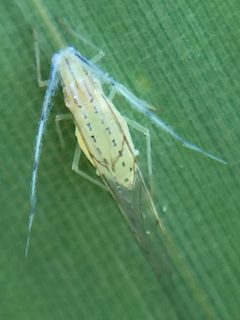
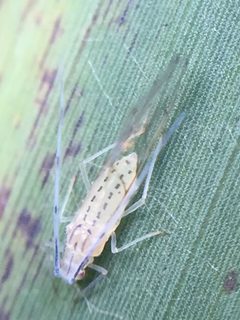
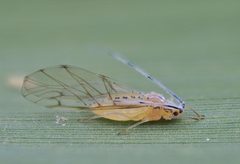
Pronunciation
How to pronounce Takecallis arundinariae: /ˈtæ.kɛ.kæl.ɪs əˌrʌn.dɪˈnɛə.raɪ/
These audio files are automatically generated. While they are not always 100% accurate, they are a good starting point.
Identification
Distinguished from by the combination of: long pubescent (~1.2× body length); short cup-shaped siphunculi with single seta; knobbed cauda with 12–15 setae; two dorsomedial rows of tuberculate processes on each with one seta; and 4–8 secondary rhinaria on forms. Differs from Takecallis taiwana in morphological details of siphunculi and abdominal (see Qiao & Zhang 2004 for full diagnostic key).
Images
Habitat
Found on leaves of bamboo plants (Poaceae: Bambusoideae), particularly Phyllostachys ; occupies undersides of leaves in small scattered colonies of 1–3 individuals per leaf; occurs at elevations from 1100–2600 m in introduced South American
Distribution
Native to Eurasia; introduced and established worldwide including North America, Europe (Belgium, Switzerland, Germany, Spain), and South America (Argentina, Brazil, Chile, Colombia). First recorded in northern South America in Colombia (Cundinamarca Department and Bogotá) in 2014.
Diet
Phloem feeder on bamboo (Poaceae: Bambusoideae); specifically documented on Phyllostachys
Host Associations
- Phyllostachys sp. - primary Poaceae: Bambusoideae; documented collection in Colombia
Life Cycle
Apparently anholocyclic (lacking sexual and stage); through viviparae; colonies composed of mixed nymphs and
Behavior
Forms small scattered colonies on leaf undersides (1–3 individuals per leaf); has been observed to establish readily in new environments following introduction via transport of plants
Ecological Role
Herbivore; potential pest of bamboo under high densities
Human Relevance
Pest of ornamental and cultivated bamboo; major can cause damage to plants if left uncontrolled; spread facilitated by global trade in bamboo plants
Similar Taxa
- Takecallis taiwanaCo-occurs on bamboo and similar in general appearance; distinguished by morphological details of siphunculi shape and abdominal tuberculation pattern (see Qiao & Zhang 2004)
More Details
Taxonomic history
Originally described as Myzocallis arundinariae by Edward Oliver Essig in 1917; later transferred to Takecallis
Introduction pathways
Introduction to new regions likely occurs through transport of live bamboo plants; the has been documented as establishing readily in novel environments