
Chaetosiphon
Huber, 1893
strawberry aphid
Species Guides
1- Chaetosiphon thomasi(American Hairy Rose Aphid)
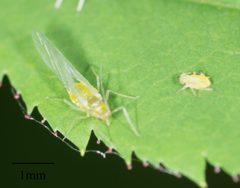
Chaetosiphon is a of aphids in the Aphididae, comprising specialized on Rosaceae , particularly strawberries (Fragaria) and roses (Rosa). The genus includes economically significant agricultural pests, most notably Chaetosiphon fragaefolii, which multiple strawberry viruses. Species in this genus exhibit complex with both holocyclic (sexual) and anholocyclic (parthenogenetic) , and show morphological variation in karyotype and chaetotaxy that has complicated taxonomic classification.
Pronunciation
How to pronounce Chaetosiphon: //ˌkeɪtoʊˈsaɪfɒn//
These audio files are automatically generated. While they are not always 100% accurate, they are a good starting point.
Identification
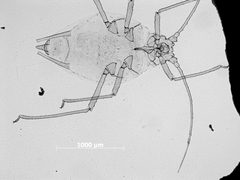
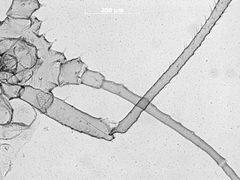
Distinguished from other by association with Fragaria and Rosa ; members of the fragaefolii group show variable submarginal setal counts that are not reliable taxonomic characters due to genetic and seasonal variation. The 17- karyotype form is morphologically recognizable as C. jacobi. Rose-feeding (C. thomasi) have shorter rostra than strawberry-feeding populations. Old World populations of C. fragaefolii have longer siphunculi and fewer submarginal setae than North American populations.
Images
Habitat
Agricultural and wild supporting Rosaceae ; primarily associated with cultivated and wild strawberries, as well as roses and Potentilla as alternative hosts.
Distribution
Native to North America; introduced and established in Europe (including England, Poland), New Zealand, and other regions. Present in strawberry-growing regions worldwide including Florida, West Germany, and British Columbia.
Diet
Phloem-feeding on Rosaceae; primary include Fragaria (strawberries) and Rosa species (roses).
Host Associations
- Fragaria × ananassa - primary cultivated strawberry
- Fragaria spp. - primary wild and cultivated strawberries
- Rosa rugosa - primary holocyclic for C. thomasi
- Rosa spp. - primary rose-feeding assigned to C. thomasi
- Potentilla spp. - alternative used by C. thomasi but apparently not P. anserina
- Potentilla anserina - alternative used by both Old and New World of C. fragaefolii
Life Cycle
Holocyclic (with ) documented in British Columbia with 2n=12 female karyotype; predominantly anholocyclic (parthenogenetic) populations in Oregon, California, England, and New Zealand with variable numbers (13, 14, 15, or 17) showing structural heterozygosity. The 17-chromosome form represents a distinct , C. jacobi. Parthenogenetic lineages derived from the holocyclic form carry one to three dissociations.
Behavior
Alary (production of winged versus wingless morphs) influenced by temperature, , and plant. Virus transmission capability documented; natural spread of strawberry crinkle virus affected by lifespan and ability to survive through the latent period of the virus.
Ecological Role
Agricultural pest and plant virus ; vectors cytorhabdovirus, strawberry yellow edge virus, and strawberry crinkle virus. Honeydew production documented. Subject to by fungi ( bassiana, Metarhizium sp.), (Aphelinus varipes), and including syrphid flies, asilid flies, Orius insidiosus, and coccinellid beetles.
Human Relevance
Significant economic pest of strawberry worldwide; in some regions (e.g., Poland). Danish jordbærbladlus translates directly to "strawberry ." Control strategies include natural materials such as neem and papaya leaf extracts.
Similar Taxa
- PentatrichopusFormer subgenus designation; Chaetosiphon (Pentatrichopus) used in historical literature for in this group, now generally treated as Chaetosiphon.
- C. jacobi17- karyotype form morphologically recognizable and previously confused with C. fragaefolii; now treated as distinct .
- C. thomasiRose-feeding with shorter rostrum, previously conflated with strawberry-feeding ; distinguished by association and .
Sources and further reading
- BugGuide
- Wikipedia
- iNaturalist taxon
- NCBI Taxonomy
- Catalogue of Life
- Learning the Insect Lingo While Working Abroad
- Biology and Control of the Strawberry Aphid, Chaetosiphon fragaefolli (Cockerell) (Homoptera: Aphididae) in Florida
- INVESTIGATIONS ON THE BIOLOGY OF THE STRAWBERRY APHID (CHAETOSIPHON FRAGAEFOLII), THE MOST IMPORTANT VECTOR OF STRAWBERRY VIRUSES IN WEST GERMANY.
- Effects of temperature, photoperiod, and host plant on alary polymorphism in the aphid, Chaetosiphon fragaefolii
- Honeydew production, survival and reproduction by Chaetosiphon fragaefolii (Cockerell) (Homoptera: Aphididae) on susceptible and resistant clones of Fragaria spp.
- Review: Control of Strawberry Aphids (Chaetosiphon Fragaefolii; Aphididae) Through Sustainable Natural Materials In Strawberry (Fragaria X Ananassa) Cultivation
- Biology and Fertility Life Table of the Green AphidChaetosiphon Fragaefollion Strawberry Cultivars
- The strawberry aphid complex, Chaetosiphon (Pentatrichopus) spp. (Hemiptera: Aphididae): taxonomic significance of variations in karyotype, chaetotaxy and morphology
- Morphological and Molecular Insights into the Invasive Strawberry Aphid Chaetosiphon fragaefolii – a Critical Pest and Virus Vector New to Poland with supplement
- Exploring the factors involved in the absence of parasitism of Chaetosiphon fragaefolii by generalist parasitoids in strawberry
- Influence of Trichomes in Strawberry Cultivars on the Feeding Behavior of Chaetosiphon fragaefolii (Cockerell) (Hemiptera: Aphididae)