
Cavariella
Del Guercio, 1911
Willow-Umbellifer Aphids
Species Guides
1- Cavariella konoi(Spotted Willow-Angelica Aphid)
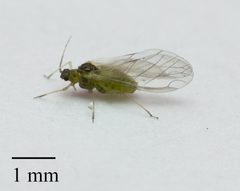
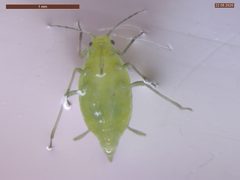
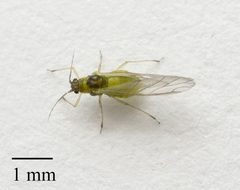
Cavariella is a of aphids in the Aphididae, tribe Macrosiphini. It is distinguished from other Macrosiphini genera by a supra-caudal process on abdominal tergite VIII bearing two setae. The genus has a Holarctic distribution with approximately half its occurring in Asia. Species in this genus exhibit a characteristic involving primary in Salicaceae (willows) and secondary hosts in Apiaceae (umbellifers), making them economically significant as pests of carrot and other crops.
Pronunciation
How to pronounce Cavariella: //ˌkævəˈriːlə//
These audio files are automatically generated. While they are not always 100% accurate, they are a good starting point.
Identification
Distinguished from other Macrosiphini by the presence of a supra-caudal process on abdominal tergite VIII with two setae distally. This morphological feature is diagnostic for the genus. -level identification requires examination of additional characters including siphunculi, cauda, and antennal ; keys are available for regional faunas including China.
Images
Distribution
Holarctic distribution with strong representation in Asia; approximately half of described are Asian. Recorded from Europe, Asia, North America, and Australia. Distribution records exist for Denmark, Norway, and Sweden.
Host Associations
- Salix - primary overwinter on willows; fundatrices develop on Salix in spring
- Apiaceae - secondary Includes carrot (Daucus carota), chervil (Anthriscus cerefolium), coriander (Coriandrum sativum), caraway (Carum carvi), wild carrot (Daucus carota ssp. carota), cow parsley (Anthriscus sylvestris), hemlock (Conium maculatum), Torilis, Cryptotaenia, and Angelica
Human Relevance
in this , particularly Cavariella aegopodii, are significant agricultural pests. The willow-carrot causes damage through direct feeding on carrot and other umbelliferous crops, and through transmission of plant viruses including carrot red leaf virus and carrot mottle virus. These viruses are persistent and circulative in the aphid, requiring at least 30 minutes acquisition access time. Virus transmission contributes to motley dwarf in carrots. Some carrot varieties show relative resistance to aphid damage.
Similar Taxa
- ElatobiumCavariella hidaensis was transferred to Elatobium, indicating historical confusion; Elatobium lacks the diagnostic supra-caudal process with two setae on abdominal tergite VIII
- TuberculaphisListed as related in some classifications; Cavariella distinguished by supra-caudal process
Sources and further reading
- BugGuide
- Wikipedia
- GBIF taxonomy match
- iNaturalist taxon
- NCBI Taxonomy
- Catalogue of Life
- Mating behaviour of Cavariella aegopodii
- Studies on the aphid, Cavariella aegopodii Scop
- Discovery of Two Novel Viruses of the Willow-Carrot Aphid, Cavariella aegopodii
- Studies on the aphid, Cavariella aegopodii Scop: On secondary hosts other than carrot
- The colonization by Cavariella aegopodii Scop, of carrot plants of different sizes
- Hitherto Unknown Morphs of <i>Cavariella indica</i> Maity and Chakrabarti (Homoptera : Aphididae) with Notes on its Biology
- Cavariella Del Guercio (Hemiptera, Aphidinae, Macrosiphini) in China, with a new species, new synonymies, and first country records
- EVALUATION OF THE GARDEN CARROT ACCESSIONS FOR THE POPULATION OF <i>CAVARIELLA AEGOPODII</i> (SCOP.) AND ECONOMICALLY VALUABLE FEATURES OF CULTURE IN THE CONDITIONS OF THE BRYANSK REGION
- Characterization of the Mitochondrial Genome of Cavariella salicicola: Insight into the Codon Usage Bias and Phylogenetic Implications in Aphidinae.