
Aleurochiton forbesii
(Ashmead, 1893)
Maple whitefly
Aleurochiton forbesii is a whitefly native to eastern North America that specializes on maple trees (Acer spp.) as its primary . The species produces two annually, with distinctive seasonal differences in puparial appearance. Unlike its European Aleurochiton aceris, it rarely reaches densities that cause significant host damage. The species has been documented as a host for the Amitus aleurodinis.
Pronunciation
How to pronounce Aleurochiton forbesii: /əˌlɔːroʊˈkaɪtən ˈfɔːrbziː/
These audio files are automatically generated. While they are not always 100% accurate, they are a good starting point.
Identification
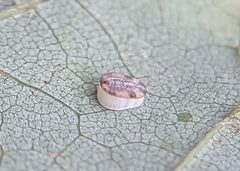
Distinguished from other whiteflies by the combination of maple association and the distinctive wax-fringed with seasonal color dimorphism. The brown pigmented pattern on puparia and the vertical whitish wax fringe are particularly diagnostic. may be separated from other Aleurochiton by geographic range and wing venation patterns typical of the .
Images
Appearance
have a generally yellow body with paler legs and . Wings are unmarked white with venation typical for the Aleurochiton. (the pupal stage) display marked seasonal dimorphism: early summer puparia are nearly colorless, while puparia develop a distinctive brown pigmented pattern. Overwintering puparia are raised on a vertical fringe of whitish wax that increases in height with age; mature individuals may have wax fringes reaching nearly two-thirds the diameter of the puparium itself.
Habitat
Deciduous forest and urban/suburban environments where maples occur. Found on the undersides of leaves of living maple trees.
Distribution
Eastern North America from New Brunswick and Ontario south to Georgia and Mississippi, west to Wisconsin, Illinois, and Missouri. Records extend to the western Canadian provinces including Alberta, Saskatchewan, Manitoba, and the Northwest Territories.
Seasonality
Two annually: early summer and generation. emerge from overwintering in spring. Overwintering puparia are most visible in fall on leaf undersides. Puparia drop to ground with dead leaves in autumn, completing development in leaf litter.
Diet
Phloem-feeding on maple trees (Acer spp.), primarily silver maple (Acer saccharinum), red maple (Acer rubrum), and occasionally Norway maple (Acer platanoides). Rarely reported on two holly : Ilex coriacea and Ilex glabra.
Host Associations
- Acer saccharinum - primary silver maple
- Acer rubrum - primary red maple
- Acer platanoides - secondary Norway maple, less commonly used
- Ilex coriacea - rare occasional reports
- Ilex glabra - rare occasional reports
Life Cycle
Hemimetabolous development with two annually. complete development in leaf litter after falling from trees in autumn, with emerging in spring. Early summer produces nearly colorless puparia; second (overwintering) brood develops brown pigmented patterns.
Behavior
Sedentary as , attached to leaf undersides. are mobile fliers. Has not been observed to reach densities that damage plants.
Ecological Role
Phloem-feeding herbivore; densities typically remain below economically or ecologically significant thresholds. Serves as for Amitus aleurodinis (Platygastridae), contributing to connections in maple-associated .
Human Relevance
Minor economic significance; occasionally noted as a maple pest but not known to cause meaningful injury to plants. Presence may indicate healthy maple in natural or urban settings.
Similar Taxa
- Aleurochiton acerisEuropean that can cause significant maple damage; distinguished by geography and by A. forbesii's lower typical
- Other Aleyrodidae on maplesWax fringe structure and seasonal puparial dimorphism are distinctive to Aleurochiton; other lack these features