
Thyanta pallidovirens
(Stål, 1859)
Red-shouldered Stink Bug, Redshouldered Stink Bug
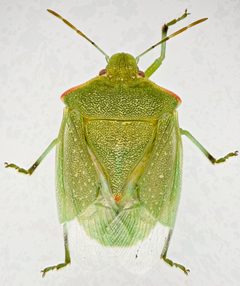
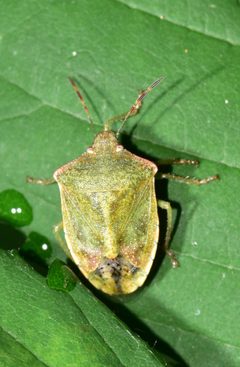
Thyanta pallidovirens, commonly known as the red-shouldered stink bug, is a phytophagous in the Pentatomidae native to North and Central America. It is recognized by a thin red band across the pronotum (the "shoulders"), which distinguishes it from similar green stink bugs. The species is an agricultural pest of legume crops including peas, lentils, and soybeans, feeding primarily on developing pods and seeds. Males use and vibrational signals to attract mates, with copulation lasting an average of 3.5 hours.
Pronunciation
How to pronounce Thyanta pallidovirens: /ˈθaɪ.æntə ˌpæl.ɪˌdoʊˈvɪ.rɛnz/
These audio files are automatically generated. While they are not always 100% accurate, they are a good starting point.
Identification
Distinguished from the redbanded stink bug (Piezodorus guildinii) by the absence of a long spine between the hind legs; T. pallidovirens lacks this spine while P. guildinii possesses it. Distinguished from the southern green stink bug (Nezara viridula) by the red shoulder band versus reddish antennal bands in N. viridula. Distinguished from the green stink bug (Chinavia hilaris) by the presence of the red shoulder band, which C. hilaris lacks.
Images
Appearance
Shield-shaped body typical of Pentatomidae. Green coloration with a distinctive thin red band across the pronotum (shoulders), giving the its . are reddish in color. The scutellum is triangular and covers a portion of the . lack the long spine between the hind legs that characterizes the redbanded stink bug (Piezodorus guildinii).
Habitat
Agricultural fields, particularly legume crops including peas, lentils, and soybeans. Also found in gardens and on various fruit and vegetable plants including tomatoes, peaches, pears, and beans. Occurs in weedy areas that serve as before crop .
Distribution
North America and Central America. In the United States, documented in soybean fields in the Midwest and in agricultural regions of Texas, particularly northeast Texas. Range extends through Central America.
Seasonality
Multiple per year in southern regions. develop first on legume weeds, then move to soybeans when flowering begins. In soybean, present and damaging from first pod formation (R3) through full seed development (R6).
Diet
Phytophagous; feeds on developing reproductive structures of plants. Nymphs and feed on pods and developing seeds of peas, lentils, and soybeans. Also feeds on fruits including peaches, pears, tomatoes, and beans. Feeding causes blemishes, depressions, and corky tissue in fruits; in legumes, causes flat pods, reduced seed fill, and delayed maturity.
Host Associations
- Pisum sativum - pea
- Lens culinaris - lentil
- Glycine max - soybean
- Prunus persica - peach
- Solanum lycopersicum - tomato
- Pyrus spp. - pear
- Phaseolus spp. - bean
- Guara lendheimeri - oviposition site laid on stems
Life Cycle
stage: barrel-shaped eggs laid in masses on leaves and stems. Nymphal stage: five instars; nymphs resemble but lack wings. Nymphs grow larger with each . Adult stage: winged, sexually mature. Development time and survival vary with plant and developmental stage.
Behavior
Males locate females through antennal contact. Courtship involves male vibrating against female and antennal tapping. Females may reject males through kicking, pushing, or away. Copulation averages 3.5 hours. Females mate multiple times. When disturbed or crushed, releases defensive odor. Mobile within and between fields; can re-infest fields after applications.
Ecological Role
Agricultural pest causing economic damage to legume, fruit, and vegetable crops. Feeding on soybean pods reduces yield, seed quality, and germination rates. Damage includes flat pods, failure of seeds to expand and fill, delayed crop maturity, and green stem retention. Can cause total yield loss in severe . Serves as prey for including praying mantids, though defensive chemicals may deter some predators.
Human Relevance
Significant agricultural pest requiring management in soybean, pea, and lentil production. guide treatment decisions: one or more and older nymphs per row foot in soybean. applications may be warranted, though efficacy varies. Management complicated by mobility and ability to re-infest fields. Soapy water can be used for hand removal in garden settings.
Similar Taxa
- Piezodorus guildiniiRedbanded stink bug has similar red band across body but possesses long spine between hind legs; T. pallidovirens lacks this spine
- Nezara viridulaSouthern green stink bug is similar in size and green coloration but has reddish antennal bands rather than red shoulder band, and has short rounded spine between hind legs
- Chinavia hilarisGreen stink bug lacks red shoulder band entirely; slightly larger than T. pallidovirens
- Thyanta custator accerraRedshouldered stink bug (eastern ) is morphologically similar and was historically confused; occurs in different geographic region
More Details
Communication
Males produce a blend of methyl (E,Z,Z)-2,4,6-decatrienoate and sesquiterpenes to attract females. Both sexes produce two distinct vibrational songs for mate attraction.
Subspecies
Three recognized: Thyanta pallidovirens pallidovirens (Stål, 1859), Thyanta pallidovirens setosa Ruckes, 1957, and Thyanta pallidovirens spinosa Ruckes, 1957.
Research significance
has been extensively studied for reproductive , including mate location, courtship, copulation duration, and female mate choice behaviors.
Sources and further reading
- BugGuide
- Wikipedia
- GBIF taxonomy match
- iNaturalist taxon
- NCBI Taxonomy
- Stink Bugs Do It, Too! | Bug Squad
- Bug Squad
- Three's a Crowd: The Saga of Two Stink Bugs and a Bee | Bug Squad
- Soybean Insects: Late-Season Pests (R1 to R7) - AgriLife Extension Entomology
- Behind the Shield | Bug Squad
- Stink Bugs: New IPM Guide for Midwestern Corn, Soybean Growers
- Reproductive Behavior of Thyanta pallidovirens (Heteroptera: Pentatomidae)
- Effect of Pea and Lentil Development on Reproduction and Longevity of Thyanta pallidovirens (Stål) (Hemiptera: Heteroptera: Pentatomidae)