
Thyanta
Stål, 1860
redshouldered stink bugs, red-shouldered stink bugs
Species Guides
7- Thyanta calceata
- Thyanta custator(Red-shouldered Stink Bug)
- Thyanta maculata
- Thyanta pallidovirens(Red-shouldered Stink Bug)
- Thyanta perditor(neotropical red-shouldered stink bug)
- Thyanta planifrons
- Thyanta pseudocasta
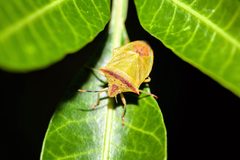
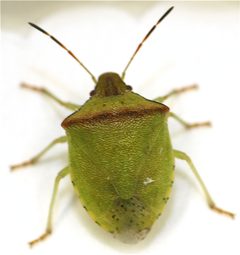
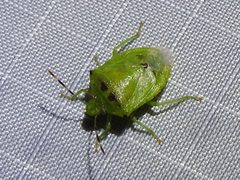
Thyanta is a of stink bugs in the Pentatomidae containing approximately 19 described . Species in this genus are recognized by a distinctive reddish band across the pronotum (the 'shoulder' region behind the ), giving them the 'redshouldered stink bugs.' Several Thyanta species are significant agricultural pests, particularly of soybean, corn, and various legume crops. The genus is native to the Americas, with species distributed from North America through South America.
Pronunciation
How to pronounce Thyanta: /ˈθaɪ.əntə/
These audio files are automatically generated. While they are not always 100% accurate, they are a good starting point.
Identification
Thyanta are distinguished from other by the presence of a reddish band across the surface of the pronotum (the 'shoulder' region). This contrasts with the redbanded stink bug (Piezodorus guildinii), which has a similar band but possesses a long spine projecting between the hind legs—a structure absent in Thyanta. Thyanta species lack the long, pointed spine characteristic of Chinavia (green stink bugs) and differ in coloration from brown stink bugs (Euschistus spp.). Some Thyanta species exhibit color ; for example, Thyanta custator accerra occurs in both green and brown forms.
Images
Habitat
Agricultural fields, particularly soybean and corn; also found in areas with wild plants including legume weeds. have been documented on cultivated crops and wild plants such as Bidens pilosa.
Distribution
Americas; documented in North America (including the Midwestern United States, Texas, Florida, and Vermont) and South America (Neotropical region). Specific distribution varies by species.
Life Cycle
with , nymph, and stages. Females lay barrel-shaped eggs in masses on plants. Nymphs pass through five instars before becoming adults, with development occurring on host plants. Adults of some exhibit seasonal dimorphism.
Behavior
Aggregating on plants has been observed. Seasonal movement between wild host plants and cultivated crops occurs. When disturbed or crushed, release defensive compounds producing an unpleasant odor.
Ecological Role
Agricultural pest; feeding damage reduces crop yield and quality. Multiple Thyanta are documented pests of soybean, causing damage to developing flowers, pods, and seeds. Damage include flat pod, delayed crop maturity, and reduced germination rates in seed production.
Human Relevance
Economic pest of soybean, corn, wheat, barley, oats, rye, sorghum, rice, peanut, common bean, lima bean, cowpea, alfalfa, clover, cotton, and tobacco. Management involves scouting with sweep nets or ground cloths and applying when exceed . approaches are recommended due to the extended vulnerability period of crops and potential for reinfestation by flying .
Similar Taxa
- Piezodorus guildiniiBoth have a reddish band across the pronotum, but P. guildinii possesses a long spine projecting between the hind legs that is absent in Thyanta.
- Chinavia hilarisSimilar shield-shaped body, but Chinavia lacks the reddish shoulder band and has a longer, pointed spine.
- Euschistus spp.Brown stink bugs differ in coloration (predominantly brown) and lack the distinctive reddish pronotal band.
Sources and further reading
- BugGuide
- Wikipedia
- GBIF taxonomy match
- iNaturalist taxon
- NCBI Taxonomy
- Soybean Insects: Late-Season Pests (R1 to R7) - AgriLife Extension Entomology
- Stink Bugs Do It, Too! | Bug Squad
- Bug Squad
- Three's a Crowd: The Saga of Two Stink Bugs and a Bee | Bug Squad
- Behind the Shield | Bug Squad
- Stink Bugs: New IPM Guide for Midwestern Corn, Soybean Growers
- Biology of Thyanta perditor (Hemiptera: Pentatomidae)
- Reproductive Behavior of Thyanta pallidovirens (Heteroptera: Pentatomidae)
- New Host Plant Record for the Stink Bug Thyanta custator (Hemiptera: Pentatomidae) in Florida
- Notes on the Biology of Thyanta calceata (Hemiptera: Pentatomidae) with Information on Adult Seasonal Dimorphism1
- Effect of Pea and Lentil Development on Reproduction and Longevity of Thyanta pallidovirens (Stål) (Hemiptera: Heteroptera: Pentatomidae)
- Nymphal and adult biology of the red-shouldered stink bug, Thyanta perditor (F.), on cultivated and on wild plants
- Tachinid Fly Parasitism and Phenology of the Neotropical Red-Shouldered Stink Bug, Thyanta perditor (F.) (Heteroptera: Pentatomidae), on the Wild Host Plant, Bidens pilosa L. (Asteraceae)