
Elasmucha
Stål, 1864
Parent shieldbugs
Species Guides
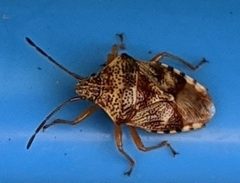
1- Elasmucha lateralis(Edge-striped Shield Bug)
Elasmucha is a of shield bugs in the Acanthosomatidae, commonly known as parent shieldbugs. in this genus are notable for exhibiting subsocial , specifically extended maternal care of and early nymphal stages. Females guard egg masses and remain with offspring through early instars, actively defending against and . The genus includes arboreal species associated with specific trees, with documented seasonal host plant switching in some species.
Identification
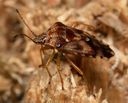
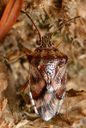
Elasmucha can be distinguished from other Acanthosomatidae by their characteristic subsocial maternal care , which is relatively uncommon among shield bugs. Species-level identification requires examination of morphological features such as body shape, coloration patterns, and genitalia; E. grisea (Parent Shieldbug) is the most widely distributed and well-known species. The genus is part of the Acanthosomatinae, which can be separated from related subfamilies by structural features of the scutellum and abdominal venter.
Images
Habitat
Arboreal; inhabit trees and shrubs. Elasmucha grisea has been documented on alder (Alnus glutinosa) and birch (Betula pendula) in northwestern Germany, with seasonal shifts between trees. Other species show associations with diverse host plants including mulberry (Morus australis), Euptelea polyandra, and Rosa multiflora.
Distribution
Records from Denmark, Norway, Sweden, and the United States (Vermont). The has a broad distribution with individual showing varying ranges; E. grisea is widespread in Europe, while E. lateralis occurs in North America.
Seasonality
Activity patterns vary by and . Elasmucha grisea shows in some regions, with spring generation developing on birch until mid-July and summer generation utilizing alder from August onward. Seasonal plant switching corresponds to phenology of catkins on respective host trees.
Diet
Phytophagous; feeds on reproductive structures of trees. Elasmucha grisea feeds on catkins of alder and birch. Feeding is restricted to specific host plant tissues, with nymphal development dependent on presence of suitable catkin resources.
Host Associations
- Alnus glutinosa - Alder; utilized primarily in summer , from August onward
- Betula pendula - Birch; preferred for spring until mid-July
- Morus australis - Mulberry; for early of E. putoni
- Euptelea polyandra - for later of E. putoni
- Rosa multiflora - for later of E. putoni
Life Cycle
or depending on and region. Females deposit in compact batches on plants. Nymphs develop through five instars; early instars remain aggregated and under maternal protection. Development time and survival depend on host plant quality and maternal care duration.
Behavior
Exhibits subsocial with extended maternal care. Females remain with masses and early nymphal stages, flattening their bodies over the with extended. Guarding responses include active defense against and ; females can locate eggs after displacement using olfactory or chemotactile orientation. Nymphs display distinct grouping behavior adapted to parental care. A possible nymphal alarm substance has been suggested to trigger guarding responses in E. putoni. by tachinid flies (Subclytia rotundivertis) reduces female survival and maternal care duration.
Ecological Role
Herbivore of tree reproductive structures; role in nutrient cycling through consumption of catkins. Maternal care influences offspring survival and . Serves as for including tachinid flies.
Human Relevance
Minor potential as pest of ornamental or forest trees through feeding on reproductive structures; no major economic significance documented. Subject of scientific interest due to rare subsocial among Heteroptera.
Similar Taxa
- AcanthosomaBoth in Acanthosomatidae; Elasmucha distinguished by well-documented subsocial maternal care , which is absent or poorly developed in Acanthosoma
- CyphostylusRelated acanthosomatid ; Elasmucha generally larger and with more pronounced parental care
More Details
Parental care effectiveness
Maternal care in Elasmucha significantly increases offspring survival rates. Parasitized females show reduced defensive response when guarding third-instar nymphs, and increases probability of female death before completion of maternal care, representing the primary cost of parasitism.
Host plant phenology
Seasonal plant switching in E. grisea is synchronized with catkin development: birch catkins are available earlier in the season, while alder catkins mature later. This temporal partitioning allows two to utilize sequential resources, optimizing reproductive output.
Sources and further reading
- BugGuide
- Wikipedia
- GBIF taxonomy match
- iNaturalist taxon
- NCBI Taxonomy
- Catalogue of Life
- Sozialverhalten zweier Elasmucha‐Arten (Heteroptera: Insecta)*
- Brooding Behavior in the Bug Elasmucha Signoreti (Heteroptera: Acanthosomatidae)
- Phenotypic selection and function of reproductive behavior in the subsocial bug Elasmucha putoni (Heteroptera: Acanthosomatidae)
- Adaptation of the externally feeding bug Elasmucha necopinata (Hemiptera: Acanthosomatidae) to its fig host
- Parasites and Female Ability to Defend Offspring in the Parent Bug Elasmucha grisea L
- Brooding Behavior in Elasmucha putoni (Heteroptera : Acanthosomatidae), and a Possible Nymphal Alarm Substance Triggering Guarding Responses
- Variation in reproductive traits associated with different host plants in the subsocial bug Elasmucha putoni (Hemiptera: Acanthosomatidae)
- Saisonaler Wirtspflanzenwechsel bei der baumbewohnenden Wanze Elasmucha grisea L. (Heteroptera: Acanthosomatidae)1