
Paromius
Fieber, 1861
dirt-colored seed bugs
Species Guides
1- Paromius longulus(dirt-colored seed bug)
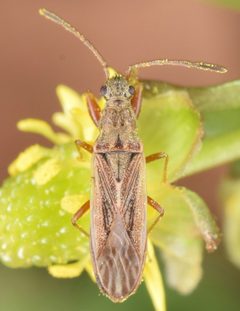
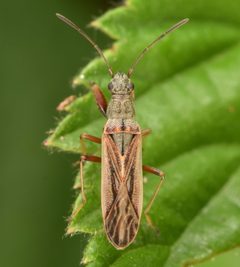
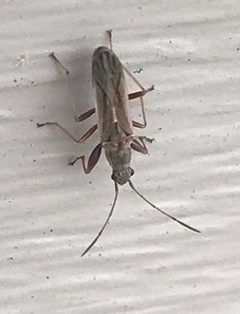
Paromius is a of seed bugs in the Rhyparochromidae containing approximately 15 described . Members are elongate, parallel-sided with glabrous and distinctive pronotal structure. The genus has broad geographic distribution spanning the Afrotropical region and subtropical Eurasia, with at least one species extending into temperate Europe. Some species are associated with grasses (Poaceae) and can be agricultural pests, while others occupy dry, xerothermic .
Pronunciation
How to pronounce Paromius: //pəˈroʊmiːəs//
These audio files are automatically generated. While they are not always 100% accurate, they are a good starting point.
Identification
-level diagnostic features include an elongate, parallel-sided body form and glabrous (hairless) . within the genus may be distinguished by pronotal collar structure, such as the V-shaped collar reported for P. gracilis. The genus is the only European representative of its tribe in some regions. Species-level identification requires examination of structural characters and may be challenging without reference specimens.
Images
Habitat
varies by : dry meadows on sand and xerothermic grasslands with warm microclimate of Mediterranean character (P. gracilis); paddy fields and surrounding gramineae weed (P. exiguus); subtropical grasslands, savannas, riverine wetlands, and halophilous vegetation across broader range.
Distribution
Afrotropical region including Madagascar; subtropical Eurasia from Mediterranean Basin through Irano-Turanian Region and sub-Himalayan belt to East Asia (southern Korea, southern China, Japan, Taiwan); northward extension into central Europe (Hungary) documented for P. gracilis.
Seasonality
Seasonal activity varies by and latitude. P. exiguus in Korea shows three annually with and sequential plant use from May through August. P. gracilis overwinters as adult with cycle in temperate regions.
Diet
Associated with Poaceae (grass ). P. gracilis linked to Andropogon, Imperata, and Ischaemum. P. exiguus feeds on grain parts of Imperata cylindrica, Calamagrostis epigeios, and Oryza sativa (rice), causing pecky grain damage.
Host Associations
- Poaceae - primary grasses including Andropogon, Imperata, Ischaemum, Calamagrostis, Oryza
- Imperata cylindrica - first for P. exiguus; also associated with P. gracilis
- Calamagrostis epigeios - second for P. exiguus
- Oryza sativa - third for P. exiguus; agricultural crop
- Andropogon - associated with P. gracilis
- Ischaemum - associated with P. gracilis
Life Cycle
Developmental patterns documented for specific : P. exiguus has three per year with five nymphal instars distinguishable by width or prothoracic width. P. gracilis is . Both species overwinter as .
Behavior
Sequential plant shifting synchronized with plant observed in P. exiguus, with between Imperata cylindrica, Calamagrostis epigeios, and rice through the growing season. aggregate on grain parts for feeding and . P. gracilis described as inconspicuous and easily overlooked, not associated with human environments.
Ecological Role
Seed on grasses; some function as agricultural pests of rice. and age structure on plants may influence local composition.
Human Relevance
P. exiguus documented as pest causing pecky grain damage in rice paddies in Korea, with monitoring relevant to timing of control measures. No significant economic impact reported for most . P. gracilis range extension into Hungary interpreted as possible climate-driven natural expansion rather than human-mediated introduction.
Similar Taxa
- other Rhyparochromidae generasimilar dirt-colored seed bug ; distinguished by body proportions, pronotal structure, and genitalic characters
- Myodochini tribe membersshare tribe-level characteristics; Paromius distinguished by specific pronotal and body form features