
Oxycarenus hyalinipennis
(Costa, 1847)
cotton seed bug
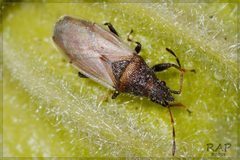
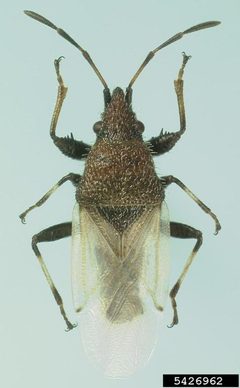
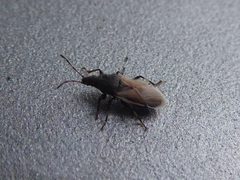
Oxycarenus hyalinipennis, commonly known as the cotton , is a small seed-feeding true in the Oxycarenidae. It is a pest of Malvaceae, with Gossypium (cotton) as its preferred . The is native to the Mediterranean region and Africa but has expanded its range to the Caribbean in recent decades. It completes three to four per year under favorable conditions.
Pronunciation
How to pronounce Oxycarenus hyalinipennis: /ˌɒksɪˈkɛːrɛnəs hɑɪˌlɪnɪˈpɛnɪs/
These audio files are automatically generated. While they are not always 100% accurate, they are a good starting point.
Identification
Distinguished from other Oxycarenus by the combination of: black body with hyaline (translucent) wings; yellowish-whitish ; partially pale yellow second antennal segment; and brown tibiae with yellow-white band. The small size (under 5 mm) and association with cotton seeds are additional diagnostic cues. Nymphs are recognizable by their pink to red , contrasting with black .
Images
Habitat
Agricultural and natural where Malvaceae plants occur. Primarily associated with cotton fields, but also found on wild malvaceous plants. In Turkey, studied in cotton fields in the Çukurova region. Requires warm climates for multiple .
Distribution
Widespread across Southern Europe (Bosnia and Herzegovina, Bulgaria, Croatia, France, Greece, Italy, Portugal, Spain, former Yugoslavia, Albania), the Afrotropical realm, the (including Brazil and Paraguay), and the (Bangladesh, Burma, Cyprus, India, Iran, Iraq, Jammu & Kashmir, Kampuchea, Laos, Pakistan, Philippines, Saudi Arabia, Sri Lanka, Syria, Turkey, Vietnam, Yemen). in the Caribbean region, with range expansion documented over the last three decades. Present in the United States (conterminous 48 states).
Seasonality
Active year-round in suitable climates. In temperate regions, multiple occur during the growing season. Generation time approximately 20 days under favorable conditions, with three to four generations per year reported.
Diet
Specialized seed-feeder, primarily on Malvaceae. Documented include: Gossypium (cotton, preferred host), Hibiscus, Sida, Abutilon, Cola, Eriodendron, Malva, Sphaeralcea, Pavonia, Dombeya, Sterculia, and Triumfetta. Hibiscus cannabinus (Deccan hemp) seeds supported optimal larval development and in laboratory studies. Feeding and oviposition are almost entirely restricted to seeds; larvae cannot develop on cotton seedlings (15–20 days old).
Host Associations
- Gossypium spp. - primary Preferred ; major pest of cotton seeds
- Hibiscus cannabinus - Optimal for larval development and
- Hibiscus spp. - Documented
- Sida spp. - Documented
- Abutilon spp. - Documented
- Malva spp. - Documented
- Pavonia spp. - Documented
- Dombeya spp. - Documented
- Sterculia spp. - Documented
- Triumfetta spp. - Documented
- Cola spp. - Documented
- Sphaeralcea spp. - Documented
- Eriodendron spp. - Documented
Life Cycle
Females lay approximately 20 . Development includes five nymphal instars. time approximately 20 days. Three to four generations per year under favorable conditions. Nymphs have pink to red , transitioning to black coloration.
Behavior
Aggregates on seeds of plants. within Malvaceae but shows host preference hierarchy. Laboratory studies indicate inability to complete development on young cotton seedlings, restricting feeding to mature seeds.
Ecological Role
Pest causing economic damage to cotton and other malvaceous crops. Serves as prey for diverse predatory including Coleoptera (9 species), Hemiptera (3 species), Neuroptera (1 species), and Araneae (4 species) in Turkish cotton fields. No significant specific -prey relationships documented.
Human Relevance
Major agricultural pest of cotton, causing economic losses in Mediterranean, African, and expanding ranges. Subject of resistance studies; have developed resistance to spirotetramat (2333-fold in laboratory selection) and imidacloprid, with associated costs. Transcriptome sequencing has been performed to characterize , nymphs, and . Management complicated by year-round activity and multiple .
Similar Taxa
- Other Oxycarenus speciesSimilar size, body shape, and hyaline wing characteristics. Distinguished by specific color patterns: O. hyalinipennis has black body with yellowish-whitish and partially pale second antennal segment.
More Details
Insecticide resistance
Laboratory selection for spirotetramat resistance produced 2333-fold in 21 ; resistance proved unstable without continued selection. costs associated with resistance include reduced nymphal survival, , hatching, and net reproductive rate. Similar fitness costs documented for imidacloprid resistance.
Transcriptome resources
Transcriptome sequence dataset available characterizing , nymphs, and , published 2026 (PMC12915258).
Taxonomic note
Authority sometimes cited as (, 1843) with basionym Aphanus hyalinipennis, or as (Costa, 1847). placement has shifted from Lygaeidae to Oxycarenidae in modern classifications.
Sources and further reading
- BugGuide
- Wikipedia
- GBIF taxonomy match
- iNaturalist taxon
- NCBI Taxonomy
- Aphytis Project Final Report | Entomology Research Museum
- Primary Type List | Entomology Research Museum
- Oxycarenus hyalinipennis . [Distribution map].
- A new host plant of the cotton seed bugs Oxycarenus hyalinipennis (COSTA), in Egypt
- Adana İlinde pamukta zararlı Çiğit emici böceği, Oxycarenus hyalinipennis (Costa) (Hemiptera: Lygaeidae) ile birlikte saptanan avcı arthropoda türleri ve popülasyon değişimleri Predatory arthropod species associated with the cotton seed bug, Oxycarenus hyalinipennis (Costa) (Hemiptera: Lygaeidae), and their population changes in cotton in Adana Province, Turkey
- Fitness costs in Oxycarenus hyalinipennis Costa (Hemiptera: Lygaeidae) associated with laboratory-selected resistance to imidacloprid
- Stability and fitness cost associated with spirotetramat resistance in Oxycarenus hyalinipennis Costa (Hemiptera: Lygaeidae)
- Studies on the Host Preference of the Cotton Seed Bug Oxycarenus hyalinipennis Costa (Lygaeidae: Hemiptera)
- A transcriptome sequence dataset characterizing eggs, nymphs and adults of Oxycarenus hyalinipennis, the cotton seed bug.