
Oxycarenidae
Stål, 1862
Genus Guides
7is a of true bugs in the order Hemiptera, superfamily Lygaeoidea. The family contains at least 20 and more than 140 described with worldwide distribution. Members are primarily associated with plants in the families Malvaceae and Sterculiaceae, with several species recognized as economically significant agricultural pests. The family forms a stable clade within Lygaeoidea based on phylogenetic analyses of mitogenomic data.
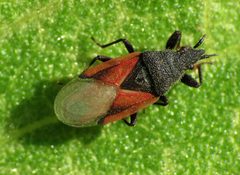
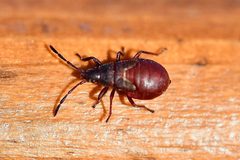
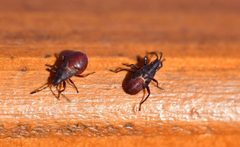
Pronunciation
How to pronounce Oxycarenidae: //ˌɒksɪˈkɛrəˌnɪdiː//
These audio files are automatically generated. While they are not always 100% accurate, they are a good starting point.
Images
Habitat
Associated with herbaceous plants, particularly in agricultural and natural settings. Specific inhabit developing reproductive structures of plants; for example, Oxycarenus hyalinipennis occurs inside calyces of Hibiscus sabdariffa near seeds. Crophius scabrosus occupy crowns of bunchgrasses (Panicum virgatum, Schizachyrium scoparium) and have been found on juniper, pine, and composite plants.
Distribution
Worldwide distribution. Documented occurrences include: China (Jiangsu, Hainan, Yunnan provinces), Brazil (Minas Gerais), and the western United States (Kansas, Wyoming, Nebraska, Vermont). Additional records from Denmark and Sweden.
Diet
Phytophagous, feeding primarily on seeds. Oxycarenus feed on seeds of Malvaceae and Sterculiaceae. Specific documentation includes feeding on developing calyces and seeds of Hibiscus sabdariffa.
Host Associations
- Abutilon indicum -
- Hibiscus sabdariffa - roselle; developing calyces and seeds
- Malvaceae - -level association for multiple
- Sterculiaceae - -level association
- Juniperus - associationCrophius scabrosus only; not confirmed as nymphal
- Pinus - associationCrophius scabrosus only; not confirmed as nymphal
- Panicum virgatum - associationCrophius scabrosus common in crowns; mating observed
- Schizachyrium scoparium - associationCrophius scabrosus common in crowns
- Artemisia - potential suggested for Crophius scabrosus nymphal development but not confirmed
Life Cycle
Development occurs on plants with individuals observed at various developmental stages in protected plant structures. For Oxycarenus hyalinipennis, all life stages occur primarily inside developing calyces near seeds. Nymphal stages of Crophius scabrosus have not been found despite extensive fieldwork, indicating that true host plants supporting complete development may differ from association plants.
Behavior
Some inhabit concealed locations within plants; Oxycarenus hyalinipennis occurs inside calyces, making detection difficult and easily misdiagnosed as fungal . of Crophius scabrosus occupy exposed positions in grass crowns and on diverse plants.
Ecological Role
Economically significant agricultural pests that inflict substantial damage to cotton and other mallow crops. Damage includes translucent spots progressing to darkened cracks, deformations, , fruit abortion, and weight loss, rendering products unmarketable.
Human Relevance
Several are recognized as pests of cultivated Malvaceae. Oxycarenus hyalinipennis (cotton seed bug) causes damage to cotton and roselle (Hibiscus sabdariffa), with the first Brazilian record on roselle documented in 2024. Damage to roselle calyces renders the primary commercial product unmarketable. Monitoring is recommended to prevent crop losses.
Misconceptions
Damage caused by Oxycarenus hyalinipennis on Hibiscus sabdariffa was initially misdiagnosed as fungal due to the concealed feeding location inside calyces; correct identification required post-harvest inspection.
More Details
Mitogenomic characteristics
Mitogenomes of Oxycarenus contain 37 genes (13 protein-coding genes, 22 tRNAs, 2 rRNAs, control region) with typical Lygaeoidea features and A+T biased composition.
Taxonomic stability
Phylogenetic analyses confirm forms a stable clade within Lygaeoidea.
Sources and further reading
- BugGuide
- Wikipedia
- GBIF taxonomy match
- iNaturalist taxon
- NCBI Taxonomy
- Catalogue of Life
- New distribution records and plant associations for Crophius scabrosus (Uhler, 1904) (Hemiptera: Lygaeoidea: Oxycarenidae)
- First record of Oxycarenus hyalinipennis (Costa, 1847) (Hemiptera: Oxycarenidae) on Hibiscus sabdariffa L. (Malvales: Malvaceae) in Brazil and characterization of plant injuries
- The redescription and complete mitogenomes of two Oxycarenus species (Hemiptera, Oxycarenidae) and phylogenetic implications.