
Neacoryphus bicrucis
(Say, 1825)
Whitecrossed seed bug, Ragwort seed bug, White-crossed seed bug
Neacoryphus bicrucis is a seed-feeding true (Hemiptera: Lygaeidae) commonly known as the whitecrossed or ragwort seed bug. The is specialized on Senecio species as plants, from which it sequesters that render it distasteful to some . It exhibits complex territorial and mating centered on host plant patches, with males defending high- areas where females preferentially oviposit. The species shows pronounced in behavior: females conditionally histolyze flight muscles based on resource availability, while males retain flight capability throughout life. It has a broad distribution across the Americas and has been introduced to Oceania.
Pronunciation
How to pronounce Neacoryphus bicrucis: /niːəˈkɔːrɪfəs baɪˈkruːsɪs/
These audio files are automatically generated. While they are not always 100% accurate, they are a good starting point.
Identification
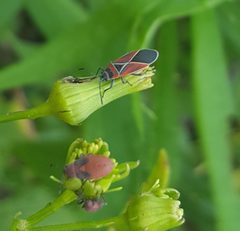
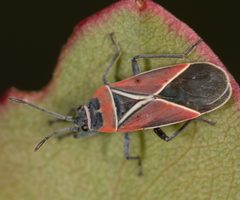
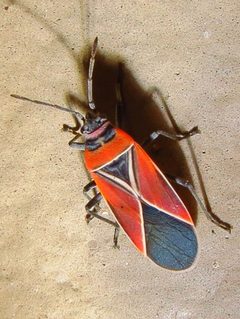
The "whitecrossed " refers to a distinctive white cross-shaped marking on the surface. As a member of Lygaeidae, it has the typical elongate-oval body form and with membranous portions characteristic of seed bugs. Specific diagnostic features distinguishing it from and similar lygaeids are not documented in available sources.
Images
Habitat
Associated with patches of Senecio plants, particularly in areas of high host plant . Documented from granite outcrops, old fields on coastal plains, piedmont regions, and Blue Ridge Mountains in Georgia, USA. Also recorded from Illinois sand prairie. use is strongly density-dependent, with most numerous in large host plant patches and areas of highest plant density within patches.
Distribution
Native to the Americas with records from USA, Guatemala, Nicaragua, Panama, Brazil, Colombia, French Guiana, and Venezuela. Introduced to Oceania (Hawaii). Present in Central America, North America, and South America.
Diet
Specialized seed-feeder utilizing only Senecio as plants. Feeds on seeds of Senecio smallii and other Senecio spp. reared on alternative hosts such as sunflower seeds (Helianthus annuus) lack defensive compounds and are palatable to .
Host Associations
- Senecio smallii - primary Source of
- Senecio spp. - primary Exclusive plants across multiple Georgia
Life Cycle
stage followed by nymphal development on plants. marks transition to reproductive phase. Females may undergo muscle histolysis shortly after eclosion when food and mates are abundant, shifting resources to . possible under short-day . Oviposition occurs preferentially in areas of high host plant .
Behavior
Males establish and patrol small territories composed of plants, expelling rival males and unreceptive females. Territory quality correlates with host plant and female density; larger males aggressively exclude smaller males from prime territories, resulting in higher mating frequency. Courtship is aggressive and resembles territorial . Males remain longer in patches with higher host plant density and where they have recently mated. Long-distance occurs by at high altitudes; flight tendency increases in males under food or mate deprivation. Starved individuals can survive over one month with minimal decline in flight ability.
Ecological Role
seed of Senecio, potentially influencing plant through seed consumption. Chemical defense through sequestered alkaloids creates predator-prey interactions of variable outcome: unpalatable to green anole lizards (Anolis carolinensis) but palatable to Fowler's toads (Bufo woodhousei fowleri).
Similar Taxa
- Other LygaeidaeSimilar body plan; distinguished by plant specificity and white cross marking
- Other Neacoryphus species likely overlap in distribution; specific diagnostic characters not documented
More Details
Chemical Defense
Sequesters from Senecio plants, which may cause distastefulness to green anole lizards. reared on non-host plants lack this defense.
Flight Physiology
Sex-dimorphic muscle investment represents a trade-off between and . Females show plastic response to environmental cues; males maintain flight capability regardless of conditions.
Sources and further reading
- BugGuide
- Wikipedia
- GBIF taxonomy match
- iNaturalist taxon
- NCBI Taxonomy
- Catalogue of Life
- Host plant toxins and unpalatability of Neacoryphus bicrucis (Hemiptera: Lygaeidae)
- Host plant density and territorial behavior of the seed bug, Neacoryphus bicrucis (Hemiptera: Lygaeidae)
- Relations between environment, migration and reproduction in a seed bug, Neacoryphus bicrucis (Say) (Heteroptera: Lygaeidae)
- Spatial and Temporal Density Dependence of Host Plant Patch Use by the Ragwort Seed Bug, Neacoryphus Bicrucis (Hemiptera: Lygaeidae)
- The cost of sexual coercion and heterospecific sexual harassment on the fecundity of a host-specific, seed-eating insect ( Neacoryphus bicrucis )
- Oviposition site preference inNeacoryphus bicrucis (Hemiptera: Lygaeidae): Responses to the density and dispersion of a single host-plant species