
Neacoryphus
Scudder, 1965
Species Guides
1- Neacoryphus bicrucis(Whitecrossed seed bug)
Neacoryphus is a of seed bugs in the Lygaeidae, established by Scudder in 1965. The genus contains approximately five to seven described , with Neacoryphus bicrucis being the most extensively studied. Members of this genus are seed-feeding insects with documented chemical defense mechanisms and complex territorial .
Pronunciation
How to pronounce Neacoryphus: /niːəˈkɔrɪfəs/
These audio files are automatically generated. While they are not always 100% accurate, they are a good starting point.
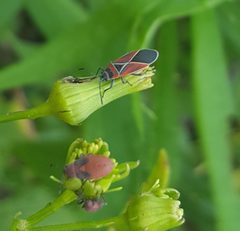
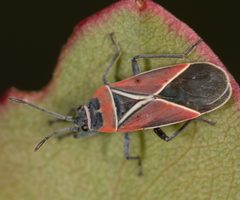
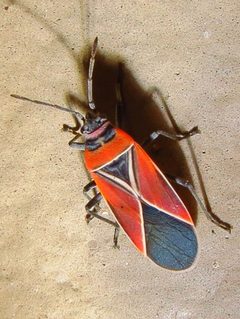
Images
Habitat
Large plant patches with high plant ; granite outcrops and old fields in coastal plain, piedmont, and montane regions.
Diet
Seeds of plants.
Host Associations
- Senecio - plantMultiple Senecio utilized across Georgia ; females preferentially oviposit in areas of high plant
- Senecio smallii - plantSource of sequestered for chemical defense
- Helianthus annuus - laboratory food sourceSunflower seeds used in rearing experiments; insects reared on sunflower lack defensive alkaloids and are palatable to
Behavior
Males patrol small territories composed of plants and aggressively expel other males and unreceptive females. Larger males exclude smaller males from high-quality territories where host plants and females are most dense. Courtship is aggressive and resembles territorial . Males remain longer in areas with higher host plant and tend to stay where they have recently mated. Both sexes migrate by at great altitudes and can disperse over long distances. Flight muscle histolysis is environmentally plastic: females with ample food and mates histolyze flight muscles soon after and fly little, while food scarcity maintains high flight ability. Most males fly throughout life, with flight tendency enhanced by lack of food or mates.
More Details
Chemical Defense
Neacoryphus bicrucis sequesters from Senecio plants, rendering it distasteful to such as the green anole lizard (Anolis carolinensis). Insects reared on non-host plants lacking these alkaloids are palatable to predators.
Reproductive Trade-offs
production in females becomes a linear function of the logarithm of food when food falls below a threshold. Females retain potential under lack of mates or -inducing .
Sources and further reading
- BugGuide
- Wikipedia
- GBIF taxonomy match
- iNaturalist taxon
- NCBI Taxonomy
- Catalogue of Life
- Host plant toxins and unpalatability of Neacoryphus bicrucis (Hemiptera: Lygaeidae)
- Host plant density and territorial behavior of the seed bug, Neacoryphus bicrucis (Hemiptera: Lygaeidae)
- Relations between environment, migration and reproduction in a seed bug, Neacoryphus bicrucis (Say) (Heteroptera: Lygaeidae)
- Spatial and Temporal Density Dependence of Host Plant Patch Use by the Ragwort Seed Bug, Neacoryphus Bicrucis (Hemiptera: Lygaeidae)
- The cost of sexual coercion and heterospecific sexual harassment on the fecundity of a host-specific, seed-eating insect ( Neacoryphus bicrucis )