
Lygaeus analis
Dallas, 1852
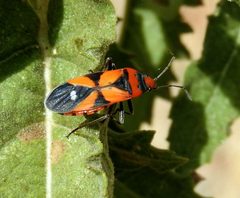
Lygaeus analis is a in the Lygaeidae, distributed from Mexico through Central America to tropical South America. The belongs to a that includes several milkweed-associated , though specific ecological details for L. analis itself remain poorly documented. It is a true bug with typical lygaeid , but published studies have not examined its in detail.
Pronunciation
How to pronounce Lygaeus analis: /laɪˈdʒiːəs əˈnælɪs/
These audio files are automatically generated. While they are not always 100% accurate, they are a good starting point.
Identification
Identification of Lygaeus analis requires examination of genitalic structures and detailed comparison with . The lacks the diagnostic markings used to distinguish the North American milkweed bugs L. kalmii (red basal spot or vertical bar on head) and L. turcicus (Y-shaped marking on head). Geographic distribution provides a useful initial filter: L. analis occurs in Mexico, Central America, and tropical South America, whereas L. kalmii and L. turcicus are primarily North American.
Images
Distribution
Mexico; Central America (Guatemala, Panama); tropical South America
Similar Taxa
- Lygaeus kalmiiShares and general body plan; distinguished by red basal spot or vertical bar on , and restricted to North America and adjacent southern Canada
- Lygaeus turcicusShares and general body plan; distinguished by Y-shaped marking on and few or no white markings on black of forewing, with North American distribution
More Details
Data limitations
Published biological and ecological information for Lygaeus analis is extremely sparse. Most detailed studies of Lygaeus , diet, and chemical have focused on the North American species L. kalmii and L. turcicus. The provided sources discuss L. kalmii extensively but do not contain specific information about L. analis. The GBIF and iNaturalist records confirm taxonomic validity and geographic range but do not provide behavioral or ecological data.
Sources and further reading
- BugGuide
- Wikipedia
- GBIF taxonomy match
- iNaturalist taxon
- Catalogue of Life
- Bugs in orange and black: A spooky Halloween trick or treat for predators - Small and large milkweed bugs, 'Lygaeus kalmii' and 'Oncopeltus fasciatus' — Bug of the Week
- Bugs in orange and black: A spooky Halloween trick for predators, Small and large milkweed bugs, Lygaeus kalmii and Oncopeltus fasciatus — Bug of the Week
- Bug Eric: Small Milkweed Bug