
Metacanthus multispinus
(Ashmead, 1887)
Green Stilt Bug
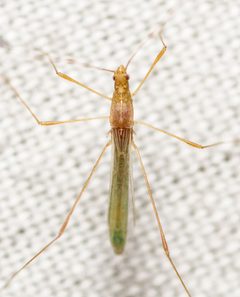
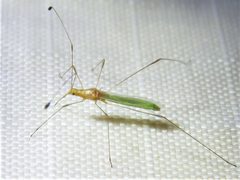
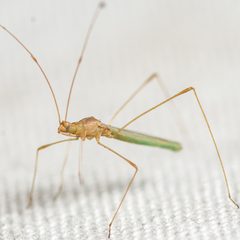
Metacanthus multispinus is a stilt bug in the Berytidae, commonly known as the Green Stilt Bug. It has a broad distribution across the Americas, ranging from the southern United States through Mexico, Central America, and into northern South America. The is characterized by the elongated, slender legs typical of stilt bugs, which elevate the body above the substrate.
Identification
Distinguished from other stilt bugs by the combination of green coloration and multiple spines on the body or legs, as indicated by the name. The Metacanthus is separated from other berytid genera by antennal and leg spine characteristics; M. multispinus specifically can be identified by spine counts and distribution patterns.
Images
Appearance
A slender, elongate true with extremely long, thin legs that give it a stilt-like appearance. Body is green in color. are long and thread-like. The specific epithet 'multispinus' refers to multiple spines, likely on the legs or body.
Distribution
Found from the southern United States (Alabama, Arizona, Arkansas, California, Colorado, District of Columbia, Florida, Georgia, Iowa, Indiana, Kansas, Louisiana, Maryland, Mississippi, Missouri, Nebraska, New Jersey, New Mexico, North Carolina, Oklahoma, Oregon, Pennsylvania, South Carolina, Texas, Utah) south through Mexico and Central America to Colombia and Venezuela in South America. Also recorded from the Netherlands Antilles in the Caribbean.
Similar Taxa
- Other Metacanthus speciesShare the same and general stilt bug ; require careful examination of spine patterns and antennal segment proportions for separation.
- Other Berytidae genera (e.g., Berytinus, Neoneides)Similar elongated body form and long legs; differ in antennal structure, spine arrangement, and body proportions.
More Details
Taxonomic History
First described by Ashmead in 1887. The has undergone taxonomic revision within the Metacanthus, which contains multiple species across the New World.
iNaturalist Observations
The has accumulated over 335 research-grade observations on iNaturalist, indicating it is encountered with moderate frequency by naturalists in its range.