
Notonecta montezuma
Kirkaldy, 1897
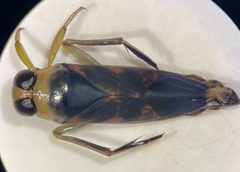
Notonecta montezuma is a of backswimmer in the Notonectidae. It is an aquatic true found in North and Middle America. Like other backswimmers, it swims upside down using its long, oar-like hind legs. The species is part of the Notonecta, which contains backswimmers that are generally larger than water boatmen and more commonly encountered in open water .
Pronunciation
How to pronounce Notonecta montezuma: /ˌnoʊtəˈnɛktə ˌmɒntɪˈzuːmə/
These audio files are automatically generated. While they are not always 100% accurate, they are a good starting point.
Identification
Notonecta montezuma can be distinguished from water boatmen ( Corixidae) by its triangular cross-section when viewed from front to back, with a keel-like surface. Unlike the flattened water boatmen, backswimmers have a boat-shaped profile adapted for rapid upside-down swimming. The front legs are short and unmodified, lacking the spoon-shaped tarsal segments found in water boatmen. The rostrum is four-segmented and free, not to the as in Corixidae.
Images
Habitat
Found in freshwater aquatic environments including ponds, slow-moving streams, and artificial water bodies such as fountains and swimming pools. Frequents open water rather than bottom substrates.
Distribution
North America and Middle America.
Behavior
Swims upside down using long hind legs modified for rowing. Surfaces to take in air, using hydrophobic hairs around the rear end and along the middle of the abdominal underside to trap air for underwater respiration. are capable of and can disperse between water bodies.
Human Relevance
May occur in swimming pools and artificial water features, where they can be mistaken for water boatmen. Can deliver a painful bite if handled, though not typically aggressive.
Similar Taxa
- Corixidae (water boatmen)Superficially similar oval body shape and aquatic , but water boatmen are flattened top-to-bottom, have spoon-shaped front tarsal segments for feeding, possess a rostrum, and frequent bottom substrates rather than open water.
- Notonecta glauca and other Notonecta speciesShare the and general backswimmer ; specific distinctions between Notonecta require closer examination of coloration and markings, which are not documented for N. montezuma in available sources.
Sources and further reading
- BugGuide
- GBIF taxonomy match
- iNaturalist taxon
- Grasshoppers of Colorado
- Grasshoppers of Colorado
- UC Davis-Based Projects: To Bee or Not to Bee? | Bug Squad
- Diversity of Bugs at Bohart Museum of Entomology | Bug Squad
- Big, black (and red), and beautiful! | Beetles In The Bush
- Bug Eric: Backswimmer or Water Boatman?