
Lethocerus medius
(Guérin-Méneville, 1857)
giant water bug
Lethocerus medius is a giant water bug in the Belostomatidae, distinguished by its substantial size and unique parental care . Males reach 49–58 mm, while females are larger at 62–63 mm. Unlike related in the Belostomatinae that on their backs, males of this species exhibit postzygotic parental care by guarding eggs deposited on objects above the water surface, moistening them, shading them, and protecting them from . This species occurs across a broad range from the southern United States through Mexico to Central America and throughout the Caribbean.
Pronunciation
How to pronounce Lethocerus medius: //lɛˈθoʊsɛrəs ˈmiːdiəs//
These audio files are automatically generated. While they are not always 100% accurate, they are a good starting point.
Identification
Distinguished from other giant water bugs by geographic range overlapping with Lethocerus uhleri in the southwestern United States and Mexico, from which it may be separated by subtle morphological differences in male genitalia and overall size. The ' unique male parental care —guarding on objects above water rather than eggs on the back—distinguishes it from Belostomatinae species such as Abedus and Belostoma. Within Lethocerinae, the specific egg-guarding posture and preferences may aid identification where ranges overlap with .
Images
Appearance
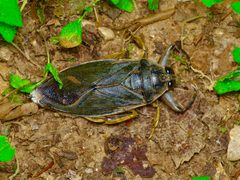
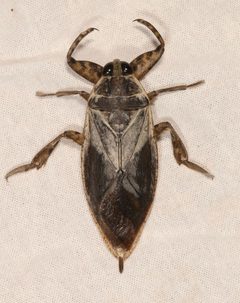
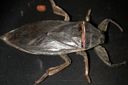
Large, robust aquatic insect with males measuring 49–58 mm and females 62–63 mm in length. Body dorsoventrally flattened with forelegs adapted for grasping prey. Coloration typically brownish, providing camouflage in aquatic environments.
Habitat
Freshwater aquatic including ponds, streams, and pools. The has been documented in mesquite/acacia scrub environments in the southwestern United States, suggesting adaptability to semi-arid regions where permanent or semi-permanent water sources occur.
Distribution
Central America from northern Panama north through Mexico to southern Arizona, New Mexico, and Texas in the United States. Also occurs on Caribbean islands including Cuba, Jamaica, the Cayman Islands, and the Bahamas.
Seasonality
have been observed at ultraviolet and mercury-vapor lights in July in southeastern Arizona, suggesting summer activity in at least part of the range. Specific seasonal patterns across the full geographic range remain undocumented.
Behavior
Males provide postzygotic parental care, a rare phenomenon within the . After females oviposit on objects above the water surface, males remain with the eggs, moistening them, shading them from sun exposure, and protecting them from by resting on top of the egg mass. This sets L. medius apart from other Lethocerus in the Lethocerinae. are attracted to artificial light sources at night.
Ecological Role
As a large predatory aquatic insect, likely functions as an apex in freshwater . The documented parental care may enhance offspring survival in variable aquatic environments.
Human Relevance
Attracted to ultraviolet and mercury-vapor lights, making it susceptible to collection during insect surveys. No specific economic or medical significance documented, though related giant water bugs can deliver painful defensive bites.
Similar Taxa
- Lethocerus uhleriOverlapping range in southwestern United States and Mexico; requires examination of male genitalia for definitive separation
- Belostoma spp.Similar and general appearance, but distinguished by back- (female carries on back) versus above-water egg guarding in L. medius
- Lethocerus americanusLarger with eastern North American distribution; L. medius is smaller and occurs in different geographic region
More Details
Parental Care Significance
The male -guarding in L. medius represents an evolutionary intermediate between the ancestral state of no parental care and the derived back- behavior of Belostomatinae. This makes the of particular interest for studies of parental care evolution in insects.
Light Trapping
Documented attraction to combined ultraviolet and mercury-vapor lighting setups in mesquite/acacia scrub in southeastern Arizona, suggesting or foraging .