
Lethocerus americanus
(Leidy, 1847)
American giant water bug, electric light bug, toe biter, fish killer
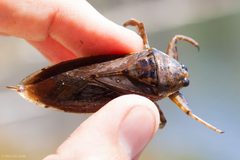
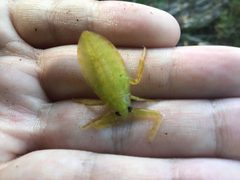
Lethocerus americanus is a large aquatic true native to southern Canada and the northern United States. measure 5–6 cm in length, with females averaging larger than males. The is a in freshwater and is known for its powerful bite, which it uses to subdue prey and defend itself. It is attracted to electric lights at night, earning it the 'electric light bug.'
Pronunciation
How to pronounce Lethocerus americanus: //ˌleθoʊˈsɛrəs əˌmɛrɪˈkɑːnəs//
These audio files are automatically generated. While they are not always 100% accurate, they are a good starting point.
Identification
Distinguished from Benacus griseus by grooves on the fore that accommodate the tibiae when folded tightly. Very similar to Lethocerus uhleri, requiring close examination for separation. The large size (5–6 cm), flattened oval body, and forelegs are distinctive among North American aquatic insects.
Images
Habitat
Freshwater including ponds, marshes, lake edges, and slow-moving streams and creeks. have been observed in run-of-river environments, including areas near trout hatcheries. adults burrow under mud and leaf matter.
Distribution
Native to southern Canada and the United States north of approximately 35°N latitude. Records from Vermont and other northern states; southern limit around 35°N with other Lethocerus occurring farther south.
Seasonality
active during warmer months. Winter drift observed from mid-October through March when water temperatures drop below 4°C, suggesting this period represents a post-final- phase. Adults overwinter by burrowing under mud and leaf matter.
Diet
feeding on other insects, small crustaceans (including crayfish), tadpoles, frogs, snails, and small fish. Prey is captured with forelegs and injected with digestive toxins through a retractable ; prey is allowed to digest externally for 10–15 minutes before consumption.
Life Cycle
are laid on vegetation at the water's edge and may be guarded by . Nymphs hatch approximately two weeks later. Females lay about 150 or more eggs in their lifetime, alternating between feeding and mating. Few nymphs survive to maturity due to and . Adults survive winter by burrowing under mud and leaf matter.
Behavior
Swims using hind legs; captures prey with forelegs. Multiple individuals have been observed hunting and sharing the same prey animal. When disturbed in water, uses speed to break away and relies on camouflage for concealment. On land, initially attempts escape or plays dead; if agitation continues, raises fore limbs and hind quarters in defensive posture and may deliver painful bite. Attracted to electric lights while flying at night. Winter drift (mid-October through March) appears to serve as post-final- mechanism.
Ecological Role
Apex in freshwater , controlling of insects, crustaceans, amphibians, and small fish. Winter drift may contribute to and among populations.
Human Relevance
Known as 'toe biter' due to painful bite if handled or disturbed; prefers to avoid humans when possible. Attracted to electric lights, sometimes entering human dwellings. Bite is defensive, not medically significant beyond pain and local reaction.
Similar Taxa
- Lethocerus uhleriVery similar in appearance; requires detailed examination for reliable separation.
- Benacus griseusDistinguished by the absence of grooves on fore to accommodate folded tibiae; L. americanus possesses these grooves.
More Details
Winter Drift
A study of over 2,100 drifting in a Wisconsin Lake Superior tributary found peak drift from mid-October through March when water temperatures were below 4°C. This timing is hypothesized to minimize risks. Sex ratio was approximately 1:1 with interannual variation.
Chromosomal Features
Male germ contain eight spermatogonial with an XY pair identifiable at every step in maturation. Three large atelomitic ring tetrads form during .
Sources and further reading
- BugGuide
- Wikipedia
- GBIF taxonomy match
- iNaturalist taxon
- NCBI Taxonomy
- Catalogue of Life
- Sharon Lawler: Professor Emerita, Compassionate Human Being | Bug Squad
- Congratulations, UC Davis Linnaean Games Team: National Champs! | Bug Squad
- How a giant water bug reached the island of Cyprus
- Research Showcases Best and Brightest Fathers of the Insect World
- So, how big do insects get? - Buglife Blog - Buglife
- Bug Eric: "Is it poisonous?"
- Winter Drift, Sex Ratios, and Size Distribution of Giant Water Bugs, <i>Lethocerus Americanus</i>, (Heteroptera: Belostomatidae) in a Lake Superior Tributary
- Spermatogenesis in the Belostomatidae. II. The chromosomes and cytoplasmic inclusions in the male germ cells of Belostoma flumineum Say, Lethocerus americanus Leidy, and Benacus griseus Say