
Abedus immaculatus
(Say, 1832)
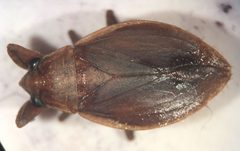
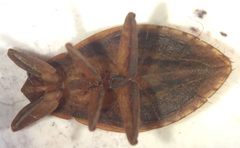
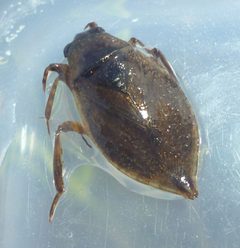
Abedus immaculatus is a of giant water bug in the Belostomatidae. It is the only Abedus species found in the eastern United States, with a range extending throughout Florida north into Georgia and west along the Gulf Coast to Mississippi. measure 13–14 mm in length, making them the smallest species in the Abedus and the smallest belostomatid in the United States. The species is the sole member of the subgenus Microabedus. It is locally common in parts of the Everglades, where it occurs in shorter hydroperiod sites.
Pronunciation
How to pronounce Abedus immaculatus: /əˈbeɪ.dəs ɪˌmæk.jəˈleɪtəs/
These audio files are automatically generated. While they are not always 100% accurate, they are a good starting point.
Identification
are distinguished from other Abedus by their small size (13–14 mm), making them the smallest in the . They are the only Abedus species occurring in the eastern United States, which provides geographic separation from found in western North America. The species is further distinguished by being the sole member of the subgenus Microabedus.
Images
Habitat
Associated with freshwater aquatic , particularly shorter hydroperiod sites in the Everglades and similar wetland systems throughout its range.
Distribution
Eastern United States: throughout Florida, north into Georgia, and west along the Gulf Coast to Mississippi.
Similar Taxa
- Abedus herbertiLarger western ; A. immaculatus distinguished by smaller size and eastern distribution
- Belostoma speciesOther giant water bugs in same ; A. immaculatus distinguished by -level characters and geographic range
More Details
Taxonomic history
Originally described by Thomas Say in 1832 as Belostoma fluminea var. immaculata. Redescribed as A. cantralli in 1950, with the two names synonymized to A. immaculatus in 1950.
Conservation status
Locally common in parts of the Everglades, though wetland loss may affect .
Sources and further reading
- BugGuide
- Wikipedia
- GBIF taxonomy match
- iNaturalist taxon
- Eating Insects at the Bohart Museum of Entomology | Bug Squad
- Would You Eat a Chocolate-Covered Cicada? | Bug Squad
- GBCT Beetle #1: Crossidius hirtipes immaculatus | Beetles In The Bush
- Bug Eric: January 2016
- September | 2022 | Beetles In The Bush
- Great Basin | Beetles In The Bush | Page 2