
Abedus herberti
Hidalgo, 1935
toe biter, ferocious water bug
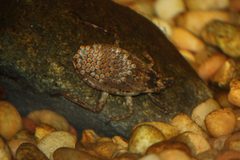
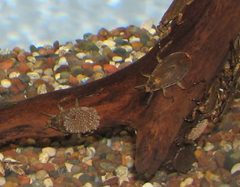
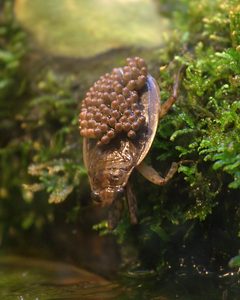
Abedus herberti is a flightless giant water bug native to streams in the southwestern United States and northwestern Mexico. measure 2–4 cm and are known for male parental care, where females attach to the male's back and he carries them until hatching. The is a sit-and-wait that captures prey with front legs and subdues it with venomous saliva. It has been documented in zoo displays and is consumed as food in some cultures, marketed as "Mexican caviar."
Pronunciation
How to pronounce Abedus herberti: /æˈbiːdəs ˈhɜːrbərtaɪ/
These audio files are automatically generated. While they are not always 100% accurate, they are a good starting point.
Identification
Flightless; lacks functional wings. Distinguished from other giant water bugs by its geographic restriction to the southwestern United States and northwestern Mexico. Males carrying masses on their backs are readily identifiable. The egg masses are large and visible, with individual eggs measuring up to 6 × 2 mm.
Images
Habitat
Streams in highland and desert regions, including pools and runs of intermittent and permanent streams. Occupies freshwater aquatic environments with access to atmospheric air for surface .
Distribution
Arizona, New Mexico, and Utah in the United States; northwestern Mexico.
Seasonality
present year-round; nymphs occur primarily in spring and early summer, suggesting overlapping .
Diet
Sit-and-wait capturing small animals with strong front legs. Prey is stabbed with a that injects saliva containing for extraoral digestion. Prey includes aquatic such as other insects and snails, and small vertebrates including young fish and tadpoles. Small and medium prey are captured alive; larger prey items (≥1.2 cm) are primarily scavenged, except for nymphs which are regularly captured alive.
Life Cycle
are deposited by females onto the surface of males, who carry them for approximately 1–2 weeks until hatching. Eggs measure up to 6 × 2 mm and possess specialized respiratory structures with a network in the upper quarter exposed to air. Nymphs progress through five instar stages before reaching adulthood. are highly cannibalistic toward nymphs; older nymphs cannibalize younger ones. Adults rarely cannibalize other adults.
Behavior
Males exhibit prolonged parental care, carrying on their backs and engaging in surface to facilitate . pumping—rhythmic body movements—enhances oxygen flow to eggs. Males defend eggs against and remove non-viable eggs. Brooding males preferentially position themselves in areas with higher dissolved oxygen. Males may mate with multiple females and carry egg clutches from different females simultaneously. Egg carrying reduces foraging ability and increases risk. The is flightless but may disperse overland between water sources, particularly to escape drought conditions. Bites in self-defense are painful but not medically dangerous.
Ecological Role
in aquatic desert stream .
Human Relevance
Marketed as "Mexican caviar" for human consumption. Frequently displayed in zoos, sometimes alongside the sunburst diving beetle (Thermonectus marmoratus), with which it co-occurs in the wild. Bites when handled, causing pain but no serious medical consequences. Subject of internet hoaxes falsely associating it with lethal viruses and skin disfigurement.
Similar Taxa
- Belostoma spp.Other giant water bugs with male - ; distinguished by different geographic ranges and typically larger size.
- Lethocerus spp.Larger giant water bugs with different reproductive (females deposit on vegetation rather than male back-).
Misconceptions
Internet hoaxes have falsely claimed this spreads lethal viruses and causes skin disfigurement, using manipulated images of hands covered in putty to resemble masses. These claims are entirely fabricated; the species is not medically dangerous to humans beyond a painful defensive bite.
Sources and further reading
- BugGuide
- Wikipedia
- GBIF taxonomy match
- iNaturalist taxon
- NCBI Taxonomy
- Catalogue of Life
- Eating Insects at the Bohart Museum of Entomology | Bug Squad
- Would You Eat a Chocolate-Covered Cicada? | Bug Squad
- Bug Eric: That Internet "Killer Bug" Hoax
- Life History of Abedus Herberti in CentralArizona (Hemiptera: Belostomatidae)
- Male Brooding Behavior of the Water Bug Abedus herberti (Hemiptera: Belostomatidae)
- Respiratory morphology of the Abedus herberti Hidalgo egg chorion (Hemiptera: Belostomatidae)
- Subsurface behaviours facilitate respiration by a physical gill in an adult giant water bug, Abedus herberti
- Overland dispersal and drought-escape behavior in a flightless aquatic insect,Abedus herberti(Hemiptera: Belostomatidae)
- Paternity assurance and altered roles in the mating behaviour of a giant water bug, Abedus herberti (heteroptera: Belostomatidae)