
Leptopodidae
Brullé, 1836
Spiny-legged Bugs
Genus Guides
1is a of true bugs in the infraorder Leptopodomorpha, commonly known as spiny-legged . The family includes approximately 30 described across five , with distribution primarily in the Old World tropics and subtropics. Members are characterized by their association with moist or aquatic microhabitats, including intertidal zones, rock pools, and riparian environments. Recent taxonomic work has expanded documented ranges, particularly in East and Southeast Asia, with new country records from China, Japan, Laos, Thailand, and Vietnam.
Pronunciation
How to pronounce Leptopodidae: //ˌlɛpt.oʊˈpɒd.ɪˌdiː//
These audio files are automatically generated. While they are not always 100% accurate, they are a good starting point.
Identification
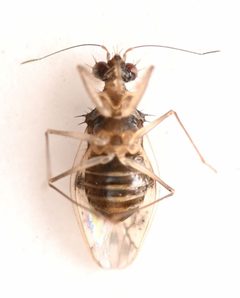
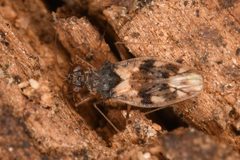
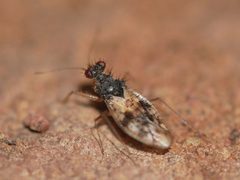
can be distinguished from other Leptopodomorpha by the combination of: fore with distinct spines or teeth (the basis for the "spiny-legged "); body often dorsoventrally flattened; with ocelli present; and 3-segmented. Male genital capsules and parameres are important diagnostic features at level. The superficially resembles Saldidae (shore bugs) but differs in tarsal segmentation and fore leg armature.
Images
Habitat
vary by and . Patapius spinosus occurs in supralittoral zones of sandy beaches and rocky intertidal areas, hiding under stones and in crevices during low tide. Valleriola species inhabit temporary rock pools on granite outcrops and boulders in rainforest and wet sclerophyll forest environments. Leotichius species have been found in xeric habitats, including areas shared with -lion larvae. Leptopus species are associated with riparian zones.
Distribution
Widespread in the Old World tropics and subtropics, with records from: Mediterranean and North African regions; southern Europe; Middle East; Indian subcontinent; Southeast Asia (Laos, Thailand, Vietnam, Cambodia, Indonesia, Philippines); East Asia (China including Hainan Island, Japan); and Australia (Queensland). Patapius spinosus has been introduced to North America and Chile. The 's known range in China has expanded from the Oriental Region to include both Oriental and Palaearctic Regions.
Behavior
Patapius spinosus has been observed hiding under stones and in crevices during low tide in intertidal . Leotichius schuhi shares habitat with larvae of xeric-adapted -lions (Neuroptera), though specific behavioral interactions have not been documented.
Similar Taxa
- SaldidaeBoth are commonly called shore bugs and occupy similar intertidal and moist . Saldidae differ in having 2-segmented and generally lacking the prominent spines on the fore characteristic of .
- LeptosaldidaeAlso placed in Leptopodomorpha; distinguished by various combinations of structure, wing venation, and leg . are more commonly encountered in contemporary faunas.
More Details
Taxonomic diversity
The comprises five : Leptopus, Patapius, Valleriola, Leotichius, and Erianotus. China records four genera and nine ; recent descriptions include Valleriola asiatica from Laos and Hainan Island, and Valleriola bui from Laos and Thailand.
Conservation of specimens
Valleriola wilsonae specimens from temporary rock pools were noted to be difficult to collect alive due to their rapid movement and the ephemeral nature of their .
Sources and further reading
- BugGuide
- GBIF taxonomy match
- iNaturalist taxon
- NCBI Taxonomy
- Catalogue of Life
- Patapius spinosus: First record of Leptopodidae (Heteroptera) from Japan
- Leptopodidae (Insecta: Hemiptera: Heteroptera) of China: key, checklist, and new records
- NOTES ON THE HABITAT AND DISTRIBUTION OF VALLERIOLA WILSONAE DRAKE IN QUEENSLAND (HETEROPTERA: LEPTOPODIDAE)
- A new species of <i>Leotichius</i> Distant (Hemiptera: Heteroptera: Leptopodidae) from Cambodia
- Two new species of Valleriola (Hemiptera: Heteroptera: Leptopodidae) and taxonomic notes on the tribe Leptopodini Brullé, 1836 from East and Southeast Asia