
Patapius spinosus
(Rossi, 1790)
spiny-legged bug
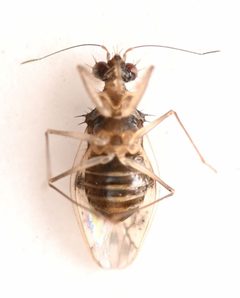
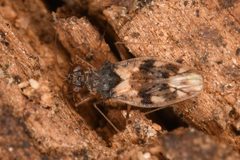
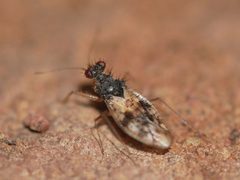
Patapius spinosus is a leptopodid distinguished by its heavily spined body. Native to Mediterranean and Atlantic coasts of Europe and North Africa, it has been introduced to North America, Chile, and Japan. It inhabits supralittoral zones of sandy beaches and rocky coasts.
Pronunciation
How to pronounce Patapius spinosus: //pəˈtæ.pi.əs spaɪˈnoʊ.səs//
These audio files are automatically generated. While they are not always 100% accurate, they are a good starting point.
Identification
Images
Appearance
Body covered with prominent spines. Long and legs relative to body size, characteristic of the Leptopodidae.
Habitat
Supralittoral zone of sandy beaches and coastal rocky shores. Found in intertidal and immediately supratidal environments.
Distribution
Native to Mediterranean and Atlantic coasts of Europe and North Africa. Introduced to North America, Chile, and Japan (first recorded 2002-2004 in Osaka and Kanagawa Prefectures).
Seasonality
have been collected in autumn (October 2002) and spring (April 2004) in Japan.
Behavior
Slow, deliberate movement across vegetation and substrate surfaces. involving transfer of fluid from beak to legs has been observed in related leptopodids.
Similar Taxa
- Jalysus spinosusFormerly confused taxonomically; a stilt bug (Berytidae) with similar name but different , feeding primarily on Panicum grasses and predatory on soft-bodied insects. Patapius spinosus is a leptopodid of coastal with different body form and .
More Details
Taxonomic History
First described by Rossi in 1790. The Japanese records represent either the eastern limit of native distribution or a recent introduction.