
Halobates micans
Eschscholtz, 1822
Common Sea Skater
Halobates micans is a wingless marine water strider and the only pelagic insect member found in the Atlantic Ocean. It is circumglobal in tropical and subtropical seas, living exclusively at the sea-air interface. measure 3.6–4.5 mm with males larger than females. The exhibits remarkable adaptations for open ocean life including water-repellent body hairs, UV-absorbent , and exceptional skating agility. It is the most widespread Halobates species, occurring from approximately 40°N to 40°S in the Atlantic and also present in the Indian and Pacific Oceans.
Pronunciation
How to pronounce Halobates micans: //ˌhæloʊˈbeɪtiːz ˈmaɪkænz//
These audio files are automatically generated. While they are not always 100% accurate, they are a good starting point.
Identification
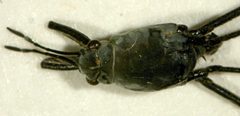
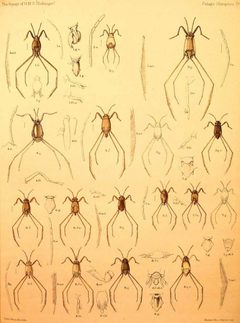
Difficult to distinguish from other Halobates by visual inspection alone. Requires close comparison of appendage segment lengths and male genital segment . Distinguished from coastal Halobates by exclusively pelagic . The only Halobates species occurring in the Atlantic Ocean; co-occurs with H. germanus and H. sericeus in Indian and Pacific Oceans where identification requires expert examination. Dead specimens show legs extended backward; live specimens maintain 'skating' leg position.
Images
Appearance
Small, wingless marine insect with silvery appearance due to air trapped by fine water-repellent body hairs. Body length 3.6–4.5 mm ( to ), with males larger than females and appendages extending beyond body length. Dark grey coloration in ; first-instar nymphs pale brown, nymphs pale-yellow to off-white. Three pairs of legs specialized for different functions: stout front pair with claws for grasping prey, long middle pair with hairs on tibia and first providing propulsive force, rear pair for steering. All legs used for . Typical hemipteran sucking mouthparts with stylets forming feeding tube.
Habitat
Exclusively marine neustonic zone (sea-air interface) of open ocean. Occurs in offshore oligotrophic tropical and subtropical waters, generally beyond 100 m depth isobath. Lower abundance in low-temperature upwelling zones and low-salinity coastal waters. Only occurs near coast when storms blow individuals ashore. Not found in freshwater; less to freshwater than coastal Halobates .
Distribution
Circumglobal in tropical and subtropical seas. Atlantic Ocean: 40°N to 40°S, including Caribbean—the only Halobates present. Indian Ocean: eastern South Indian Ocean (13–18.5°S, 114–121°E). Pacific Ocean: present in warmer offshore waters. Southeastern Brazilian Bight: Cape Frio (22°58'S) to Paraná (27°50'S). Records from Azores, Africa, Australia, and East Pacific.
Seasonality
Active breeding during austral summer (March sampling shows peak nymph and female abundance). Higher capture rates at night (60.2% relative frequency) compared to day (27.7%) and dusk-dawn (12.1%). Generational length exceeds two months; development speed temperature-dependent.
Diet
Young nymphs feed on surface biofilm. Older nymphs and are of zooplankton and floating insects, preferring struggling prey. documented: older individuals prey on younger nymphs but not same-age conspecifics. Large prey items may be shared among several individuals.
Host Associations
- Sargassum spp. - oviposition substratefloating gas vesicles used for -laying; batches of 7–55 eggs per vesicle
- petroleum lumps - oviposition substrateused for -laying at 1.44–1.63 eggs/mm²
- flotsam (seabird feathers, driftwood, plastic) - oviposition substrate also laid on conspecifics
Life Cycle
Wingless at all life stages; complete spent on sea surface. 1 mm long, olive when fresh turning orange after several days. Development up to one month at 20°C. Nymphs hatch using chitinized 'egg-burster' to puncture ; takes approximately 3 minutes. Eggs hatch in synchronized intervals, likely reducing risk. Five nymphal instars before maturity; first two instars most abundant in . Sexes indistinguishable in stages. Pre- individuals sluggish and cease feeding.
Behavior
Maintains 'skating' posture with legs positioned for movement; dead specimens show legs extended backward. Skates at 50–100 cm/s and jumps 10–12 cm vertically. Forms age-segregated or 'patches' to reduce risk. Does not dive voluntarily; can survive submergence up to 2 hours at 31.5°C (longer in cooler, oxygen-rich water). Attracted to artificial light, likely due to prey aggregation at light sources. Net avoidance using well-developed and agility. activity pattern with higher surface presence at night.
Ecological Role
in epineustonic of open ocean. Bioindicator for cadmium distribution and geochemical cycling in Atlantic surface waters; cadmium accumulation correlates with . Indicator of water mass characteristics—abundance correlates with presence of oligotrophic Tropical Water. Serves as prey for seabirds (remains found in bridled tern Sterna anaethetus); coastal specimens preyed upon by songbirds, fish, and lizards.
Human Relevance
Used as biological indicator for heavy metal (cadmium) pollution monitoring in ocean surface waters. Accumulates heavy metals from seawater, providing data on marine . Attraction to ship lights facilitates specimen collection for research. No direct economic importance; occasionally blown ashore by storms where it may attract minor scientific interest.
Similar Taxa
- Halobates germanusOverlaps in Indian and Pacific Oceans; distinguished by appendage segment lengths and male genitalia; H. germanus not found in Atlantic
- Halobates sericeusOverlaps in Pacific Ocean; distinguished by appendage segment lengths and male genitalia
- Halobates sobrinusAnother pelagic of open ocean; distinguished by morphological details requiring expert examination
- Halobates splendensAnother pelagic of open ocean; distinguished by morphological details requiring expert examination
- Coastal Halobates speciesFound near shore; more to freshwater; H. micans only occurs coastally when storm-blown
More Details
Heavy metal bioaccumulation
Pelagic sea skaters accumulate heavy metals from seawater; H. micans specifically used to map cadmium distribution patterns in Atlantic surface waters from 1966–1987
UV protection
contains UV-absorbent compounds as to constant sun exposure in open ocean lacking shade; more opaque than freshwater gerrids
Energy storage
Lipid stores primarily triglycerides (92% in related pelagic ), likely similar in H. micans, adapted for food-limited open ocean environment
Sources and further reading
- BugGuide
- Wikipedia
- GBIF taxonomy match
- iNaturalist taxon
- NCBI Taxonomy
- The Day That The Beetles Invaded the Bohart | Bug Squad
- Abundance and distribution of Halobates micans (Insecta : Gerridae) in the northwest Atlantic
- Occurrence, distribution and abundance of Halobates micans Eschscholtz, 1822 (Heteroptera, Gerridae) along the southeastern Brazilian coast
- The sea-skater Halobates micans: an open ocean bioindicator for cadmium distribution in Atlantic surface waters
- Occurrence and density of Halobates micans (Hemiptera: Gerridae) in the eastern South Indian Ocean
- Comparison of temperature preference for habitat among three species of oceanic sea skaters, <i>Halobates micans</i>,<i> H. germanus</i> and <i>H. sericeus</i>