
Halobates
Eschscholtz, 1822
sea skaters, ocean striders
Species Guides
2- Halobates micans(Common Sea Skater)
- Halobates sericeus(Pacific pelagic water strider)
is a of marine water striders comprising over 40 , representing the only insects known to inhabit the open ocean surface. Five species are truly pelagic, living far from land on calm tropical and subtropical seas, while most species occupy sheltered coastal marine . These insects possess specialized adaptations for life on the high seas, including hydrofuge body hairs, reduced or absent wings, and modified middle legs that function as paddles for propulsion. They are that feed on organisms trapped in the sea surface microlayer, and their unique makes them significant components of the neustonic .
Pronunciation
How to pronounce Halobates: /ˌhæloʊˈbeɪtiːz/
These audio files are automatically generated. While they are not always 100% accurate, they are a good starting point.
Identification
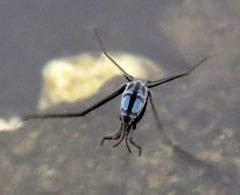
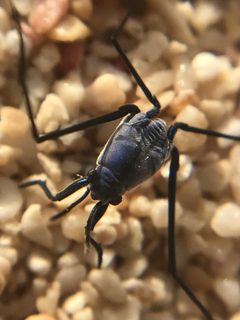
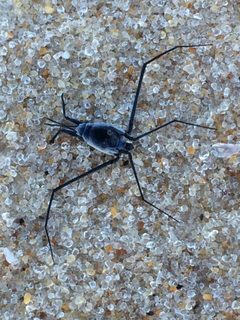
are small insects, with body lengths up to 6.5 mm and widths up to 3 mm, and leg spans reaching at least 15 mm. They are wingless, with long , short front legs adapted for prey capture, long middle legs used for propulsion, and somewhat shorter rear legs for steering. The sexes are similar in general appearance, though males are thinner than females and possess modified genital segments; gravid females may display notably plump . Nymphs resemble miniature . Species-level identification requires examination of characters including interocular width of the , head color markings, relative lengths of fore tarsal segments, mesotibio-tarsal hair fringe, and male genital segment structure and vesical armature.
Images
Habitat
Most inhabit sheltered coastal marine environments, particularly in association with mangroves and other marine vegetation. Five oceanic species—H. micans, H. germanus, H. sericeus, H. splendens, and H. sobrinus—are truly pelagic, living on the open ocean surface far from land. Coastal species are largely restricted to the Indo-Pacific region, with H. robustus occurring in the Galápagos Islands. The generally prefers temperatures of 24–28 °C, is infrequent below 20 °C, and only exceptionally recorded in waters below 15 °C. A single species, H. acherontis, has been documented in rivers up to 70 km upstream from the ocean.
Distribution
Tropical and subtropical marine worldwide. The five pelagic have distinct oceanic distributions: H. germanus, H. sericeus, H. splendens, and H. sobrinus occur in the Indian and/or Pacific Oceans; H. micans has a circumglobal range between approximately 40°N and 40°S and is the only pelagic species found in the Atlantic Ocean and Caribbean. Coastal species are predominantly Indo-Pacific in distribution, with very small ranges for some species restricted to single archipelagos. The Atlantic Ocean lacks coastal species, possibly due to competitive exclusion by the veliid Trochopus.
Diet
Coastal feed primarily on terrestrial insects that have fallen into the water. Oceanic species consume zooplankton and other items from the sea surface microlayer, including floating insects, fish and larvae, and dead jellyfish. Small prey is captured and consumed individually, while larger prey such as small fish may be attacked by groups of three to four individuals. Some species prefer struggling prey, others immobile prey. and older nymphs cannibalize younger nymphs, though generally not their own age class. The diet of newly-hatched nymphs remains unknown; captive specimens have refused food items accepted by older nymphs and adults, suggesting possible feeding on the organic film at the ocean's surface.
Life Cycle
Females lay 1–20 whitish or translucent , each approximately 1 mm long and half as wide. Coastal deposit eggs on rocks, plants, and other structures near the water surface close to shore. Oceanic species attach egg masses to floating objects including cuttlebone, feathers, and in recent decades, plastic debris. Eggs may hatch just above or just below the water surface. Nymphs develop through five instars, resembling miniature throughout development.
Behavior
use a rowing stroke for propulsion, with middle pressed rapidly downward and backward to create circular surface waves that generate forward thrust. This mechanism enables speeds of 1 m per second or faster. They can capture aquatic prey just below the surface with their front legs but do not dive. Oceanic are incapable of diving or seeking shade, resulting in continuous exposure to solar radiation. Some species form groups and exhibit rafting . They can survive storms; coastal species may be blown ashore during severe weather.
Ecological Role
in the neustonic , feeding on organisms concentrated in the sea surface microlayer. Among the most abundant macrofauna in some oceanic regions, with local densities reaching 1 individual per 19 m² in oceanic and 120 individuals per m² in breeding of coastal species. Prey for storm petrels (which actively hunt them, sometimes splashing water to attract or detect them), noddies, other seabirds, and surface-feeding fish.
Human Relevance
Oceanic have been documented laying on floating plastic waste, with one extreme case of approximately 70,000 eggs in 15 layers on a single plastic gallon jug. This utilization of anthropogenic debris may increase breeding surface availability and potentially disrupt marine through expansion. H. micans has been used as a bioindicator for cadmium distribution in Atlantic surface waters. The presents unique research opportunities for materials science, particularly regarding the unknown physical properties that enable H. sericeus to reflect more than 99.9998% of UV radiation at 280 nm wavelength.
Similar Taxa
- AustrobatesClose relative within Gerridae; coastal marine
- AsclepiosClose relative within Gerridae; coastal marine
- TrochopusVeliid water striders that occupy similar coastal mangrove in the Atlantic region where is absent
Sources and further reading
- BugGuide
- Wikipedia
- GBIF taxonomy match
- iNaturalist taxon
- NCBI Taxonomy
- Catalogue of Life
- Biology of Halobates (Heteroptera: Gerridae)
- Biology of Halobates (Heteroptera: Gerridae)
- THE MARINE INSECT HALOBATES GERRIDAE): BIOLOGY, ADAPTATIONS, DISTRIBUTION, AND PHYLOGENY
- Cool coma temperature and oceanographic properties in habitat of oceanic sea skaters,Halobates
- Reconstructing the evolutionary and ecological history of the sea skaters Halobates spp. (Heteroptera: Gerridae)
- The sea-skater Halobates micans: an open ocean bioindicator for cadmium distribution in Atlantic surface waters
- The sea skaters, genus Halobates Eschscholtz (Hemiptera : Gerridae), of Australia: Taxonomy, phylogeny and zoogeography
- Reproductive behaviour of the ocean skater Halobates robustus (Hemiptera: Gerridae) in the Galapagos Islands
- The ecology and behaviour of a marine insect, Halobates fijiensis (Hemiptera: Gerridae)
- Occurrence, distribution and abundance of Halobates micans Eschscholtz, 1822 (Heteroptera, Gerridae) along the southeastern Brazilian coast
- Seasonal Change in Distribution and Heat Coma Temperature of Oceanic Skaters, Halobates (Insecta, Heteroptera: Gerridae)
- Microbial diversity and functional potential of the Halobates melleus (Heteroptera: Gerridae) microbiome from the Red Sea coastline.