
Apiomerus spissipes
(Say, 1825)
Plains Bee Assassin
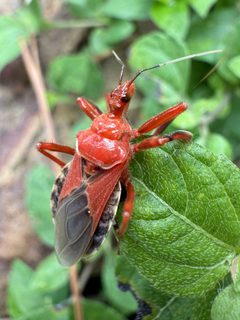
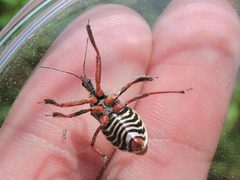
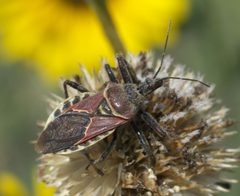
Apiomerus spissipes is a of assassin bug in the Reduviidae, commonly known as the Plains Assassin. It ranges broadly across the Great Plains of North America and is replaced further east by the closely related but generally darker A. crassipes. The species is known for its habit of ambushing on flowers, particularly bees, though it will prey on other insects as well. Its coloration has been observed to include pale surfaces with black front and hind margins.
Pronunciation
How to pronounce Apiomerus spissipes: /æˌpaɪ.oʊˈmɪərəs ˈspɪsaɪpiːz/
These audio files are automatically generated. While they are not always 100% accurate, they are a good starting point.
Identification
Keys to A. spissipes based on pale surfaces with black front and hind margins in Florida Reduviidae literature. Generally lighter in coloration than the closely related A. crassipes, which replaces it further east. Distinguished from other Apiomerus by color pattern and geographic distribution across the Great Plains.
Images
Habitat
Found in dry-mesic woodland and open including glades. Has been observed on coneflowers (Echinacea sp.) and other flowering plants where it ambushes .
Distribution
Broadly distributed across the Great Plains of North America. Recorded from western Oklahoma through the central plains. Found in North America and Central America according to distribution records.
Diet
Preys upon bees and other visiting flowers. Has been observed feeding on stink bugs (Piezodorus guildinii). Will ambush prey at nest entrances as well as on flowers.
Behavior
Ambush that lurks on or under flowers to capture visiting . Has been observed hiding under petals of coneflowers, positioning itself to avoid detection by prey.
Ecological Role
of and other insects. May serve as prey for larger predators such as spiders (documented as prey of Peucetia viridans, the green lynx spider).
Human Relevance
None documented.
Similar Taxa
- Apiomerus crassipesClosely related that replaces A. spissipes further east; generally darker in coloration.
- Apiomerus floridensisUndescribed name from unpublished dissertation for Florida ; may represent what has been called A. spissipes in Florida but remains nomenclaturally unavailable.