
Apiomerus floridensis
Berniker & Szerlip, 2011
Florida Bee Assassin
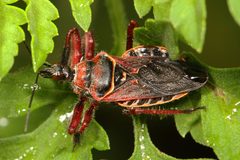
Apiomerus floridensis is a of assassin bug in the Reduviidae, commonly known as the Florida Assassin. The species was formally described in 2011 by Berniker and Szerlip, validating a name originally proposed in an unpublished 1980 Ph.D. dissertation. It belongs to a group of predatory insects known for hunting bees and other insects, particularly on flowers and at nest entrances. The species is to Florida and represents part of a taxonomic revision that clarified eastern U.S. previously misidentified as A. spissipes.
Pronunciation
How to pronounce Apiomerus floridensis: /ˌæp.i.oʊˈmɛr.əs ˌflɔːr.ɪˈdɛn.sɪs/
These audio files are automatically generated. While they are not always 100% accurate, they are a good starting point.
Identification
Distinguished from the similar A. spissipes by coloration: pale with black front and hind margins. Previously misidentified as A. spissipes in Florida; accurate identification requires reference to the 2011 formal description or updated keys incorporating the split. The species is to Florida, which helps separate it from other eastern U.S. Apiomerus species with broader distributions.
Images
Appearance
Medium-sized assassin bug. Males measure 12.5–14.2 mm in length; females are larger, 13.9–16.2 mm. surface pale with black margins on front and hind margins. As a member of the Apiomerus, likely possesses forelegs adapted for capturing prey and an elongate body form typical of harpactorine assassin bugs.
Habitat
Associated with sand scrub on the Lake Wales Ridge of central Florida. Occurs in high-quality remnant scrub . Specific microhabitat preferences within Florida are not well documented beyond general association with scrub vegetation.
Distribution
to Florida, United States, particularly southward from Duval County. Historical records from northern Mexico attributed to this require verification; the core confirmed range is peninsular Florida.
Diet
Predatory, with documented habit of preying upon bees (Hymenoptera: ) on flowers and by ambushing at nest entrances. Other insects are also taken.
Behavior
. Has been observed hunting on flowers. Employs ambush tactics at nest entrances.
Ecological Role
of bees and other insects; may influence and dynamics in scrub . Serves as prey for other predators including green lynx spiders (Peucetia viridans).
Human Relevance
Of interest to entomologists and naturalists due to its taxonomic history and status. No documented agricultural or medical significance.
Similar Taxa
- Apiomerus spissipesOverlaps in eastern U.S. and was historically confused with A. floridensis in Florida. Separated by coloration pattern and geographic distribution.
Misconceptions
The name "A. floridensis" was used informally for nearly 30 years based on an unpublished 1980 Ph.D. dissertation, leading to confusion with A. spissipes. The was not formally available for nomenclatural purposes until the 2011 publication by Berniker et al.
More Details
Taxonomic history
The was originally described in Sigurd Leopold Szerlip's 1980 unpublished University of California, Berkeley Ph.D. dissertation, which proposed 19 new species in the . Because dissertations do not meet ICZN publication criteria, the name remained unavailable until Berniker et al. (2011) formally published it. Szerlip participated as coauthor in the 2011 validation.
Research significance
The Szerlip dissertation contained extensive information and detailed genitalic studies that remained inaccessible to the scientific for three decades. The 2011 publication incorporated phylogenetic analysis and revised concepts.