
Himacerus
Wolff, 1811
damsel bugs
Species Guides
2- Himacerus apterus(tree damsel bug)
- Himacerus major(Grey Damsel Bug)
Himacerus is a of predatory damsel bugs in the Nabidae, Nabinae. The genus includes several Eurasian , with Himacerus apterus being the most studied. These are that inhabit forest edges, meadows, and open woodlands. Some species have been introduced to North America, notably H. apterus in eastern Canada.
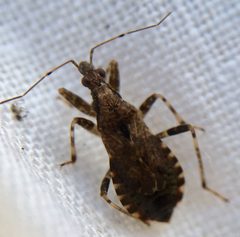
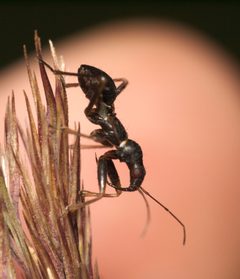
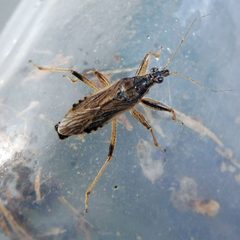
Pronunciation
How to pronounce Himacerus: //haɪˈmæsərəs//
These audio files are automatically generated. While they are not always 100% accurate, they are a good starting point.
Identification
Himacerus are distinguished from other Nabidae by their relatively elongated body form and the structure of the male genitalia. Species within the can be separated by wing development (brachypterous versus forms), body size, and coloration. H. apterus is typically wingless or short-winged in most , while H. major is larger and grey in coloration.
Images
Habitat
in this inhabit open pine woodlands with herb and shrub layers, forest edges, meadows, and areas with dense low vegetation. Himacerus apterus specifically avoids agricultural fields, preferring natural or semi-natural with grasses and bushes.
Distribution
The is native to the Palearctic region, with records from Europe (including Denmark, Norway, Sweden, Germany), Asia (Middle and South Asia), and North Africa. Himacerus apterus has been introduced to eastern North America (Nova Scotia, Canada), with records from 1943–1989.
Seasonality
are active from July through autumn. are laid in late summer and overwinter, with nymphs emerging in May–June and developing through four instars before reaching adulthood in July–August.
Diet
feeding on small arthropods including aphids, caterpillars, mites, and other small insects. First and second instar nymphs feed on small insects and mites in the herb layer; from the third instar onward, nymphs climb bushes and trees to hunt.
Life Cycle
with one per year. are deposited in autumn within stems of herbs and grasses, where they overwinter. Development includes four larval instars lasting approximately 7–15 days each at 21–22°C. The complete nymphal period spans roughly 40 days under laboratory conditions.
Behavior
Active that employ menotactic orientation using light rays to maintain fixed directions, with vertical patterns particularly important for navigation. Intraspecific depends on satiation level; occurs between individuals of different sizes. Running activity has been documented using actograph measurements.
Ecological Role
Predatory that regulate of small arthropods in forest and meadow . Considered potential agents, though mass rearing is hindered by and low production in captivity.
Human Relevance
Evaluated for of forest and agricultural pests, but not yet deployable due to and insufficient -laying in rearing conditions. H. apterus is an introduced in North America with unknown ecological impacts.
Similar Taxa
- NabisAnother nabid with similar predatory habits; Himacerus tend to be more associated with woody vegetation and show greater wing reduction in
- ProstemmaNabid with different preferences and body proportions; Himacerus has more elongated body form and distinct male genitalia structure
More Details
Wing polymorphism
Himacerus apterus exhibits pronounced wing dimorphism: in Bavarian , 89% of females and 98% of males were brachypterous (short-winged), with only 11% and 2% respectively being (long-winged). This wing reduction correlates with their primarily ground-dwelling habit in stable .
Venomous prey capture
H. apterus injects neurotoxic saliva into prey. A single female can kill prey weighing approximately 500 mg in 66 minutes through venom alone. Feeding involves alternating saliva injection and uptake of liquefied tissues.
Reproductive anatomy
Unlike most other true bugs, female H. apterus lack a spermatheca (receptaculum seminis). occurs within the ovaries before laying.
Sources and further reading
- BugGuide
- Wikipedia
- GBIF taxonomy match
- iNaturalist taxon
- NCBI Taxonomy
- Zur Kenntnis der RaubwanzeHimacerus apterusF. (Hetereptesa, Nabidae)
- Zur Kenntnis der Raubwanze Himacerus apterus F. (Heteroptera, Nabidae) Teil I1
- HIMACERUS APTERUS(FABRICIUS), A EURASIAN NABIDAE (HEMIPTERA) NEW TO NORTH AMERICA: DIAGNOSIS, GEOGRAPHICAL DISTRIBUTION, AND BIONOMICS