
Himacerus apterus
(Fabricius, 1798)
tree damsel bug
Himacerus apterus, commonly known as the tree , is a predatory hemipteran in the Nabidae. It is native to Eurasia and was first recorded in North America from eastern Nova Scotia between 1943 and 1989. The exhibits wing , with most individuals being brachypterous (short-winged). It is a of small arthropods and has been considered for applications, though complicates mass rearing efforts.
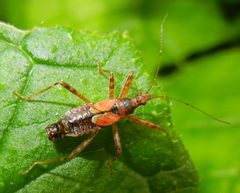
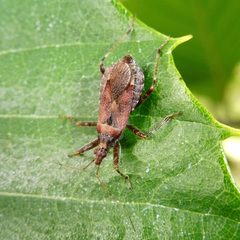
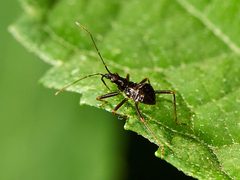
Identification
Distinguished from other damsel bugs by the combination of black connexivum with orange-red spots and reddish-brown wings. Wing is common but not diagnostic alone. The can be separated from other Himacerus species by genitalia characteristics and overall color pattern. In North America, it is the only representative of the Himacerus.
Images
Appearance
are 8–10.5 mm in males and 9–11.5 mm in females. The body features a black connexivum with orange-red spots. Wings are reddish-brown with a wingspan of 8–10 mm. Wing is common: in Bavarian , 89% of females and 98% of males were brachypterous, with 11% and 2% respectively. The is adapted for prey capture and mechanical processing of liquefied food particles.
Habitat
Primary is open pine forests with well-developed herb and shrub layers. The avoids agricultural areas and cultivated fields. In Eurasia, it occurs in bright, not overly dry pine woodlands with gramineae and bushes. Third instar nymphs and climb bushes and tree crowns to hunt.
Distribution
Native to most of Europe and southern and central Asia. First recorded in North America from eastern Nova Scotia, Canada, based on collections made between 1943 and 1989. The has not established widely in North America beyond these historical records.
Seasonality
lay in late summer. Eggs overwinter in plant stems and hatch in spring. Larvae occur from May to August. Development of larval stages at 21–22°C takes approximately 7.7, 7.9, 10.5, and 15.2 days for the four instars respectively.
Diet
Highly . First and second instar larvae feed on small insects and mites in the herb layer, particularly on gramineae and herbaceous plants. From the third instar onward, the hunts on bushes and in tree crowns. Prey includes mites, aphids, and other small insects. Under laboratory conditions with excess prey, killing rate approaches one prey item per day. The species uses neurotoxic venom injected through the to subdue prey.
Life Cycle
Four larval instars. Mean number per female is 20.2 developed eggs. Eggs are deposited in autumn within stems of herbs and grasses where they overwinter. Unlike most other true bugs, females lack a spermatheca (receptaculum seminis); occurs in the . Development duration of larval stages at 21–22°C: first instar 7.7 days, second instar 7.9 days, third instar 10.5 days, fourth instar 15.2 days. occurs under laboratory conditions, particularly when individuals are not fully satiated.
Behavior
Exhibits menotactic orientation, using light rays to maintain fixed directions (light-compass orientation). Vertical visual patterns are particularly important for orientation. Characteristic movements involve multiple legs simultaneously. Running activity has been measured using actograph devices. Intraspecific depends on satiation level, with hungry individuals showing more aggressive interactions. Optic and tactile stimuli play primary roles in prey capture. The is and active during daylight hours.
Ecological Role
of small arthropods in forest . May contribute to of forest pests, though practical application is limited by and difficulties in production for mass rearing. The occupies an intermediate trophic position, feeding on herbivorous mites and insects while serving as prey for birds.
Human Relevance
Evaluated for potential use in of forest pests, but deemed not yet viable due to in captivity and insufficient production for mass rearing. Optimal laboratory rearing uses larvae of the blow fly Phormia regina as food.
Similar Taxa
- Other Himacerus speciesSimilar body plan and coloration; require examination of genitalia for definitive identification
- Other Nabidae (damsel bugs)Share general body form and predatory habit; distinguished by specific color pattern of black connexivum with orange-red spots
More Details
Wing polymorphism
The shows significant wing dimorphism, with brachypterous (short-winged) forms dominating (89% females, 98% males in studied Bavarian populations). forms are rare.
Venom apparatus
The substance injected into prey is a . A single female can kill prey weighing approximately 500 mg total in 66 minutes. Feeding involves alternating saliva secretion and uptake.
Reproductive system
Unusual among true bugs in lacking a spermatheca; occurs within the rather than sperm storage for later fertilization.
Sources and further reading
- BugGuide
- Wikipedia
- GBIF taxonomy match
- iNaturalist taxon
- NCBI Taxonomy
- Encyrtid Holdings | Entomology Research Museum
- Lethrus apterus Archives - Entomology Today
- Research Showcases Best and Brightest Fathers of the Insect World
- Uncategorized | Blog - Part 42
- Survival of the fittest: predator wasps breed at the expense of spider juveniles | Blog
- Zur Kenntnis der RaubwanzeHimacerus apterusF. (Hetereptesa, Nabidae)
- Zur Kenntnis der Raubwanze Himacerus apterus F. (Heteroptera, Nabidae) Teil I1
- HIMACERUS APTERUS(FABRICIUS), A EURASIAN NABIDAE (HEMIPTERA) NEW TO NORTH AMERICA: DIAGNOSIS, GEOGRAPHICAL DISTRIBUTION, AND BIONOMICS