
Teleonemia scrupulosa
Stål, 1873
lantana lace bug
Teleonemia scrupulosa is a sap-sucking lace bug (Hemiptera: Tingidae) widely distributed across tropical and subtropical regions. It is a herbivore of camara (Verbenaceae) and has been deployed as a agent against this shrub in multiple countries since 1961. The exhibits strong microhabitat preferences, thriving in high-light environments but failing to establish in shaded conditions. Its feeding causes characteristic chlorotic damage and can severely impair plant .
Pronunciation
How to pronounce Teleonemia scrupulosa: /ˌtɛl.i.oʊˈniː.mi.ə ˌskruː.pjʊˈloʊ.sə/
These audio files are automatically generated. While they are not always 100% accurate, they are a good starting point.
Identification
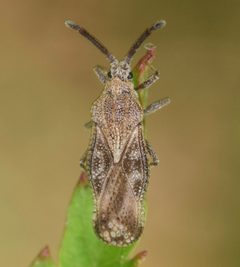
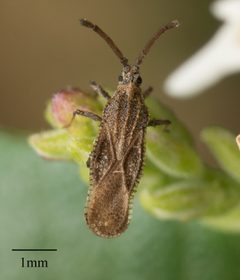
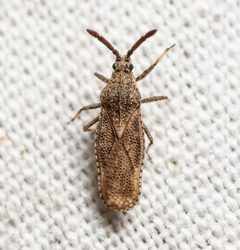
Small lace bug with the reticulated, lace-like forewings typical of Tingidae. As a member of Teleonemia, likely exhibits elongated body form and expanded, flattened paranota (lateral thoracic expansions). Specific diagnostic features distinguishing T. scrupulosa from require examination; identification in the field is primarily based on association with camara plants.
Images
Habitat
Open, sunny locations with high light intensity; associated with camara growing in sun-exposed microhabitats. Does not proliferate in shaded environments regardless of plant variety.
Distribution
Native range uncertain; currently recorded from Africa, Australia, the Caribbean, Central America, North America, Oceania, South America, and Southern Asia. Introduced to some locations as a biocontrol agent, including South Africa (released 1961).
Diet
Phloem or mesophyll sap-sucking herbivore; feeds specifically on camara. Causes chlorotic feeding damage visible as yellowing on foliage.
Host Associations
- Lantana camara - primary shrub; sole known for development and
- Lantana camara orange flower variety - preferred preferred in high-light environments
- Lantana camara pink flower variety - utilized in sun but not in shade
Behavior
Strong preference for high-light microhabitats over shaded conditions; preference driven more by sunlight intensity than by host plant variety. Feeding activity induces rapid increase in stomatal resistance in host plants.
Ecological Role
agent against camara; herbivory damage at approximately 20% leaf area reduces by 90% through increased stomatal resistance. Engages in exploitative competition or plant-mediated interactions with other Lantana herbivores such as the flea beetle Longitarsus bethae.
Human Relevance
Deployed intentionally as a agent to suppress camara in multiple countries. Success limited by microhabitat requirements; ineffective in shaded .
Similar Taxa
- Longitarsus bethaeshares plant camara and co-occurs in biocontrol contexts; distinguished as a flea beetle (Coleoptera: Chrysomelidae) with different feeding mode and damage
- Other Teleonemia speciescongeneric lace bugs with similar ; require examination of genitalic or wing venation characters for definitive identification
Sources and further reading
- BugGuide
- Wikipedia
- GBIF taxonomy match
- iNaturalist taxon
- NCBI Taxonomy
- Catalogue of Life
- Effect of herbivory by Teleonemia scrupulosa on the performance of Longitarsus bethae on their shared host, Lantana camara
- Differences between sun and shade habitats on the invasive shrub Lantana camara and its biocontrol agent Teleonemia scrupulosa
- Altitudinal distribution off theLantanalace bugTeleonemia scrupulosaStai. in the Anaimalai hills (Western Ghats), India
- Correction to: Differences between sun and shade habitats on the invasive shrub Lantana camara and its biocontrol agent Teleonemia scrupulosa