
Longitarsus
Latreille, 1829
flea beetles
Species Guides
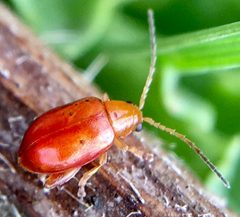
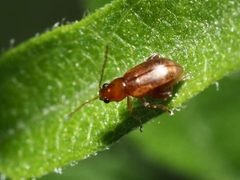
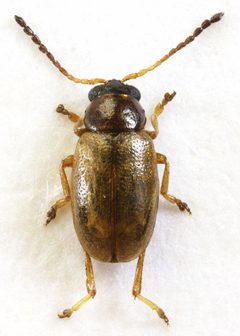
16Longitarsus is the largest of flea beetles (Chrysomelidae: Galerucinae), comprising over 700 with a distribution. Species exhibit diverse ecological strategies, including subaquatic lifestyles with inside hydrophyte stems, and terrestrial herbivory on various plant . Many species show wing , with containing fully winged, reduced-winged, or -winged individuals. plant associations are generally phylogenetically conserved at the clade level, though Boraginaceae-associated species represent an exception.
Pronunciation
How to pronounce Longitarsus: /lɒnˈdʒɪtɑːrsəs/
These audio files are automatically generated. While they are not always 100% accurate, they are a good starting point.
Identification
-level identification requires examination of male genitalia and careful comparison with . The is characterized by the flea beetle body plan (elongate, compressed) typical of Alticini, but definitive genus-level field characters are not established. Wing (fully developed, reduced, or wings) occurs in many species and can complicate identification. Abdominal wing-folding spicule patches have been documented in British species.
Images
Habitat
Highly variable across . Includes terrestrial environments associated with diverse plants, and subaquatic where species inhabit hydrophyte-dominated wetlands. One Oriental species has been documented pupating inside stem aerenchyma of aquatic plants.
Distribution
. Documented from all zoogeographical regions including the Western Palaearctic, Oriental Region (southern India), and Britain.
Diet
Phytophagous. plant associations are phylogenetically conserved in most Western Palaearctic clades, with strict associations to specific plant . Documented host plants include Limnophila (hydrophyte), camara, and houndstongue (Cynoglossum).
Host Associations
- Limnophila - plantsubaquatic ; inside stem aerenchyma
- Limnophila aquatica - plantspecific for Longitarsus limnophilae
- Lantana camara - plantshared with Teleonemia scrupulosa
- Cynoglossum - planthoundstongue; below-ground herbivory
Life Cycle
laid on tender leaves and buds. Larvae are open feeders. occurs in soil or, in at least one subaquatic , inside stem aerenchyma of hydrophyte . This represents the first documented case of an Oriental flea beetle pupating within its hydrophyte host stem.
Behavior
possess saltatorial (jumping) ability typical of flea beetles. capability varies: wing occurs in at least 25 of 37 British examined, with individuals showing fully developed, reduced, or wings. Flight appears relatively unimportant in this saltatorial group. Some species are below-ground herbivores, feeding on roots.
Ecological Role
Herbivores that can influence plant composition through selective feeding. Some sequester iridoid glycosides from plants. Below-ground feeding species may function as root herbivores with distinct impacts compared to folivores.
Human Relevance
Some have been evaluated or employed for of plants, including camara and houndstongue (Cynoglossum).
Similar Taxa
- Other Alticini generaDistinguished by combination of morphological characters requiring examination of male genitalia and comparison with ; no simple field characters separate Longitarsus from all related flea beetle
More Details
Wing polymorphism
Documented in 25 of 37 British examined. Variation classified as fully developed, reduced (three sub-groups), or . in wing shape recorded for some species.
Chemical defense
Selective of iridoid glycosides from plants has been documented, indicating biochemical to host plant chemistry.
Phylogenetic patterns
-plant associations show phylogenetic conservatism in Western Palaearctic , with most recovered clades strictly associated with specific plant . Boraginaceae-associated species represent an exception to this pattern.
Sources and further reading
- BugGuide
- Wikipedia
- GBIF taxonomy match
- iNaturalist taxon
- NCBI Taxonomy
- Catalogue of Life
- Figures 9–12 from: Prathapan K, Viraktamath C (2011) A new species of Longitarsus Latreille, 1829 (Coleoptera, Chrysomelidae, Galerucinae) pupating inside stem aerenchyma of the hydrophyte host from the Oriental Region. ZooKeys 87: 1-10. https://doi.org/10.3897/zookeys.87.1294
- Figure 1 from: Prathapan K, Viraktamath C (2011) A new species of Longitarsus Latreille, 1829 (Coleoptera, Chrysomelidae, Galerucinae) pupating inside stem aerenchyma of the hydrophyte host from the Oriental Region. ZooKeys 87: 1-10. https://doi.org/10.3897/zookeys.87.1294
- Figures 13–16 from: Prathapan K, Viraktamath C (2011) A new species of Longitarsus Latreille, 1829 (Coleoptera, Chrysomelidae, Galerucinae) pupating inside stem aerenchyma of the hydrophyte host from the Oriental Region. ZooKeys 87: 1-10. https://doi.org/10.3897/zookeys.87.1294
- Figure 1 from: Salvi D, D’Alessandro P, Biondi M (2019) Host plant associations in Western Palaearctic Longitarsus flea beetles (Chrysomelidae, Galerucinae, Alticini): a preliminary phylogenetic assessment. In: Schmitt M, Chaboo CS, Biondi M (Eds) Research on Chrysomelidae 8. ZooKeys 856: 101-114. https://doi.org/10.3897/zookeys.856.32430
- Selective sequestration of iridoid glycosides from their host plants in Longitarsus flea beetles
- Effect of herbivory by Teleonemia scrupulosa on the performance of Longitarsus bethae on their shared host, Lantana camara
- Host Specificity of Longitarsus quadriguttatus Pont., a Below-Ground Herbivore for the Biological Control of Houndstongue
- Host plant associations in Western Palaearctic Longitarsus flea beetles (Chrysomelidae, Galerucinae, Alticini): a preliminary phylogenetic assessment
- Wing‐polymorphism in British species of Longitarsus beetles (Chrysomelidae: Alticinae)