
Longitarsus jacobaeae
Waterhouse, 1858
Ragwort Flea Beetle, Tansy Ragwort Flea Beetle
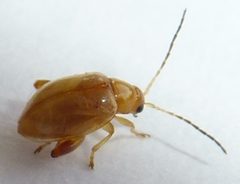
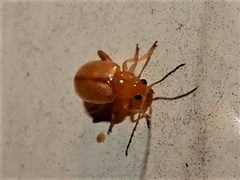
Longitarsus jacobaeae is a flea beetle (Chrysomelidae) native to Europe, widely introduced as a agent for tansy ragwort (Senecio jacobaea), a toxic weed affecting livestock. and larvae feed on ragwort foliage, with larvae mining roots and crown tissue. The exhibits pronounced seasonal behavioral patterns, including summer and winter inactivity. It has established successfully in North America, Australia, and New Zealand.

Pronunciation
How to pronounce Longitarsus jacobaeae: /lɔŋɡɪˈtarsʊs ˌjakobˈaɪ.iː/
These audio files are automatically generated. While they are not always 100% accurate, they are a good starting point.
Identification
Small flea beetle with enlarged hind adapted for jumping. Distinguished from other Longitarsus by strong association with tansy ragwort; positive identification requires examination of male genitalia or expert taxonomic verification.
Images
Habitat
Open grasslands, pastures, and disturbed areas where tansy ragwort occurs.
Distribution
Native to Europe; introduced to North America, Australia, and New Zealand for . GBIF records confirm presence in Europe, North America, and Australia.
Seasonality
Active spring through early summer (May–July) and late summer through autumn (August–October). enter summer in mid-summer (July) and winter inactivity (January), during which they do not respond to plant odors.
Diet
and larvae feed exclusively on tansy ragwort (Senecio jacobaea). Adults consume foliage; larvae mine roots and crown tissue.
Host Associations
- Senecio jacobaea - OBLIGATETansy ragwort; sole for feeding and . Highly host-specific; does not attack native Senecio in New Zealand or economically important plants.
Life Cycle
Complete . emerge in spring, feed on foliage, and oviposit at base of plants. Larvae develop in roots and crown, pupating in soil. New adults emerge in late summer. Italian exhibits adult during summer months.
Behavior
orient to upwind plants using olfactory cues, responding to plants 60–300 cm away. Starved individuals show directed upwind movement; satiated beetles move randomly. Males are attracted to volatiles from females, female , and host plants fed upon by females, but not to clean host plants or male feces. Synthetic jacobine (a from tansy ragwort) attracts males when combined with host plant volatiles.
Ecological Role
herbivore; primary agent reducing tansy ragwort . Works in combination with cinnabar moth (Tyria jacobaeae) and ragwort (Platyptilia isodactyla) in integrated weed management programs.
Human Relevance
Widely used agent for tansy ragwort in pastures and rangelands. Reduces reliance on chemical herbicides. Success documented in New Zealand, where combined bio-agent pressure has reduced ragwort from dense to negligible levels within several years.
Similar Taxa
- Other Longitarsus speciesMany Longitarsus are flea beetles with similar ; L. jacobaeae distinguished by specificity and association with tansy ragwort.
- Cinnabar moth (Tyria jacobaeae)Shares plant and role; distinguished as lepidopteran with conspicuous black-and-red warning coloration, versus coleopteran flea beetle.
Sources and further reading
- BugGuide
- GBIF taxonomy match
- iNaturalist taxon
- NCBI Taxonomy
- Senecio jacobaeae Archives - Entomology Today
- Meet six unsung heroes of the pollination world - Buglife Blog - Buglife
- New Zealand Farmers use Moths and Beetles to Fight Weeds
- Host specificity of the ragwort flea beetle Longitarsus jacobaeae (Waterhouse) (Coleoptera:Chrysomelidae)
- Attraction of Longitarsus jacobaeae Males to Cues Associated with Conspecific Females (Coleoptera: Chrysomelidae)
- Factors affecting the response ofLongitarsus jacobaeae(Coleoptera: Chrysomelidae) to upwind plant odours
- Responses of ragwort flea beetleLongitarsus jacobaeae(Coleoptera: Chrysomelidae) to signals from host plants
- Longitarsus jacobaeae (Coleoptera: Chrysomelidae), a Flea Beetle for the Biological Control of Tansy Ragwort. 1. Host Plant Specificity Studies2
- Field and laboratory observations of the life history of the Swiss biotype of Longitarsus jacobaeae (Coleoptera: Chrysomelidae).
- Longitarsus jacobaeae (Coleoptera: Chrysomelidae), a Flea Beetle for the Biological Control of Tansy Ragwort. Ii. Life History of a Swiss Biotype2
- Longitarsus jacobaeae (Coleoptera: Chrysomelidae), a Flea Beetle for the Biological Control of Tansy Ragwort. 4. Life History and Adult Aestivation of an Italian Biotype2