
Stephanitis takeyai
Drake & Maa, 1955
Andromeda lace bug
Stephanitis takeyai, the andromeda , is a small sap-feeding insect native to Japan that has become an pest of ornamental Ericaceae in North America and Europe. It is closely associated with Pieris japonica (Japanese andromeda), its preferred , but has been documented on multiple within Ericaceae including Rhododendron, Vaccinium, and Kalmia. The exhibits facultative seasonal host alternation in parts of its native range, moving from evergreen Pieris japonica in winter to deciduous Lyonia elliptica in summer when the latter is available.
Pronunciation
How to pronounce Stephanitis takeyai: /ˌstɛfəˈnaɪtɪs ˌtækeɪˈjaɪ/
These audio files are automatically generated. While they are not always 100% accurate, they are a good starting point.
Identification
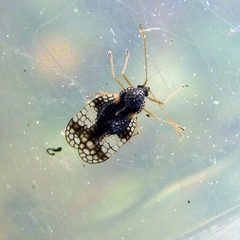
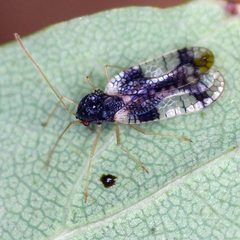
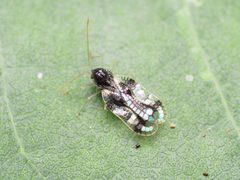
The combination of small size (~3 mm), rounded pronotum, and black-and-white lacy wings with gold highlights distinguishes this from other lace bugs. It can be separated from the closely related azalea lace bug (Stephanitis pyrioides) by association and subtle morphological differences, though expert examination may be required for definitive identification. Fecal spots (tar spots) on leaf undersides and stippled bleaching of foliage are characteristic signs of .
Images
Habitat
Associated with woody shrubs in the Ericaceae. In its native range in Japan, found in secondary forests and parks. In introduced regions, occurs in residential landscapes, gardens, and nurseries where plants are cultivated. are more abundant and damaging on plants growing in full sun exposure compared to shaded locations.
Distribution
Native to Japan (Honshu). Introduced to North America (USA: Connecticut, Delaware, New Jersey, Pennsylvania, Rhode Island) and Europe (Netherlands, Poland, UK: England and Wales). Also recorded from India. The has spread throughout the eastern United States since its introduction around 1945.
Seasonality
Overwinters as inserted into leaf tissue, with eggs hatching around the first week of May in temperate regions. Multiple occur during the growing season, with development rapid in warm conditions. Four or more generations may complete in a single growing season. are present from late spring through fall, with peaks in summer months.
Diet
Phloem feeder that pierces plant with a straw-like beak to withdraw cell contents, removing chlorophyll and causing characteristic stippling damage. Both nymphs and feed on leaf undersides.
Host Associations
- Pieris japonica - primary Preferred ; evergreen shrub used year-round, especially in winter
- Lyonia elliptica - secondary Deciduous shrub used in summer in parts of native range where available; higher quality food resource supporting greater growth
- Pieris floribunda - to ; damage minimal
- Rhododendron calendulaceum - Acceptable ; nymph observed
- Rhododendron 'Hampton Beauty' - Acceptable ; nymph observed
- Rhododendron 'Autumn Empress' - Acceptable
- Vaccinium arboreum - Slight damage noted; may serve as
- Vaccinium virgatum - May serve as
- Calluna vulgaris - Tested
- Kalmia latifolia - Tested
- Pieris phillyreifolia - Tested
- Pieris japonica 'Temple Bells' - Cultivar with high preference in multi-choice tests
Life Cycle
Overwinters as partially inserted into leaf tissue of plants. The exposed egg surface is coated with maternal excrement, likely providing camouflage from and . Eggs hatch in spring (approximately first week of May in temperate regions). Nymphs pass through several instars, feeding on leaf undersides and molting repeatedly before reaching adulthood. Multiple overlapping occur through the growing season. Development rate and longevity vary with temperature and host plant quality.
Behavior
Females insert into leaf tissue and coat exposed surfaces with fecal material. Both nymphs and feed gregariously on leaf undersides, remaining hidden beneath foliage. Seasonal alternation occurs in some , with movement from evergreen to deciduous hosts during summer when both are available. This is facultative rather than obligate.
Ecological Role
Herbivore that can significantly impact plant through chlorophyll removal and premature leaf abscission. Serves as host for specialized natural enemies including the Anagrus takeyanus. Heavy in sunny, plantings can cause plant stunting, branch dieback, and plant death. Natural enemies including spiders, larvae, predatory , and parasitic wasps provide , particularly in diverse, shaded landscapes.
Human Relevance
Significant pest of ornamental Ericaceae in landscapes and nurseries. Damage appears as stippled, bleached, or snowy-white foliage with tar-like fecal spots on leaf undersides. Heavy cause leaf drop, stunted growth, and plant decline, particularly on Pieris japonica and some Rhododendron . Management strategies include planting varieties (e.g., Pieris floribunda), siting susceptible plants in partial shade with diverse vegetation, and applying insecticidal soaps, oils, or directed to leaf undersides. Native to Japan; introduced to eastern North America and Europe through horticultural trade.
Similar Taxa
- Stephanitis pyrioidesAzalea lace bug; closely related pest with similar and damage , but primarily associated with Rhododendron (azalea) rather than Pieris. Expert morphological examination required for definitive separation.
- Corythuca cydoniaeHawthorn lace bug; native North American found on serviceberry, hawthorn, and cotoneaster. Distinguished by native status and different associations.
More Details
Population Dynamics and Host Quality
Research in Japan demonstrates that exploiting Lyonia elliptica in summer exhibit approximately 100-fold greater growth between compared to populations restricted to Pieris japonica year-round, indicating strong adaptive value for seasonal alternation where the deciduous host is available.
Parasitoid Coevolution
The Anagrus takeyanus has evolved -specific strategies corresponding to alternation patterns in S. takeyai. Where host alternation occurs, the enters summer diapause immediately after winter diapause; where host alternation is absent, no summer diapause occurs. This represents a derived to the derived host-alternating of its host.
Sources and further reading
- BugGuide
- Wikipedia
- iNaturalist taxon
- NCBI Taxonomy
- And may all your azaleas be white - Azalea lace bug, Stephanitis pyrioides, and friends, Andromeda lace bug, Stephanitis takeyai, and hawthorn lace bug, Corythuca cydoniae — Bug of the Week
- Lace bugs on the attack! — Bug of the Week
- Bug of the Week
- Stephanitis takeyai . [Distribution map].
- Host Plant Utilization Within Family Ericaceae by the Andromeda Lace Bug Stephanitis takeyai (Hemiptera: Tingidae)
- Seasonal host alternation by the andromeda lace bug, Stephanitis takeyai (Heteroptera: Tingidae) between its two main host‐plant species
- The Effect of Temperature on the Development and Longevity of the Andromeda Lace Bug, Stephanitis takeyai (Heteroptera: Tingidae) on Its Two Main Host Plants, Pieris japonica and Lyonia elliptica
- Interpopulation variation of hibernal‐aestival‐diapause in the egg parasitoid wasp Anagrus takeyanus: adaptation to seasonal host‐plant alternation of the tingid host, Stephanitis takeyai