
Stephanitis pyrioides
(Scott, 1874)
Azalea Lace Bug
Stephanitis pyrioides, the azalea lace bug, is an pest native to the East Palaearctic that has spread globally. It is a feeder on Rhododendron , particularly azaleas, causing characteristic white stippling damage to leaves through mesophyll feeding. The species undergoes multiple annually in temperate regions and has become a significant pest of ornamental horticulture.
Pronunciation
How to pronounce Stephanitis pyrioides: /stɛfəˈnaɪtɪs pɪriaɪˈoʊdiːz/
These audio files are automatically generated. While they are not always 100% accurate, they are a good starting point.
Identification
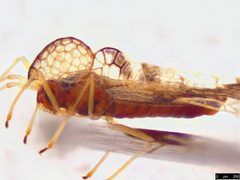
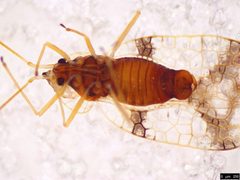
Distinguished from other Stephanitis by association and subtle morphological characters; S. pyrioides specifically attacks Rhododendron/azalea whereas S. takeyai occurs on Pieris (andromeda) and S. pyri on Pyrus (pear). of S. pyrioides have been observed to have slightly different pronotal and wing reticulation patterns compared to S. takeyai. Fecal spots (tarry black excrement) on undersides of leaves are a reliable field indicator of .
Images
Appearance
Habitat
Found on cultivated and ornamental Rhododendron shrubs, particularly in sunny, exposed landscape plantings. are typically suppressed in shadier, more diverse plantings. plant irrigation levels and light intensity affect suitability and .
Distribution
Native to East Palaearctic (Japan, Korea, Taiwan, China). Introduced and established in North America (eastern and western United States, Hawaii), Europe (France, Italy, Netherlands, Greece, Slovenia, Switzerland, Russia), South America (Brazil), and Oceania (Australia). First recorded in European Russia in 2020.
Seasonality
In western Washington, undergoes two full and a partial third generation annually. First generation 5% early instar estimated at 69 (base 10.2°C from January 1), with 50% emergence at 171 degree-days. hatch typically begins early May in temperate regions. Development rate varies with plant susceptibility, with faster development on susceptible hosts.
Diet
Mesophyll feeder on Rhododendron leaves. Uses to penetrate leaf and withdraw cellular contents, removing chlorophyll and causing stippling damage. Does not feed on phloem sap.
Host Associations
- Rhododendron spp. - primary -wide association; subgenus Azaleastrum (azaleas) most susceptible, subgenus Hymenanthes least susceptible
- Rhododendron × hybridum - Recorded in Russia
- Deciduous azalea (section Pentanthera) - Varying resistance levels; R. canescens and R. periclymenoides show resistance mediated by leaf wax chemistry
Life Cycle
Overwinters as inserted partially into leaf tissue by females, with exposed surfaces coated with excrement for camouflage. Eggs hatch in spring (approximately early May in temperate regions). Nymphs pass through several instars, feeding and molting before becoming . Multiple overlapping occur through the growing season. In western Washington: two full generations plus partial third; southeastern US may have four or more generations.
Behavior
Feeds exclusively on undersides of leaves. Females deposit in leaf tissue and coat with fecal material, likely as / camouflage. Shows preference for plants with elevated nitrogen levels. Leaf wax chemistry influences host acceptance, feeding, and oviposition .
Ecological Role
Herbivorous pest of ornamental plants; damage reduces and rates. Serves as prey for including spiders, larvae, predatory , and parasitic . occur in plantings with reduced natural enemy .
Human Relevance
Major economic pest of azaleas and rhododendrons in horticultural and landscape settings. Feeding damage reduces aesthetic value and marketability of ornamental plants. Management relies on , cultural practices (shady, diverse plantings), and targeted applications directed to leaf undersides. insecticides or short-residual contact products (insecticidal soap, oil) are recommended when needed.
Similar Taxa
- Stephanitis takeyaiAndromeda lace bug; similar appearance and but restricted to Pieris (andromeda) ; arrived from Asia in 1945 versus 1916 for S. pyrioides
- Corythuca cydoniaeHawthorn lace bug; native North American on hawthorn, serviceberry, cotoneaster; overwinter in leaf litter rather than as in leaves
- Stephanitis pyriPear lace bug; occurs on Pyrus ; now sympatric with S. pyrioides in southern Russia where both can be distinguished by morphological characters
More Details
Host Plant Resistance Mechanism
Epicuticular leaf wax serves as the primary resistance mechanism in deciduous azalea . Wax extracts from genotypes (R. canescens, R. periclymenoides) confer resistance when applied to susceptible genotypes, and conversely reduce resistance when susceptible wax is applied to resistant plants. Trichome presence does not predict damage susceptibility.
Fertilization Effects
Elevated nitrogen increases preference by S. pyrioides, but does not increase leaf injury levels once colonization occurs—differing from typical phloem-feeder responses to nitrogen.
Invasion History
Arrived in North America from Asia in 1916; in European Russia (Sochi) by 2020, likely via imported plants from Italy. Molecular barcoding data confirm identification and distinguish from .
Sources and further reading
- BugGuide
- Wikipedia
- GBIF taxonomy match
- iNaturalist taxon
- NCBI Taxonomy
- And may all your azaleas be white - Azalea lace bug, Stephanitis pyrioides, and friends, Andromeda lace bug, Stephanitis takeyai, and hawthorn lace bug, Corythuca cydoniae — Bug of the Week
- Bug of the Week
- Lace bugs on the attack! — Bug of the Week
- Always a surprise: European earwig, Forficula auricularia — Bug of the Week
- Worldwide webworm - Fall webworm, Hyphantria cunea — Bug of the Week
- Stephanitis pyrioides . [Distribution map].
- Azalea Lace Bug, Stephanitis pyrioides (Scott) (Insecta: Hemiptera: Tingidae)
- Susceptibility of Rhododendron to Azalea Lace Bug, Stephanitis pyrioides (Scott)1
- Effect of Supplemental Nitrogen Fertilization on the Movement and Injury of Azalea Lace Bug (Stephanitis pyrioides(Scott)) to Container-grown Azaleas
- A Scientific Review on the Ecology and Management of the Azalea Lace Bug Stephanitis pyrioides (Scott) (Tingidae: Hemiptera)
- Epicuticular lipids from azalea (Rhododendron spp.) and their potential role in host plant acceptance by azalea lace bug, Stephanitis pyrioides (Heteroptera: Tingidae)
- Leaf Wax Extracts of Four Deciduous Azalea Genotypes Affect Azalea Lace Bug (Stephanitis pyrioides Scott) Survival Rates and Behavior
- Development of Azalea Lace Bug, Stephanitis pyrioides, on Susceptible and Resistant Rhododendron species in Western Washington
- First record of the azalea lace bug Stephanitis pyrioides (Scott, 1874) (Hemiptera: Heteroptera: Tingidae) in the European part of Russia: Molecular genetics and taxonomy of an alien pest
- Comparative Metabolomic Responses of Three Rhododendron Cultivars to the Azalea Lace Bug (Stephanitis pyrioides).