
Creontiades
Distant, 1883
green mirids, verde plant bugs
Species Guides
2- Creontiades debilis(plant bug)
- Creontiades rubrinervis
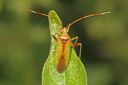
Creontiades is a of plant bugs ( Miridae) comprising over 50 described distributed across tropical and subtropical regions worldwide. Several species are significant agricultural pests, particularly of cotton, where they damage developing reproductive structures. The genus exhibits broad plant associations, with some species showing high mobility between natural vegetation and crop systems.
Pronunciation
How to pronounce Creontiades: //kri.ˌɒn.tiˈeɪ.diz//
These audio files are automatically generated. While they are not always 100% accurate, they are a good starting point.
Identification
Small to medium-sized mirids; green or greenish coloration common in many (hence "green mirids"). Specific diagnostic features for -level identification require examination of male genitalia and other fine morphological characters; species-level identification is challenging and typically requires taxonomic expertise.
Images
Habitat
Agricultural crops (especially cotton, lucerne/alfalfa, sorghum, pigeon pea), natural vegetation including arid zone ephemeral , and semi-natural field edges. Some utilize multiple across managed and unmanaged landscapes.
Distribution
Widespread in tropical and subtropical regions: Australia ( and introduced ), Africa, southern Europe, Middle East, South Asia, and South America. Specific distributions vary by species; C. dilutus is Australian endemic, C. pacificus occurs across Oriental and Australian regions including Pacific islands, C. pallidus has broad Afro-Eurasian distribution.
Diet
Phytophagous; feeds on developing seeds, floral buds, meristematic tissues, and young fruit. Specific feeding targets vary by plant and .
Host Associations
- Gossypium hirsutum - primary cotton; major pest for multiple
- Medicago sativa - lucerne/alfalfa; important alternate for C. dilutus
- Cajanus cajan - pigeon pea
- Sorghum bicolor - sorghum; C. pallidus associated with sorghum
- Cullen australasicum - in Australian arid zones
- Goodenia cycloptera - ephemeral in Australian arid zones
- Melilotus indicus - sweet clover near river systems
Life Cycle
stage followed by five nymphal instars; development rates temperature-dependent. In C. dilutus, egg development requires ~69.4 above 15.8°C threshold; nymphal development requires ~156.7 day-degrees above 15.1°C threshold. Total development from egg to approximately 15 days at optimum temperatures (30-32°C).
Behavior
or activity patterns observed in C. dilutus; individuals remain motionless during day unless disturbed. finding appears driven by arrestment cues rather than long-range volatile attraction; movement arrested by host substrates prior to contact. Highly mobile, with documented movement between adjacent crop and between natural vegetation and agricultural systems.
Ecological Role
Herbivore; some act as significant agricultural pests causing yield loss through feeding damage to reproductive structures. Serves as prey for including assassin bugs (e.g., Pristhesancus plagipennis). associations documented (e.g., Leiophron decipiens on C. pallidus, though rates typically low).
Human Relevance
Major pest of cotton in Australia (C. dilutus), United States (C. signatus), and other regions. Damage includes reduced seed set, boll injury, and floral bud destruction. Management relies on applications, agents, and cultural practices; as primary pest linked to reduced insecticide use in Bt cotton systems.
Similar Taxa
- MegacoelumClosely related with which Creontiades shares generic limits; taxonomic distinction requires examination of type and fine morphological characters
- CampylommaCo-occurring mirid in some agricultural systems; C. diversicornis studied alongside C. pallidus in Turkish cotton fields
- EurystylusCo-occurring sorghum in West African systems; stages and studied in parallel with C. pallidus
Sources and further reading
- BugGuide
- Wikipedia
- GBIF taxonomy match
- iNaturalist taxon
- NCBI Taxonomy
- Catalogue of Life
- Creontiades pallidus . [Distribution map].
- Biology of mirid bug, Creontiades biseratense (Hemiptera: Miridae)
- Review of the biology and control of Creontiades dilutus (Stål) (Hemiptera: Miridae)
- Identification, pest status, ecology and management of the Green Mirid, Creontiades dilutus (Stal) (Hemiptera: Miridae), a pest of cotton in Australia
- Multiple host-use by the generalist cotton pest Creontiades dilutus(Hemiptera: Miridae) in natural and agricultural landscapes
- Oviposition Patterns of Creontiades signatus (Hemiptera: Miridae) on Okra-Leaf and Normal-Leaf Cotton
- Effect of temperature on the biology of Creontiades dilutus (Stål) (Heteroptera: Miridae)
- Taxonomic Review ofCreontiadesDistant in Australia (Hemiptera: Miridae: Mirinae)
- Inferring Invasion Paths Into Cotton by Creontiades dilutus (Hemiptera: Miridae) From Arid Zone and Agricultural Sources
- Notes on the biology and immature stages of West African sorghum head bugs Eurystylus immaculatus and Creontiades pallidus (Heteroptera: Miridae)
- Diel activity patterns and arrestment behaviour in host associations of green mirids (Creontiades dilutus)
- Utilizing the assassin bug, Pristhesancus plagipennis (Hemiptera: Reduviidae), as a biological control agent within an integrated pest management programme for Helicoverpa spp. (Lepidoptera: Noctuidae) and Creontiades spp. (Hemiptera: Miridae) in cotton
- Factors affecting the distribution of two mirid bugs, <i>Creontiades pallidus</i> (Rambur) and <i>Campylomma diversicornis</i> (Reuter) (Hemiptera: Miridae) and notes on the parasitoid <i>Leiophron decifiens</i> Ruthe (Hymenoptera: Braconidae)
- Resolving multiple host use of an emergent pest of cotton with microsatellite data and chloroplast markers (Creontiades dilutusStål; Hemiptera, Miridae)
- Field Edge and Field-to-Field Ecotone-Type Influences on Two Cotton Herbivores: Cotton Fleahopper, Pseudatomoscelis seriatus (Hemiptera: Miridae), and Verde Plant Bug, Creontiades signatus