
Enchenopa
Amyot & Audinet-Serville, 1843
Species Guides
25- Enchenopa binotata(Two-marked Treehopper Complex)
- Enchenopa brevis(Leatherwood Treehopper)
- Enchenopa latipes(wide-footed treehopper)
- Enchenopa n-sp-az-i
- Enchenopa n-sp-az-ii
- Enchenopa on-betula
- Enchenopa on-carya
- Enchenopa on-ceanothus-americanus
- Enchenopa on-ceanothus-herbaceus
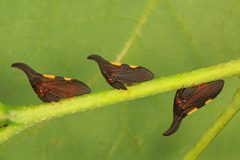
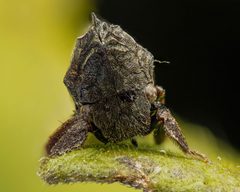
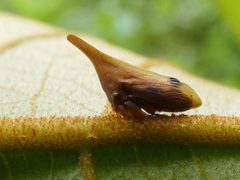
Enchenopa is a of treehoppers ( Membracidae) containing more than 50 described . The genus underwent major revision in 2014, resulting in 51 recognized species. Members are characterized by their enlarged, often pronotum typical of treehoppers. The Enchenopa binotata has been extensively studied as a model system for through plant shifts, with different species or specialized on distinct host plants and exhibiting assortative mating based on plant-associated vibrational signals.
Pronunciation
How to pronounce Enchenopa: /ɛn.kəˈnoʊ.pə/
These audio files are automatically generated. While they are not always 100% accurate, they are a good starting point.
Identification
Enchenopa can be distinguished from the related Campylenchia by the rounded lower margin of the . The genus is characterized by the typical body plan with an enlarged pronotum that extends posteriorly over the . Species identification often requires examination of plant associations and male genitalia; the Enchenopa binotata complex in particular comprises multiple cryptic species that are difficult to distinguish morphologically but are reproductively isolated through host plant fidelity and divergent signals.
Images
Habitat
Enchenopa are found in association with their plants, which include various woody shrubs and trees. Specific associations vary by species, with many tied to particular plant or . The genus occurs in diverse vegetation types from temperate to tropical regions in the Americas.
Distribution
The Enchenopa occurs throughout the Americas, from the United States south through Mexico, Central America, and South America to Argentina. The type Membracis monoceros was described from Brazil. Specific distribution records include: Vermont and other parts of the United States, Mexico, northwest Ecuador, Brazil, and Argentina (including Buenos Aires Province and Chaco Province).
Diet
All Enchenopa are phloem feeders, using to extract plant sap from their plants. Specific host plant associations vary among species; the Enchenopa binotata complex includes species specialized on different host plants including legumes and other woody plants.
Host Associations
- Various woody plants - phloem feeding plants vary among
- Pigeon pea (Cajanus cajan) - plantEnchenopa gracilis reported as pest on this crop in Brazil
- Malvaceae - plantEnchenopa gracilis observed on mallow shrubs in Argentina
- Solidago buckleyi - plantEnchenopa latipes recorded on this goldenrod
Life Cycle
Females deposit in masses covered with protective froth. Egg froth serves a protective function during development. Nymphs develop on plants, with higher mortality observed on non-native host plants. Developmental timing is influenced by host plant .
Behavior
Enchenopa treehoppers communicate using substrate-borne vibrational signals transmitted through plant stems. Males produce -specific or -specific vibrational songs to attract females; in the E. binotata complex, these songs differ among -associated populations and sound like whale songs. Song characteristics vary with temperature. Females show strong fidelity to their natal host plants for oviposition, with reduced deposition, hatching success, and nymph survival on non-native hosts. This host fidelity promotes assortative mating and reproductive isolation.
Ecological Role
As phloem feeders, Enchenopa transfer nutrients from plants to higher . Some species, particularly in the E. binotata complex, are tended by ants that collect honeydew , forming mutualistic associations. The serves as a model system for studying the evolutionary of plant-insect interactions and speciation mechanisms.
Human Relevance
Some are minor agricultural pests. Enchenopa gracilis has been reported as a pest on pigeon pea (Cajanus cajan) in Brazil and associated with various crops including acerola (Malpighia glabra). The E. binotata complex is a prominent research model for studying , plant , and evolution.
Similar Taxa
- CampylenchiaNorth American resemble Enchenopa in having brown and lacking yellow pronotal crest markings, but differ in having an angular rather than rounded lower margin of the
- MembracisThe type of Enchenopa (M. monoceros from Brazil) does not resemble North American species currently placed in Enchenopa; taxonomic revision may reassign many Enchenopa species to Membracis
More Details
Taxonomic instability
The Enchenopa is currently undergoing taxonomic revision. The 2014 revision recognized 51 , but further reorganization is anticipated. Most North American species currently assigned to Enchenopa do not resemble the Brazilian type species and will likely be transferred to Membracis, the type genus of the .
Research significance
The Enchenopa binotata is one of the best-studied systems for . Research has demonstrated that plant shifts can drive reproductive isolation through assortative mating based on plant-associated vibrational signals, providing empirical support for models of ecological speciation without geographic isolation.
Vibrational communication
Enchenopa treehoppers were among the first insects in which substrate-borne was extensively studied. Their signals are transmitted through plant stems as bending waves, and signal divergence among -associated has been linked to speciation.
Sources and further reading
- BugGuide
- Wikipedia
- GBIF taxonomy match
- iNaturalist taxon
- NCBI Taxonomy
- Catalogue of Life
- Membracidae | Beetles In The Bush | Page 2
- Gelechiidae | Beetles In The Bush
- April | 2011 | Beetles In The Bush | Page 2
- Hemiptera | Beetles In The Bush | Page 9
- How One Entomologist Puts Communication and Policy Training Into Action in Pesticide Safety Education
- Host-Plant-Induced Assortative Mating in Enchenopa Treehoppers
- Enchenopa binotata Complex: Sympatric Speciation?
- Egg Froth Distribution and Deposition by Enchenopa binotata (Homoptera: Membracidae
- HOST‐PLANT‐INDUCED ASSORTATIVE MATING IN ENCHENOPA TREEHOPPERS
- Host shifts favor vibrational signal divergence in Enchenopa binotata treehoppers
- Review for "The potential for the evolution of thermally sensitive courtship behaviours in the treehopper, <i>Enchenopa binotata</i>"
- Review for "The potential for the evolution of thermally sensitive courtship behaviours in the treehopper, <i>Enchenopa binotata</i>"
- Review for "The potential for the evolution of thermally sensitive courtship behaviours in the treehopper, <i>Enchenopa binotata</i>"
- Review for "The potential for the evolution of thermally sensitive courtship behaviours in the treehopper, <i>Enchenopa binotata</i>"
- Decision letter for "The potential for the evolution of thermally sensitive courtship behaviours in the treehopper, <i>Enchenopa binotata</i>"
- Review for "The potential for the evolution of thermally sensitive courtship behaviours in the treehopper, <i>Enchenopa binotata</i>"
- Ecological and Behavioral Basis for Reproductive Isolation in the Sympatric Enchenopa binotata Complex (Homoptera: Membracidae)
- Divergence in the Enchenopa binotata Say Complex (Homoptera: membracidae) Effected by Host Plant Adaptation
- Decision letter for "The potential for the evolution of thermally sensitive courtship behaviours in the treehopper, <i>Enchenopa binotata</i>"
- 7. Host Shifts, The Evolution Of Communication, And Speciation In The Enchenopa Binotata Species Complex Of Treehoppers
- Two new species of the treehopper genus Enchenopa Amyot & Serville, 1843 (Hemiptera, Membracidae) from northwest Ecuador.