
Gyponana
Ball, 1920
Species Guides
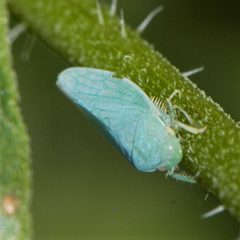
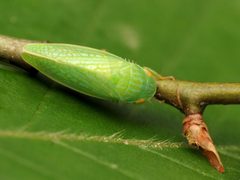
36Gyponana is a of leafhoppers in the Cicadellidae comprising at least 90 described , primarily distributed in North and South America. Species are typically green, occasionally with blue or pink coloration, and are difficult to identify based on external alone. The genus is notable for producing brochosomes—hollow, soccer ball-shaped nanoparticles that coat the body surface, conferring superhydrophobic and anti-reflective properties. Some species have been introduced to Europe, with established in Switzerland and Italy.

Pronunciation
How to pronounce Gyponana: //dʒɪˈpoʊnəˌnə//
These audio files are automatically generated. While they are not always 100% accurate, they are a good starting point.
Identification
Difficult to identify to based on external characteristics; male genitalia examination typically required. Distinguished from similar leafhopper by brochosome : Gyponana brochosomes feature more angled, geometric pits compared to the smoother, more circular brochosomes of genera such as Curtara. Four subgenera recognized (Clovana, Gyponana, Pandara, Sternana), with subgenus Gyponana containing the majority of species.
Images
Habitat
Diverse throughout North and South America; occupy various vegetation types. Introduced in Europe found in urban gardens and agroecosystems, with Cornus sanguinea documented as a preferred plant in invaded areas.
Distribution
Native range: North and South America, with highest diversity in the United States. Introduced range: Europe (southern Switzerland, northern Italy), with potential records from Borneo. Specific documented localities include Ticino (Switzerland), Lombardy and Veneto (Italy), and Ontario (Canada) for G. mali.
Seasonality
active during warmer months; fall blacklighting records indicate continued activity into autumn in temperate regions. Some likely overwinter as adults.
Host Associations
- Cornus sanguinea - preferred plant in European invaded areasBased on observations from Switzerland and Italy 2015–2019
Behavior
Coats body and wings with brochosomes using comb-like rows of spines on hind legs. Brochosomes are excreted from in liquid droplets and spread across the . Females of some leafhopper (not specifically documented for Gyponana) produce specialized rod-like brochosomes for nest coating; this has not been confirmed for Gyponana.
Ecological Role
Plant-feeding herbivore; some act as . Gyponana hasta is a documented vector of California aster-yellows virus. Introduced European represent , with potential impacts on viticulture and ornamental plants.
Human Relevance
Research interest in brochosome structure for biomimetic materials development, specifically superhydrophobic and anti-reflective coatings. Some are agricultural pests as . Attracted to blacklight traps, making them accessible for citizen science observation and collection.
Similar Taxa
- RugosanaFormerly treated as subgenus of Gyponana; elevated to status based on barcode evidence distinguishing its lineage
- CurtaraProduces brochosomes with smoother, more circular compared to the angled, geometric pits characteristic of Gyponana brochosomes
- GraphocephalaSympatric leafhopper with colorful (e.g., G. coccinea) often found in similar ; distinguished by distinct color patterns and brochosome
More Details
Subgeneric classification
Four subgenera recognized: Clovana (monospecific, southwestern USA), Gyponana (largest, majority of ), Pandara (monospecific), and Sternana (monospecific)
Invasion biology
Gyponana mali represents the first record of tribe Gyponini in the Palearctic Region. European shows intermediate male genitalia between G. mali and G. extenda, suggesting possible incomplete boundaries or hybridization.
Brochosome research
Brochosomes from Gyponana exhibit contact angles exceeding 150 degrees, indicating superhydrophobic wing surfaces. Brochosome size varies significantly within and between species but shows no correlation with body size.
Sources and further reading
- BugGuide
- Wikipedia
- GBIF taxonomy match
- iNaturalist taxon
- NCBI Taxonomy
- Catalogue of Life
- brochosomes, Gyponana sp. - Entomology Today
- brochosomes comparison - Entomology Today
- Bug Eric: Last Night to Blacklight?
- Leafhopper Brochosomes: Nanoparticles Inspiring Future Materials
- Taxonomy, distribution, and food plants ofGyponana hasta, a leafhopper vector of California aster-yellows virus
- First records of the North American leafhopper Gyponana mail (Hemiptera: Cicadellidae) invading urban gardens and agroecosystems in Europe