
Graphocephala
Van Duzee, 1916
sharpshooters, leafhoppers
Species Guides
16- Graphocephala atropunctata(blue-green sharpshooter)
- Graphocephala aurora
- Graphocephala coccinea(red-banded leafhopper)
- Graphocephala confluens(Willow Leafhopper)
- Graphocephala constricta
- Graphocephala cythura
- Graphocephala fennahi(rhododendron leafhopper)
- Graphocephala hieroglyphica(Hieroglyphic Leafhopper)
- Graphocephala ignava
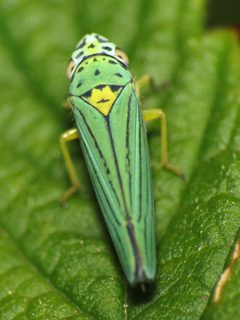
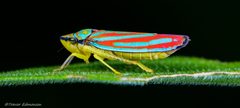
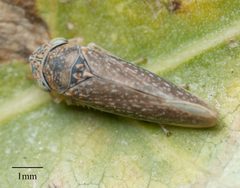
Graphocephala is a large of leafhoppers in the Cicadellidae, commonly known as sharpshooters. The genus is notable for its colorful, often vividly patterned and its economic significance as of plant . Members range from southern Canada to northern South America, with several species extensively studied for their role in transmitting Xylella fastidiosa, the bacterium causing Pierce's in grapevines. The genus includes well-known species such as the candy-striped leafhopper (G. coccinea) and the blue-green (G. atropunctata), a principal native vector of X. fastidiosa in California vineyards.
Pronunciation
How to pronounce Graphocephala: //ˌɡræfoʊˈsɛfələ//
These audio files are automatically generated. While they are not always 100% accurate, they are a good starting point.
Images
Distribution
Found from southern Canada to northern South America. Specific have more restricted ranges: G. coccinea occurs from the Rocky Mountains eastward in the U.S. and Canada, south to Panama, with G. c. coccinea restricted to Atlantic coastal areas and G. c. quadrivittata found inland; G. atropunctata is native to coastal California; G. fennahi occurs in the Western Palaearctic region.
Seasonality
Most appear to have one per year in northern parts of their range, with potentially two generations in southern climates. are present in late fall in temperate regions, with winter spent in the stage.
Diet
All members feed on plant sap using to tap into xylem fluids of foliage and stems. Specific plants vary by : G. coccinea is a feeder recorded from ferns, cranberries, rhododendron, azalea, laurel, and forsythia; G. atropunctata feeds on wine grapes and other woody plants; G. fennahi specializes on Rhododendron.
Host Associations
- Vitis vinifera - plantwine grapes, of G. atropunctata
- Xylella fastidiosa - G. atropunctata is principal native of this bacterium causing Pierce's
- Rhododendron - plantspecialized of G. fennahi
- Polynema eutettexi - of G. atropunctata in California
Life Cycle
Winter is spent in the stage. Eggs are inserted between layers of leaf tissue by females using a blade-like ovipositor. Nymphs hatch and five times before reaching adulthood. One per year in northern range, potentially two in southern climates.
Behavior
Leafhoppers at rest cock their hind legs to enable rapid leaping escape from danger. Most are alert and react quickly to disturbance by jumping, flying, or dodging around vegetation. Females of some produce specialized rod-like brochosomes to coat nests on plant tissues. of waste fluids occurs frequently and forcefully—one observed G. coccinea specimen excreted one droplet per second for two minutes.
Ecological Role
As xylem feeders, Graphocephala transfer nutrients from plants to higher . Their feeding activity can reduce plant and, in some cases, plant with significant agricultural consequences. They serve as prey for various insect and .
Human Relevance
Several are significant agricultural pests due to transmission. G. atropunctata is the principal native of Xylella fastidiosa in California vineyards, transmitting Pierce's which can kill grapevines. G. coccinea has been implicated in transmitting Pierce's Disease to grapevines and other woody plants. The colorful appearance of species like G. coccinea (candy-striped leafhopper) makes them popular subjects for nature photography and insect appreciation.
Similar Taxa
- Other Cicadellidae generaLeafhoppers share general body plan; Graphocephala distinguished by color patterns, size (5.7-8.4 mm in G. coccinea), and specific wing markings
More Details
Brochosomes
Like all leafhoppers, Graphocephala produce brochosomes—complex nanoparticles resembling hollow soccer balls constructed of proteins and lipids. These are excreted from and spread over the body using comb-like spines on the hind legs, creating a superhydrophobic and anti-reflective coating. Females produce specialized rod-like brochosomes to coat nests.
EPG studies
Graphocephala atropunctata has been extensively studied using electropenetrography (EPG) to characterize stylet penetration and waveform patterns during feeding. These studies have established methodological parameters for feeding behavior research and enabled comparison with other Xylella worldwide.
Microbiome research
The of G. atropunctata has been characterized using deep 16S rRNA sequencing, revealing Agrobacterium as the most common bacterial , along with Pseudomonas, Ensifer, Baumannia, and others. Many of these bacteria likely interact with X. fastidiosa in the foregut where the colonizes.
Sources and further reading
- BugGuide
- Wikipedia
- GBIF taxonomy match
- iNaturalist taxon
- NCBI Taxonomy
- Catalogue of Life
- Bug Eric: True Bug Tuesday: Candystriped Leafhopper
- Leafhopper Brochosomes: Nanoparticles Inspiring Future Materials
- Bug Eric: Grand Finale
- Bug Eric: Last Night to Blacklight?
- Online and On Tour: How One Entomologist Shares Her Passion for Insects With the World
- Bug Eric: 2024
- Deep 16S rRNA gene sequencing of anterior foregut microbiota from the blue‐green sharpshooter (Graphocephala atropunctata)
- Stylet Penetration Behaviors of <I>Graphocephala atropunctata</I> (Signoret) (Hemiptera, Cicadellidae): EPG Waveform Characterization and Quantification
- EPG waveform library for Graphocephala atropunctata (Hemiptera: Cicadellidae): Effect of adhesive, input resistor, and voltage levels on waveform appearance and stylet probing behaviors
- On the occurrence and ecology of the Rhododendron-leafhopper,Graphocephala fennahi young 1977, in the Western Palaearctic region (Homoptera, Cicadellidae)
- Graphocephala marathonensis(Olsen) (Hemiptera: Cicadellidae): Host-Plant Associations of a Little-Known Leafhopper, with Notes on Seasonality
- Taxonomic notes on Polynema eutettexi Girault (Hymenoptera: Mymaridae) and a similar species reared as an egg parasitoid of Graphocephala atropunctata (Signoret) (Hemiptera: Cicadellidae) in California
- Do Sharpshooters From Around the World Produce the Same EPG Waveforms? Comparison of Waveform Libraries From Xylella fastidiosa (Xanthomonadales: Xanthomonadaceae) Vectors Kolla paulula (Hemiptera: Cicadellidae) From Taiwan and Graphocephala atropunctata From California