
Platypedia putnami
(Uhler, 1877)
Putnam's Cicada, Putnam's Wing-banger
Species Guides
1- Platypedia putnami keddiensis(Putnam's Cicada)
Platypedia putnami is a of in the Cicadidae, commonly known as Putnam's Cicada or Putnam's Wing-banger. It occurs in mountainous regions of western North America, typically at elevations around 6,000 feet in evergreen forest understory. Unlike most cicadas, males lack abdominal tymbals and instead produce sound by snapping their wings against vegetation—a termed . The species has four recognized distributed across its range.
Pronunciation
How to pronounce Platypedia putnami: /plæ.tɪˈpiː.di.ə ˈpʌt.nəˌmaɪ/
These audio files are automatically generated. While they are not always 100% accurate, they are a good starting point.
Identification
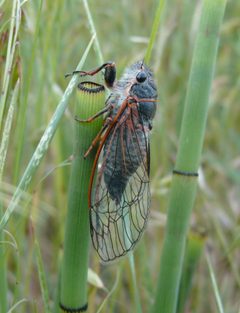
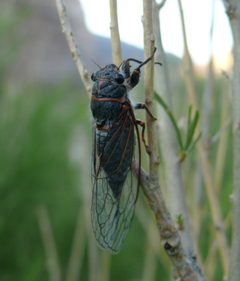
Distinguished from other cicadas by the absence of tymbal organs—males produce sound through wing-snapping () rather than abdominal tymbals. The combination of slender hairy black body, orange pronotal collar, and black helps identify it within the Platypedia. Geographic occurrence in south-central Colorado at ~6,000 feet elevation in evergreen forest understory supports identification as P. putnami among the 21 Platypedia in western North America.
Images
Appearance
Slender, hairy body with black coloration and orange highlights. Features an orange pronotal collar and black . Wings are present in and used in sound production.
Habitat
Evergreen forest understory at elevations around 6,000 feet. Associated with mountainous terrain in western North America.
Distribution
Western North America: recorded from Arizona, California, Colorado, Nebraska, and Nevada. Specifically documented in south-central Colorado (Las Animas County, Blodgett Peak area) and mountainous regions of the western Great Plains.
Seasonality
active in mid-to-late June. Peak activity coincides with summer months in montane regions.
Diet
Nymphs feed on sap from roots of trees and shrubs. feed on sap flowing in limbs of trees and shrubs using .
Host Associations
- trees and shrubs - sap sourceroots (nymphs); limbs ()
Life Cycle
with , nymph, and stages. Nymphs live underground, feeding on root sap. Development likely spans multiple years (3–7 years typical for non-periodical cicadas), with staggered producing appearances of adults. Nymphs emerge at night, climb vertical surfaces, and into adults. remain attached to vegetation after .
Behavior
Males produce sound by —snapping wings against branches or vegetation to create a -ticking noise. This occurs in place of the loud tymbal singing typical of most cicadas. Both sexes may produce sound through crepitation, potentially enabling two-way . are active during daytime but emerge from nymphal stage at night. Males perch on vegetation while signaling.
Ecological Role
Herbivore that taps plant sap, potentially serving as prey for birds, cicada killer (Sphecius spp.), and parasitic sarcophagid flies (Emblemasoma spp.). Contributes to nutrient cycling through events and deposition.
Human Relevance
Subject of entomological study due to unusual sound production mechanism. Occasionally encountered by insect collectors and naturalists in montane western North America. Not known to be economically significant.
Similar Taxa
- Magicicada spp. (periodical cicadas)Both are cicadas, but Magicicada has synchronous 13- or 17-year emergences and males possess tymbal organs for loud singing; Platypedia putnami has staggered and wing-snapping sound production
- Diceroprocta spp.Co-occurs in some regions (e.g., Arizona), but Diceroprocta males have tymbal organs and produce typical songs; also differs in preference (lower elevations, desert environments)
- Cacama valvata (Cactus Dodger)Co-occurs in southwestern regions but at lower elevations; has tymbal organs, different coloration, and distinctive behavioral traits ( backward down branches, hanging upside-down)
- Other Platypedia species21 in western North America share wing-snapping sound production and general ; P. putnami distinguished by geographic range, elevation preference, and specific coloration pattern
More Details
Sound production mechanism
P. putnami belongs to a group of that have lost tymbal organs and evolved —sound production by snapping wings against the body or substrate. This produces a subtle -ticking noise rather than the loud song of tymbal-bearing cicadas. Both sexes may produce sound through this mechanism, potentially allowing two-way unlike the one-way male-to-female signaling in most cicadas.
Subspecies
Four recognized: P. p. putnami (Uhler, 1877), P. p. keddiensis Davis, 1920, P. p. lutea Davis, 1920, and P. p. occidentalis Davis, 1920. Subspecies vary in geographic distribution and minor morphological features.