
Magicicada
Davis, 1925
Periodical Cicadas
Species Guides
7- Magicicada cassinii(Cassin's periodical cicada)
- Magicicada neotredecim(Neotredecim Periodical Cicada)
- Magicicada septendecim(Pharaoh cicada)
- Magicicada septendecula(Decula Periodical Cicada)
- Magicicada tredecassini(Cassin's 13-Year Cicada)
- Magicicada tredecim(Riley's 13-Year Cicada)
- Magicicada tredecula(Little 13-Year Cicada)
is a of found in eastern North America, comprising seven that emerge in synchronized mass events after 13- or 17-year underground development periods. These cicadas are among the longest-lived insects, spending nearly their entire lives as nymphs feeding on tree root xylem before emerging to , mate, and die within weeks. The genus is famous for its prime-numbered periodicity, satiation strategy, and the formation of distinct geographic that emerge on different schedules.
Pronunciation
How to pronounce Magicicada: //ˌmædʒɪˈsɪkədə//
These audio files are automatically generated. While they are not always 100% accurate, they are a good starting point.
Identification
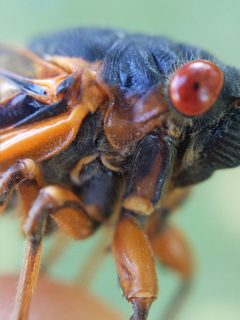
Distinguished from annual cicadas (Tibicen, Neotibicen) by red or orange (annual cicadas have black eyes), smaller size, and mass synchronized . The three 17-year are separated by abdominal coloration and male song: M. septendecim produces a low-pitched "pharaoh" call with a frequency sweep, M. cassini produces a buzzy trill with no frequency modulation, and M. septendecula has a song intermediate between the two. The four 13-year species parallel these forms. Emergence holes (dime-sized) and mud turrets at the base of trees indicate impending appearance. Stragglers emerging in off-years can be identified by association with known distributions.
Images
Appearance
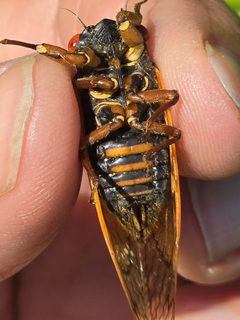
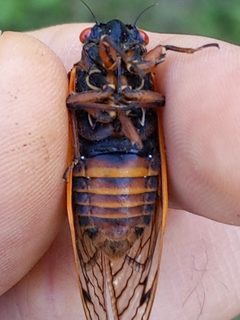
have broad with large on the sides, short , and transparent membranous wings held roof-like over the body. The is stout with three ocelli arranged in a triangle on the surface. Coloration varies by : septendecim has broad orange stripes on the , M. cassini has black abdomen without stripes, and M. septendecula has narrow orange stripes. Body length ranges 25-40 mm. Nymphs are tan-colored with white before , developing two distinct black patches behind the eyes immediately prior to molting. Males possess tymbals (sound-producing organs) on the abdomen; females have a prominent ovipositor.
Habitat
Deciduous forest and woodland with mature trees; specifically upland woods for M. septendecim and M. septendecula, floodplain woods for M. cassini. Nymphs require well-drained soils for burrowing and root feeding. Survives in disturbed second-growth forest where original has been altered. tree specificity varies: M. septendecula prefers hickories and walnuts for oviposition, while M. septendecim shows less host specificity. M. cassini characteristically replaces other along wooded slopes leading to streams.
Distribution
Eastern North America, primarily United States, with range extending from Oklahoma and Iowa eastward to the Atlantic coast, and from Georgia northward to New York and southern New England. Distribution is organized into 15 : 12 broods of 17-year cicadas and 3 broods of 13-year cicadas, each occupying distinct geographic areas with limited overlap. Brood ranges are historical and not contiguous with ranges; individual broods may contain multiple species. Some broods (XIII and XIX) emerge in the same year in different regions; 2024 marked a rare dual of these two broods.
Seasonality
emerge in spring when soil temperatures reach approximately 17.9°C (64°F) at 20 cm depth, typically late April to early June depending on latitude and weather conditions. peaks in the last two weeks of May for most northern . Adults live 2-4 weeks above ground. The 17-year emerge in different years than 13-year species except during rare dual-emergence events. Stragglers may appear 1-4 years before or after their 's scheduled emergence.
Diet
Nymphs feed exclusively on xylem fluids from tree roots underground for 13 or 17 years. have reduced feeding capacity; when they do feed, they take xylem sap from twigs. Adults do not consume solid food.
Host Associations
- Deciduous forest trees - nymphal Roots provide xylem sap for nymphal development; specific tree vary by type
- Hickories (Carya spp.) and walnuts (Juglans spp.) - oviposition Preferred by M. septendecula; other less specific
- Various hardwood trees - oviposition Females cut slits in pencil-sized branches to deposit ; flagging (twig death) results from damage
Life Cycle
are deposited in slits cut into tree branches; upon hatching, nymphs drop to ground and burrow to find tree roots. Nymphs undergo five instars underground, feeding on root xylem for 13 or 17 years. When soil temperatures trigger , nymphs exit through tunnels and climb vegetation to into . Adults live briefly (2-4 weeks), during which males chorus to attract females, mating occurs, and females oviposit. Mass emergence represents satiation strategy—overwhelming numbers ensure some survive to reproduce. Decomposing adults provide nutrient pulse to forest soils.
Behavior
Males produce -specific acoustic signals from treetops; chorusing creates collective noise exceeding 90 decibels. Males engage in active between trees while singing. Defensive against include wing flipping (observed in 80% of encounters) and disturbance squawks (65%). Synchronized is cued by soil temperature, not calendar date. Nymphs construct exit tunnels and sometimes mud turrets over holes before emergence. are and poor fliers, moving primarily by climbing.
Ecological Role
Nymphs act as long-term consumers of tree root resources, potentially placing chronic burden on trees. Mass creates pulsed resource subsidy: billions of individuals become available food for birds, mammals, reptiles, and arthropods, enhancing and survival. -laying causes branch flagging (dieback), effectively pruning trees and potentially stimulating new growth. Decomposing bodies enrich soil microbial and increase nitrogen availability. Nymph burrowing aerates soil and creates water infiltration channels that persist for over a year.
Human Relevance
Subject of intense scientific interest due to prime-numbered periodicity, evolution of synchronized , and formation. Citizen science projects ( Safari app) track distributions and . Cultural phenomenon during emergence years; generates tourism to viewing areas. Occasionally considered nuisance due to noise levels and abundance. Consumed as food in some traditions. Misleadingly called "locusts," though unrelated to grasshoppers. Historical records of brood distributions extend to 19th century.
Similar Taxa
- Tibicen/Neotibicen (annual cicadas)Similar appearance and but distinguished by black , larger size, (not periodical) , and different acoustic signals. Annual cicadas emerge individually throughout summer rather than in synchronized mass events.
- Okanagana rimosa (proto-periodical cicada)Shares periodic pattern but on shorter, less rigid cycles; not true . Subject of comparative study regarding interactions and evolution of periodicity.
Misconceptions
Frequently mislabeled as "locusts," which are grasshoppers (Orthoptera) with swarming —cicadas are unrelated true bugs (Hemiptera) with different . Not venomous or dangerous to humans; do not sting or bite defensively. Tree damage from oviposition is usually cosmetic and does not kill healthy mature trees.
More Details
Prime-numbered periodicity
13- and 17-year cycles are prime numbers, hypothesized to have evolved as an against or with shorter , preventing synchronization with .
Brood system
Geographically defined called emerge on different schedules; brood ranges are stable over centuries but not perfectly aligned with ranges. Some areas have no ; others may have adjacent broods emerging in consecutive years.
2024 dual emergence
Simultaneous of XIII (17-year, Northern Illinois) and Brood XIX (13-year, Great Southern Brood) occurred in spring 2024—an event not repeating for 221 years. Broods overlapped geographically only in central Illinois.
Sources and further reading
- BugGuide
- GBIF taxonomy match
- iNaturalist taxon
- NCBI Taxonomy
- Catalogue of Life
- Cicada surprise in the DMV! Brood IX and straggling Brood X periodical cicadas, Magicicada spp. — Bug of the Week
- Nature’s other epic event this spring: Periodical cicadas, Magicicada spp. — Bug of the Week
- Just a trickle, not a flood, so when will the main event happen? And how do you tell the guys from the gals? Periodical Cicadas, Magicicada spp. — Bug of the Week
- Cicada surprise! Brood V and straggling periodical cicadas, Magicicada spp. — Bug of the Week
- When will periodical cicadas of Brood XIV make their appearance? Magicicada spp. — Bug of the Week
- Adieu Brood II: Magicicada spp. — Bug of the Week
- The Distribution of Periodical Cicada (Magicicada) Brood I in 2012 with Previously Unreported Disjunct Populations (Hemiptera: Cicadidae,Magicicada)
- Experimental infection of a periodical cicada (Magicicada cassinii) with a parasitoid (Emblemasoma auditrix) of a proto-periodical cicada (Okanagana rimosa)
- The Habitats of 17‐Year Periodical Cicadas (Homoptera: Cicadidae: Magicicada Spp.)
- FLAGGING: HOSTS DEFENCES VERSUS OVIPOSITION STRATEGIES IN PERIODICAL CICADAS (MAGICICADA SPP., CICADIDAE, HOMOPTERA)