
Siphlonuridae
primitive minnow mayfly
Genus Guides
1- Siphlonurus(primitive minnow mayflies)
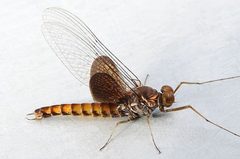
, commonly called primitive minnow mayflies, is a of mayflies (Ephemeroptera) characterized by morphological traits considered ancestral within the order. Members are adapted to cool waters and occur across temperate regions of the Northern Hemisphere. The family includes approximately six extant : Ameletoides, Edmundsius, Parameletus, Siphlonisca, Siphlonurus, and the former genus Metretopus (now sometimes placed in Siphlonuridae). Nymphs inhabit diverse freshwater including temporary ponds, streams, and floodplains, with habitat preferences often shifting during ontogeny.
Pronunciation
How to pronounce Siphlonuridae: /sɪfloʊˈnjʊrɪˌdeɪ/
These audio files are automatically generated. While they are not always 100% accurate, they are a good starting point.
Identification
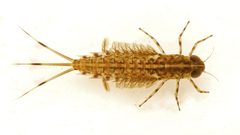
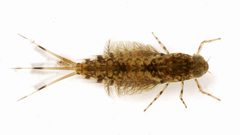
Distinguished from other Ephemeroptera by the combination of: unnotched , shorter than twice width, lacking prominent golden spine rows, and rounded abdominal gills of uniform structure. Three caudal filaments are subequal in length. Keys to Fennoscandian exist for both and nymphal stages. Nymphs of some can be separated by size class and association.
Images
Appearance
possess three long slender caudal filaments of approximately equal length. The (upper lip) lacks a notch. are shorter than twice the width. Nymphs have rounded abdominal gills that are similar to each other in structure. on the underside of the head lack prominent rows of golden spines. in size has been observed in some , with females averaging larger than males in final instars.
Habitat
Cool freshwater environments including temporary ponds, streams, and river floodplains. Specific preferences vary by and life stage. In Siphlonurus typicus, nymphs develop in temporary ponds. In Oniscigaster wakefieldi, small nymphs (1–10 mm) occupy fine sediments in quiet shallow water; medium nymphs (11–18 mm) inhabit pebble substrates in silt matrices up to 50 cm deep; mature nymphs (19–26 mm) occur adjacent to emergent boulders at riffle bases. Siphlonisca aerodromia nymphs occupy stream main channels and adjacent Carex floodplains following snowmelt.
Distribution
Northern Hemisphere temperate regions. Documented from: eastern North America (Connecticut, Maine, Vermont), western North America, Fennoscandia (Finland, Sweden, Norway, Denmark), Russian Far East, and New Zealand. Specific distribution varies by and .
Seasonality
generally occurs in late spring to early summer. Siphlonurus typicus: 27 May to 21 June in Connecticut. Siphlonisca aerodromia: late May or early June in Maine. Oniscigaster wakefieldi: studied July 1965–November 1966 with year-round nymphal presence. Nymphal development typically spans winter to spring months.
Diet
Nymphal diet shifts with season and . Siphlonisca aerodromia nymphs initially feed on detritus at near 0°C water temperatures; following snowmelt, animal material including nymphs becomes increasingly common in floodplain habitats.
Life Cycle
documented in multiple . Siphlonurus typicus: nymphal development March–June, 11 maturity classes identified, degree days excellent predictor of maturity (r²=0.963). Siphlonisca aerodromia: small nymphs appear in January, emerge late May–early June, approximately 394 per female, eggs deposited in stream main channel. Oniscigaster wakefieldi: 20–25 larval instars over 17-month period. Female-biased sex ratios observed in some populations (Siphlonurus typicus at 1.35:1 at one site).
Behavior
Oviposition occurs directly on water bodies, inlets, and outlets, indicating result from both local migrants and permanent residents. Nymphs exhibit ontogenetic shifts, with size classes occupying distinct microhabitats. Following snowmelt, nymphs may move from main channels into adjacent floodplain vegetation.
Similar Taxa
- BaetidaeBoth contain small minnow-like mayflies; distinguished by unnotched , shorter relative to width, and rounded uniform gills versus often more differentiated gill structures in Baetidae
- HeptageniidaeFlattened body form and gill placement differ; nymphs lack the dorsoventral flattening and gill characteristic of Heptageniidae
More Details
Taxonomic note
Metretopus was historically treated as a separate but is included in in some classifications. The is considered morphologically primitive within Ephemeroptera based on multiple plesiomorphic characters.
Sources and further reading
- BugGuide
- Wikipedia
- GBIF taxonomy match
- iNaturalist taxon
- NCBI Taxonomy
- Catalogue of Life
- The Occurrence and Biology of Siphlonisca Aerodromia Needham (Ephemeroptera: Siphlonuridae) in Maine, U.S.A.
- Two new species of Parameletus Bengtsson, 1908 (Ephemeroptera: Siphlonuridae), and notes on other species from the Far East of Russia
- Life history aspects of the mayfly Siphlonurus typicus (Ephemeroptera: Siphlonuridae) with a new application for measuring nymphal development and growth
- Life History and Ecology of Siphlonurus mirus Eaton (Ephemeroptera: Siphlonuridae) in an Intermittent Pond
- The genus <i>Metretopus</i> (Ephemeroptera, Siphlonuridae) in Fennoscandia - identification, faunistics and natural history
- The life history, nymphal growth rates, and feeding habits of Siphlonisca aerodromia Needham (Ephemeroptera: Siphlonuridae) in Maine
- Redescription of Parameletus chelifer Bengtsson and P. minor (Bengtsson), with keys to nymphal and adult stages of the Fennoscandian species of Siphlonuridae (Ephemeroptera)
- Molecular data and species distribution models reveal the Pleistocene history of the mayfly Ameletus inopinatus (Ephemeroptera: Siphlonuridae)1
- Studies on the larva of Oniscigaster wakefieldi (Ephemeroptera: Siphlonuridae) in Waitakere stream, Auckland