
Drunella
Needham, 1905
Blue-winged Olives, Spiny Crawler Mayflies
Species Guides
11- Drunella coloradensis(Small Western Green Drake)
- Drunella cornuta
- Drunella cornutella(spiny crawler mayfly)
- Drunella doddsii(Western Green Drake)
- Drunella flavilinea(Flav)
- Drunella grandis(Western Green Drake)
- Drunella lata
- Drunella pelosa
- Drunella spinifera(Western Slate Olive)
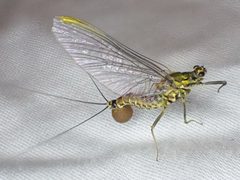
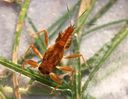
Drunella is a of spiny crawler mayflies in the Ephemerellidae, comprising at least 20 described . These mayflies are aquatic insects with nymphs that inhabit stream environments and are significant components of freshwater . are important to fly fishermen, who commonly refer to them as "Blue-winged Olives" and imitate them with artificial flies. Some species, such as Drunella grandis (the green drake), are particularly valued as trout food sources.

Pronunciation
How to pronounce Drunella: //druˈnɛl.lə//
These audio files are automatically generated. While they are not always 100% accurate, they are a good starting point.
Images
Habitat
Stream environments, including mountain streams and flowing water systems. Nymphs occupy benthic and show microdistribution patterns related to fine substrate characteristics. Some exhibit flexibility along altitude gradients.
Distribution
North America (including Vermont, Wyoming), China (Shennongjia National Park), and Japan. The has a Holarctic distribution pattern with documented across temperate regions.
Life Cycle
Hemimetabolous development with aquatic nymph stage and terrestrial winged stage. Nymphs are the primary feeding and growth phase. Specific show flexibility along environmental gradients; for example, Drunella submontana exhibits adaptive shifts in life history traits across altitude gradients in China. Drunella coloradensis nymphs have been observed to drift primarily during dark periods, indicating or activity patterns.
Behavior
Nymphs exhibit behavioral sensitivity to environmental stressors. Drunella coloradensis nymphs show increased drift in response to pH reductions, with drift activity concentrated during dark periods and rapid response within 2-4 hours of pH change. At intermediate pH decline (pH 7.01), nymphs reduce sitting behavior and increase burrowing; at greater acidity (pH 6.02), burrowing returns to control levels while drifting and crawling increase. Ventilatory behaviors increase with pH decline regardless of severity.
Ecological Role
Important prey item for salmonid fishes including trout. Nymphs contribute to benthic dynamics and serve as bioindicators of stream health, with behavioral responses offering sensitive indicators of sub-acute stress in aquatic communities. Increased drift under stress may alter -prey encounter rates and community-level processes.
Human Relevance
Highly significant to recreational fly fishing. are imitated with artificial dry flies, while nymph patterns copy the aquatic stage. Drunella grandis (green drake) and related are among the most important hatches for trout anglers in North America. Fly patterns include extended-body designs to match the slender of adults. Knowledge of Drunella , timing, and preferences is considered essential for successful angling.
Sources and further reading
- BugGuide
- Wikipedia
- GBIF taxonomy match
- iNaturalist taxon
- NCBI Taxonomy
- Catalogue of Life
- Teach a Man to Fish (and some entomology) and You’ll Feed Him for a Lifetime
- Green Drakes - Entomology Today
- THE ADULT OF DRUNELLA ALLEGHENIENSIS (EPHEMEROPTERA: EPHEMERELLIDAE) WITH BIOLOGICAL NOTES
- Behavioral Responses ofDrunella coloradensis(Ephemeroptera) Nymphs to Short-Term pH Reductions
- Life history flexibility of Drunella submontana Brodsky, 1930 (Ephemeroptera: Ephemerellidae) along altitude gradients in Shennongjia National Park, China
- Microdistribution of <i>Drunella trispina</i> (Uéno) (Ehemeroptera, Ephemerellidae) larvae in relation to fine substrate ミツトゲマダラカゲロウ(<i>Drunella trispina</i> (Uéno))(カゲロウ目,マダラカゲロウ科)幼虫の河床分布と細粒底質の関係