
Drunella grandis
(Eaton, 1884)
Western Green Drake, Green Drake, Spinner Green Drake
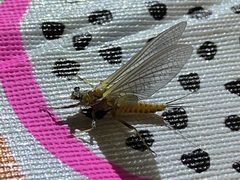
Drunella grandis is a of spiny crawler mayfly in the Ephemerellidae. It is commonly known as the Western Green Drake among fly fishermen, who highly value this species for its importance as a trout food source. The species is native to North America and has been documented with three recognized . are notable for their large size and greenish coloration, making them a prominent feature of western North American streams.
Pronunciation
How to pronounce Drunella grandis: //druːˈnɛlə ˈɡrændɪs//
These audio files are automatically generated. While they are not always 100% accurate, they are a good starting point.
Identification
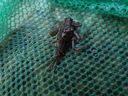
can be recognized by their relatively large size and greenish body color. Nymphs are identified as 'spiny ' by the presence of paired spines on the abdominal segments, a characteristic of the Ephemerellidae. Distinguishing D. grandis from other Drunella requires examination of detailed morphological features including genitalia and wing venation patterns. The D. grandis flavitincta, D. grandis grandis, and D. grandis ingens differ in subtle coloration and size characteristics.
Images
Habitat
Found in flowing freshwater environments including streams and rivers. Nymphs inhabit the benthic zone, crawling among rocks and debris. Specific substrate preferences and water quality requirements are not well documented in available sources.
Distribution
Native to North America. Documented from the Nearctic region with records across western North America. The three show some geographic partitioning: D. grandis flavitincta and D. grandis ingens were described by McDunnough in 1934, while the nominate subspecies D. grandis grandis was described by Eaton in 1884.
Seasonality
timing varies by location and elevation. As with many western mayflies, activity is concentrated in summer months, though specific periods are not well documented in available sources.
Life Cycle
Typical development with aquatic nymphal stage and winged stage. Nymphs are 'spiny ' that inhabit stream bottoms. Adults are short-lived and do not feed. Specific details on -laying , nymphal development duration, and number of instars are not documented in available sources.
Behavior
are known to form mating swarms. Nymphs are benthic rather than burrowers or swimmers, using their spines and legs to cling to substrate in flowing water. Specific behavioral details beyond general patterns are not well documented.
Ecological Role
Important component of stream . Nymphs serve as prey for fish and other aquatic . provide a significant food source for trout and other surface-feeding fish, contributing to the ' importance in aquatic and fly fishing.
Human Relevance
Highly significant to fly fishing and trout angling. Known as the 'Western Green Drake' or 'Green Drake' in angling . Artificial flies模仿ing this , including extended body patterns, are widely used. The species is considered one of the most important western mayflies for trout fishing, with anglers closely monitoring timing to match the hatch.
Similar Taxa
- Drunella doddsiiSimilar large green drake in the same , overlapping in range and . Requires detailed examination of genitalia and coloration for separation.
- Ephemerella excruciansAnother spiny crawler mayfly with similar size and , but in a different . Drunella generally larger with different wing venation patterns.
- Drunella lata with similar preferences and nymphal . differ in size and specific coloration details.
More Details
Taxonomic History
Originally described as Ephemerella grandis by Eaton in 1884, later transferred to the Drunella. Three are recognized: D. grandis flavitincta, D. grandis grandis, and D. grandis ingens.
Fly Fishing Significance
The 'spinner green drake' stage is particularly important to anglers. Professional fly tyers create extended body patterns to accurately mimic the slender of spent . The is considered a 'major hatch' in western North American trout streams.
Sources and further reading
- BugGuide
- Wikipedia
- GBIF taxonomy match
- iNaturalist taxon
- NCBI Taxonomy
- Catalogue of Life
- Teach a Man to Fish (and some entomology) and You’ll Feed Him for a Lifetime
- Guest Blog Post: Researchers split the birdcatcher trees (genus Pisonia) into three | Blog
- Bug Eric: Wasp Wednesday: Western Cicada Killer
- Nomenclatural changes in Phymatodes | Beetles In The Bush